
Tether propulsion (Non-Rocket Spacelaunch)
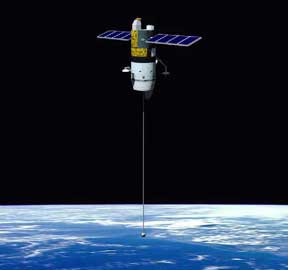
Tether propulsion consists in using long, very strong cables (known as tethers) to change the velocity of spacecraft and payloads. The tethers may be used to initiate launch, complete launch, or alter the orbit of a spacecraft. This form of propulsion would be significantly less expensive than spaceflight using modern rocket engines.
How does it work?
Tethers are kept straight by either rotating end for end, or by the difference in the strength of gravity over their length (tidal stabilisation). Tethers require strong, light materials. Possible such materials include crystalline plastics such as ultra high molecular weight polyethylene, aramid or carbon fiber. Another possibility is to use carbon nanotubes when the technology becomes available.
A momentum exchange tether is a rotating tether that would grab a spacecraft and then release it at later time. This can transfer momentum from the tether to and from the spacecraft with very little loss. A rotating momentum exchange tether is also known as a bolo.
Another type of tether is an electrodynamic tether. It’s a conductive tether that carries a current that can generate thrust or drag from a planetary magnetic field, in much the same way as an electric motor.
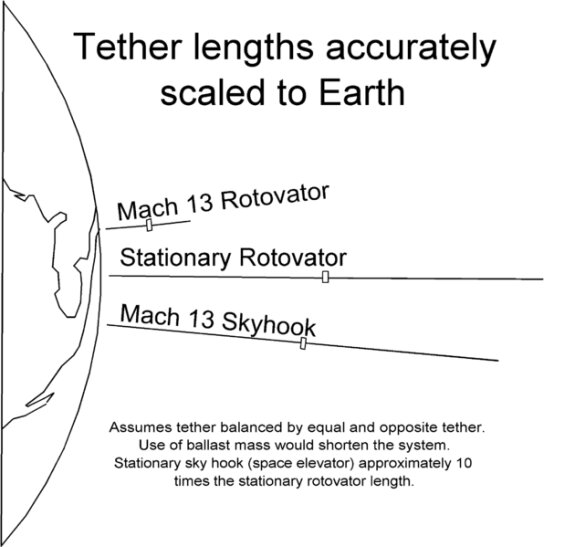
Most space tethers fall in two categories. They are called “skyhooks” if they are tidally locked and therefore always perpendicular to the Earth’s surface (though not necessarily geostationary). They are referred to as “rotovators” if they are not tidally locked.
Skyhooks
The skyhook’s name was coined by Italian scientist Giuseppe Colombo because it appears to be “hooked onto the sky” (due to the fact that it is tidally locked).
Short tethers are called “hypersonic skyhooks” because the tip nearest the Earth travels about Mach-12 to 16 in typical designs. Longer tethers would travel more slowly. At the limit of zero ground speed, it would no longer be a skyhook and be re-classified as a space elevator.
An aircraft or sub-orbital vehicle transports cargo to the lower end of the skyhook and then, in most designs, climbers transport the cargo to the other end of the tether where it can take advantage of the momentum transfer.
Rotovators
The word rotovator is a portmanteau derived from the words rotor and elevator. It is a high speed rotating tether, spinning so that the tips have a significant speed of about 1–3 km/s. The maximum speed is limited by stress tolerance and safety factor of the tether but it can be greatly increased if it is of thicker cross-section in the middle and tapers and is lighter, thinner at the tips (just like in a typical space elevator design).
A spacecraft could rendezvous with one end of the tether, latch to it, and be accelerated by the tether’s rotation. The tether and spacecraft would then separate at a later point when the spacecraft’s velocity has been changed by the rotovator. Alternatively, the tether can also be used to slow down incoming spacecraft, thus increasing the rotational momentum of the tether.
The momentum given to the spacecraft is not free. Unless the average momentum gained from inward traffic equals that imparted to outward traffic, some additional energy is required to maintain a constant orbit and rotational speed. For example, solar panels generating current could be used for electrodynamic tether propulsion.
Because the tips have a significant speed (typically 1–3 km/s), it can be possible in some cases to cancel the orbital speed such that the tips are stationary at their lowest point with respect to a planetary surface or lunar body. As described by Moravec, this is “a satellite that rotates like a wheel.”
The tip of the tether moves in approximately a cycloid, in which it is momentarily stationary with respect to the ground. In this case, a payload that is “grabbed” by a capture mechanism on the rotating tether during the moment when it is stationary would be picked up and lifted into orbit; and potentially could be released at the top of the rotation, at which point it would be moving with a speed significantly greater than the escape velocity and thus could be released onto an interplanetary trajectory. This would make it much easier for the tether to grab a payload and it would release it at much higher velocity than a simple rotovator such as a bolo.

On bodies with an atmosphere, such as the Earth, the tether tip must stay above the dense atmosphere, or the atmospheric drag will cause it to lose speed and thus fall into a lower orbit, eventually crashing down to the surface. On bodies with reasonably low orbital speed and very little or no atmosphere (such as the Moon and possibly Mars), a rotovator in low Earth orbit can potentially touch the ground, thereby providing cheap surface transport.
Tether satellite missions
Here are the most notable space missions that tested tethers in space.
Gemini 11 mission: 1966
The first such mission took place in 1966. Gemini 11 deployed a 30m tether connecting it to the Agena target vehicle. It created a small amount of artificial gravity (0.00015 g) by spinning the two spacecraft.
TSS-1 mission: 1992
The TSS-1 (Tethered Satellite System-1) was a joint NASA-Italian Space Agency project. It was flown during STS-46 aboard the Space Shuttle Atlantis from July 31 to August 8, 1992. The mission discovered a lot about the dynamics of a tethered system, although the satellite was deployed only 260 meters. A protruding bolt jammed the deployment mechanism and prevented deployment to full extension. It deployed far enough though, to show that it could be deployed, controlled, and retrieved, and that the TSS was easy to control and even more stable than predicted. Due to the malfunction, the mission was reflown as TSS-1R a few years later.
SEDS I mission: 1993
The SEDS-I (Small Expendable Deployer System) NASA mission deployed a 20 km tether attached to a spent Delta second stage in 1993. This was the first fully successful orbital flight test of a long tether system. The tether swung to the vertical and was cut one orbit after the start of deployment. This slung the payload and tether onto a reentry trajectory accurate enough that a pre-positioned observer was able to videotape the payload re-entry and burnup.
SEDS II mission: 1994
SEDS-2 was launched on a Delta (along with a GPS Block 2 satellite) on March 9, 1994. It was a very similar experiment to its predecessor SEDS-1. The tether snapped 3.7 days after deployment. The payload reentered (as expected) within hours, but the 7.2 km length at the Delta end survived with no further cuts until re-entry on May 7, 1994. The tether was an easy naked eye object when lit by the sun and viewed against a dark sky.
TSS-1R mission: 1996
TSS-1R was a follow-up mission to TSS-1. It was released in February 1996 from STS-75 Columbia space shuttle mission. Over 19 kilometers of the tether were deployed before the tether burned through due to a short-circuit and broke. It remained in orbit for a number of weeks and was easily visible from the ground, appearing something like a small but surprisingly bright fluorescent light traveling through the sky.
TiPS mission: 1996
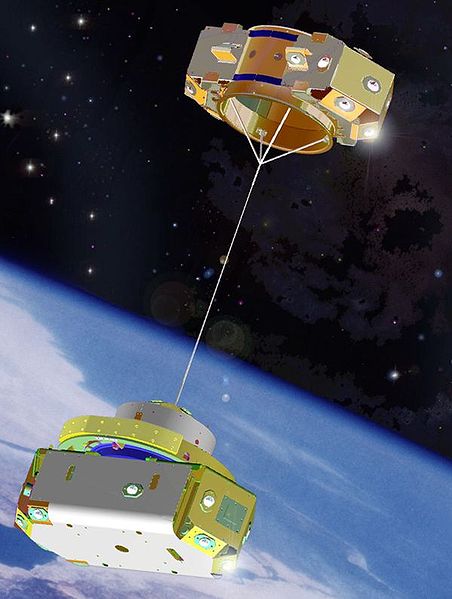
The Tether Physics and Survivability Experiment (TiPS) was launched in 1996 as a project of the US Naval Research Laboratory. it was successfully deployed to a tether length of four kilometers. The two tethered objects were called “Ralph” and “Norton”. TiPS was visible from the ground with large binoculars or a telescope and was occasionally spotted by amateur astronomers. The tether broke finally in July 2006.
MAST mission: 2007
The Multi-Application Survivable Tether (MAST) tether experiment was launched aboard a Russian Dnepr rocket in April 2007. The experiment hardware was designed under a NASA Small Business Technology Transfer (STTR) collaboration between Tethers Unlimited, Inc. (TUI) and Stanford University. Unfortunately, the tether did not deploy successfully.
YES2 mission: 2007
Young Engineers’ Satellite 2 (YES2) was launched on September 14, 2007 from Baikonur. It was a 36 kg student-built tether satellite part of ESA’s Foton-M3 microgravity mission. The YES2 satellite employed a 30 km long tether to deorbit a small re-entry capsule.
STARS mission: 2009
The Space Tethered Autonomous Robotic Satellite (STARS) robotic spacecraft was developed by the Kagawa Satellite Development Project in the Kagawa University. It was made up of mother and daughter satellites connected by a tether. STARS was launched on 23 January 2009 as a secondary payload aboard the JAXA H-IIA flight 15.
STARS-II mission: 2014
The Space Tethered Autonomous Robotic Satellite 2 (STARS-II) was a follow-up from the Kagawa Satellite Development Project at Kagawa University. It carried a 300-meter electrodynamic tether made from ultra-thin stainless-steel and aluminium wires. One goal was to demonstrate technology for de-orbiting space debris. STARS-II launched on 27 February 2014 as a secondary payload aboard an H-IIA rocket and re-entered about two months later, on 26 April 2014. The experiment was only partially successful; tether deployment could not be confirmed, though its faster-than-expected orbital decay hinted the tether had extended.
STARS-C mission: 2016
STARS-C was a 2U CubeSat built by a team at Shizuoka University. It was designed to deploy a 100-meter aramid-fiber tether between a mother satellite and a daughter satellite. According to the space tether missions record, STARS-C launched on 9 December 2016 from the Japanese Experiment Module (Kibo) on the International Space Station and re-entered on 2 March 2018. Its signal was intermittent and no direct tether-deployment data was returned, but estimates from orbital drag suggest the tether extended to about 30 meters.
KITE mission: 2016
The Kounotori Integrated Tether Experiment (KITE) was a test of electrodynamic-tether technology on JAXA’s H-II Transfer Vehicle (HTV-6), an ISS resupply craft launched in December 2016. After undocking from the station, KITE was meant to deploy a 700-meter electrodynamic tether. The deployment failed and the vehicle burned up in the atmosphere. The experiment did, however, successfully demonstrate a carbon-nanotube field-emission cathode.
TEPCE mission: 2019
The Tether Electrodynamic Propulsion CubeSat Experiment (TEPCE) was a U.S. Naval Research Laboratory mission built on a triple-CubeSat design with a 1-kilometer conducting tether. It launched in June 2019 as a secondary payload on a Falcon Heavy (the STP-2 mission). The tether deployed in November 2019 and measured the electrodynamic force on the tether, a rare full success for a space-tether test. A large change in its decay rate on 17 November 2019 indicated deployment, which led to its rapid re-entry on 1 February 2020.
Tether propulsion safety issues
The use of tethers in space poses many challenges and safety issues. A lot of them are similar to those of a space elevator described in a previous article, but some are unique to the space tether concept.
Atomic oxygen
One major problem to space tethers in low Earth orbit is the erosion from monomolecular oxygen. When oxygen molecules (made up of two oxygen atoms) split, the resulting single oxygen atoms are highly reactive. Space tethers moving at very high orbital speeds make the problem even worse.
The solution would be to build automatic robotic climbers that would constantly scan every portion of the tether and repair any damage. Using more resistant materials as coating for the tether would also be a good idea.
Micrometeorites and space junk
Simple tethers that have been already tested in space were quickly cut by micrometeorites and space junk. The lifetime of a simple, one-strand tether in space is on average about five hours for a length of ten kilometers. This was why a lot of the early tether missions failed.
In 1996 the US Naval Research Laboratory successfully flew a long-term tether that used very fluffy yarn which remained uncut several years after deployment. Another proposal is to use a tape or cloth. Dr. Robert P. Hoyt patented an engineered circular net, such that a cut strand’s strains would be redistributed automatically around the severed strand. This is called a Hoytether. Hoytethers have theoretical lifetimes of tens of years.
Large pieces of space junk would cut most tethers, but since they are currently tracked on radar and have predictable orbits, a tether could be wiggled to dodge known pieces of junk. Another more radical solution to this problem would be to completely clean up low Earth orbit of space debris. In fact they could be collected and recycled in space and used in the construction of space infrastructure (such as satellites, space stations or even spacecraft).
Material strength
Space tether concepts such as the rotovator are currently limited by the strengths of available materials. Although ultra-high strength plastic fibers available today (such as Kevlar and Spectra) would enable the construction of rotovators that would pluck masses from the surface of the Moon and Mars, a rotovator from these materials would not be strong enough to lift cargo from the surface of the Earth. The material requirements for a rotovator and other similar space tether concepts would be almost as high as those of a space elevator. Carbon nanotubes are likely the best candidate.
Vibrations
Computer models frequently show tethers can snap due to vibration. This is very similar to the vibrational harmonics problem discussed in the space elevator article.
The solution to this problem is almost exactly the same as for a space elevator, except that here the cable is much shorter, so the vibrations would be much less extreme and thus much easier to control. Carefully choreographing the speed and timing of each climber (elevator car that climbs the cable or tether) can cancel out all the dangerous vibrations. However, a suitable damping system within the cable should be constructed in case it all gets out of control. That way it may be possible to dampen the resonant frequency against the Earth’s magnetosphere.
Cargo capture
Failure for a tether to capture a payload can cause problems. Several systems have been proposed, such as shooting nets at the cargo, but all add weight, complexity, and additional possibilities for structural failure.
Space tethers in fiction
Novels
The Last Theorem is Arthur C. Clarke’s posthumously published novel which he co-wrote with Frederik Pohl. The novel describes the skyhook as a means of interplanetary travel rather than simply a means to reach orbit. It is used as a means of transport by athletes and delegates to the “first-ever lunar Olympics”.
Another interesting novel is The Descent of Anansi published in 1982 by Steven Barnes and Larry Niven. A space station-factory attempts to become commercially independent from its government by exporting super-strong nanowire that can only be manufactured in zero g. Following an attempt to sabotage their first delivery and hijack the cargo, the intrepid crew realize they can escape the hijackers. Their shuttle Anansi can become a modern day version of its namesake, an African Spider-god by descending to Earth on a thread. The physics of tidal forces are well explained, and the possibilities of orbital tethers to accelerate payloads into higher orbits or de-orbit shuttles without retro-rockets is cleverly woven into an interesting hard science fiction thriller.
The construction of skyhooks, including a space elevator and several other orbital devices for launching craft into orbit and interplanetary travel, as well as decelerating and capturing craft on arrival, is a central theme in the science fiction novel The Barsoom Project, the second book in the Dream Park series, by Larry Niven and Steven Barnes. The destructive potential of a falling skyhook is also explored, and the potential for this to be exploited by terrorists.
Charles Sheffield’s The Web Between the Worlds (1979) is among the most significant novels built around tether momentum transfer. Its engineer-protagonist extrudes super-strong cables to build a space elevator, and the same high-tensile materials are used to fling payloads without the mass-wastage of rockets.
Robert L. Forward’s Saturn Rukh (1997)—by the physicist who helped develop the theory of rotating skyhooks—features stranded astronauts who use high-tensile cables to couple their craft to passing moons, letting the tethers impart momentum much as an orbital tether would.
TV and anime
Space tethers are also present in many movies and television series. For example, in the Star Wars expanded universe, skyhooks are common above the planet Coruscant. They are frequently private retreats owned by corporations or wealthy individuals. In the LucasArts video game Star Wars: The Force Unleashed a skyhook is being constructed on the planet Kashyyyk.
Another example is the Turn-A Gundam anime series, which depicts an ancient hypersonic skyhook which has been maintained operational by nanomachines over thousands of years. An ancient mass driver is also used for transporting space-vessels from Earth’s surface to the skyhook.
In the anime Bubblegum Crisis: Tokyo 2040, the three main protagonists arrive at the series’ climactic battle with Galatea in Earth orbit by commandeering a skyhook transit system.
On the military television show The Unit, Sergeant Major Blaine uses a skyhook for his “AIR” extraction during a mission. He carried a duffel bag with an oxygen tank, mask, rope, harness and a balloon in the shape of a rocket with a red tip.
Conclusion
Despite all the risks involved, a space tether system would be a very profitable project. It is a much simpler concept than the space elevator and thus it would be much less expensive. It would bring down the spacelaunch costs considerably and would open up outer space for exploration and eventually colonization.
As of today, operational momentum-exchange tethers remain largely experimental, and no full-scale cargo-launch tether has yet flown.
Links to the other articles in this series:
Would you like to receive similar articles by email?

Paul Tomaszewski
Paul Tomaszewski is a science & tech writer as well as a programmer and entrepreneur. He is the founder and editor-in-chief of CosmoBC. He has a degree in computer science from John Abbott College, a bachelor's degree in technology from the Memorial University of Newfoundland, and completed some business and economics classes at Concordia University in Montreal. While in college he was the vice-president of the Astronomy Club. In his spare time he is an amateur astronomer and enjoys reading or watching science-fiction. You can follow him on LinkedIn and Twitter.


2 Comments
Nelson
Paul,
I really enjoy what you are writing.
I particularly like the fact that you are documenting all your your discourse, something that is often omitted from most people writing on the subject of Space Elevators.
Nelson
Paul Tomaszewski
Thanks for the nice comment!