Why Didn’t a Planet Form Where the Asteroid Belt Is Now Located?
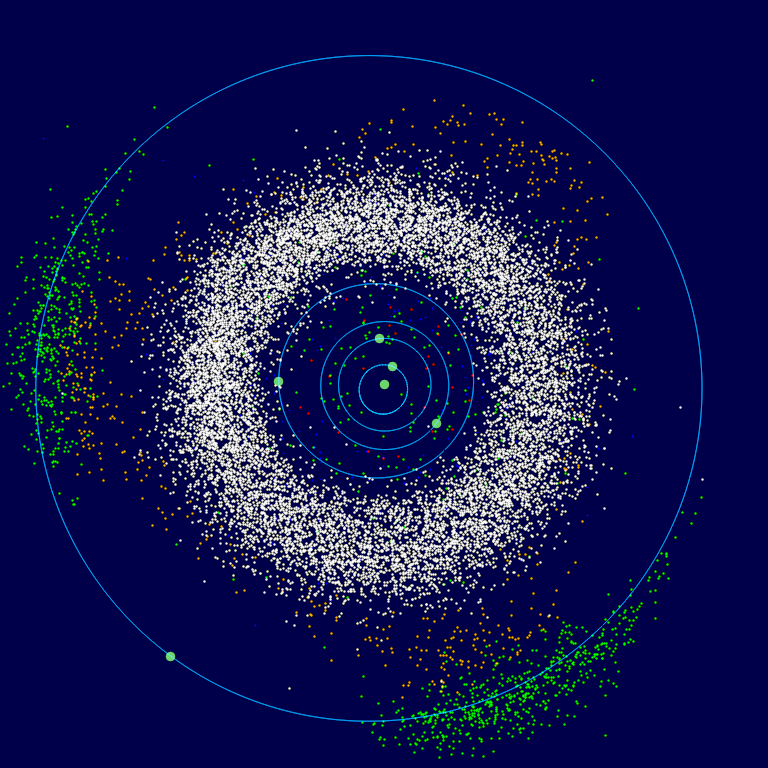
The asteroid belt is an enormous region of space between the orbits of Mars and Jupiter. It contains millions of rocky bodies ranging in size from small particles to large asteroids. For centuries, astronomers have been looking for planets there, sometimes mistaking large asteroids like Ceres, Vesta, and Pallas for planets. In the end, though, no true, full-sized planet was ever discovered in this area, though Ceres is now recognized as a dwarf planet.
The Role of Jupiter’s Gravity
One of the prevailing theories on why a planet did not form in the asteroid belt is that Jupiter’s gravitational influence prevented it from happening. Jupiter is by far the largest planet in our solar system. Its gravity stirred the region through orbital resonances. This increased the speed of collisions and prevented bodies from growing into a planet. In particular, mean-motion resonances with Jupiter destabilized many orbits. As a result, material was ejected or excited into high-speed impacts that broke bodies apart rather than allowing them to merge.
What’s left in the belt contains only about 4 percent of the Moon’s mass in asteroids, or less than a thousandth of Earth’s mass. The belt is simply too small to form a planet.
However, modern models suggest the asteroid belt was likely much more massive in the early solar system. It was later depleted by Jupiter’s gravitational influence and early dynamical reshaping of the system.
Other Contributing Factors
Another contributing factor is the asteroid belt’s position near the “snow line” (or frost line), where temperatures in the early solar system were low enough for volatile compounds like water ice to condense. This region had a different mix of solid materials compared to inner regions of the solar system. Therefore, it affected how efficiently planetesimals could grow.
In addition, planet formation is driven by gravity and accretion rather than solar wind compression. In the asteroid belt region, the solid material density was relatively low. This, combined with Jupiter’s gravitational perturbations, prevented runaway growth into a planet.
Conclusion
The absence of a planet in the asteroid belt is primarily due to the disruptive influence of Jupiter’s gravity, combined with the low total mass of the belt and its distance from the Sun. Notably, missions such as NASA’s Dawn mission, which visited Vesta and Ceres, have deepened our understanding of this region. However, further study of the asteroid belt is still important. Continued research is needed for a better understanding of the formation and evolution of our enigmatic solar system.
Sources:
- Sean N. Raymond et al. The empty primordial asteroid belt, Science Advances (2017). DOI: 10.1126/sciadv.1701138
- NASA. Asteroids in depth (2021). https://solarsystem.nasa.gov/asteroids-comets-and-meteors/asteroids/in-depth/
Would you like to receive similar articles by email?

Paul Tomaszewski
Paul Tomaszewski is a science & tech writer as well as a programmer and entrepreneur. He is the founder and editor-in-chief of CosmoBC. He has a degree in computer science from John Abbott College, a bachelor's degree in technology from the Memorial University of Newfoundland, and completed some business and economics classes at Concordia University in Montreal. While in college he was the vice-president of the Astronomy Club. In his spare time he is an amateur astronomer and enjoys reading or watching science-fiction. You can follow him on LinkedIn and Twitter.


You May Also Like
November Orionid Meteor Shower Guide
How Did Venus Get Its Name?