Why Does Mercury Have So Many Craters?
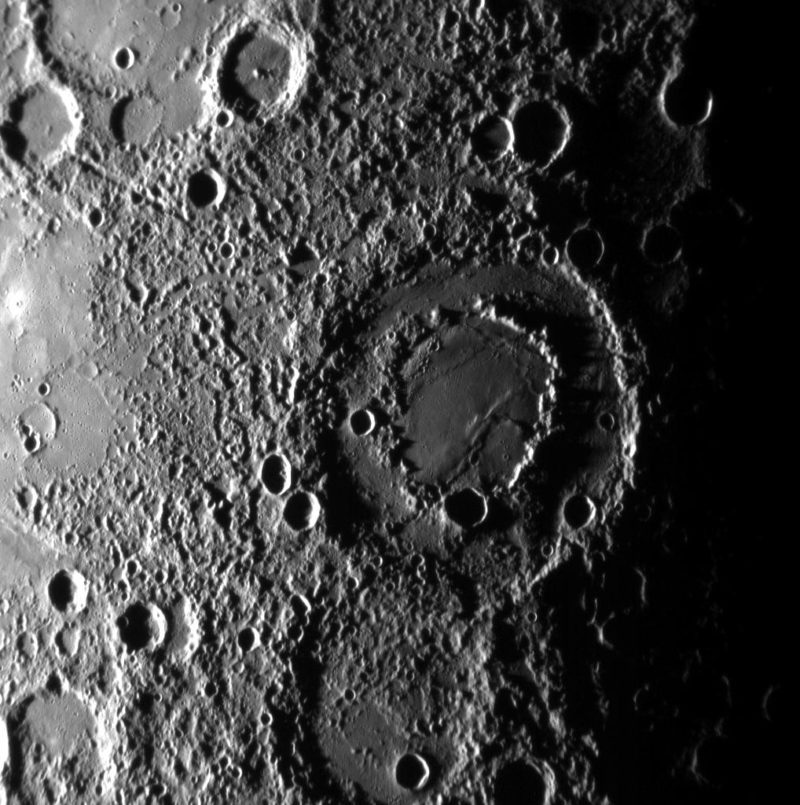
“Why does Mercury have so many craters?” is a question that has long interested scientists and is now largely understood. In this article, we will take a deep dive into the planet’s origins to uncover the reasons behind its heavily cratered surface. Through careful examination of existing research and data, we aim to shed light on this fascinating phenomenon and provide a greater understanding of our neighboring planet.
The Origin of the Planet Mercury
The origin of the planet Mercury is a fascinating topic. It sheds some light on why it has so many craters. This small planet is one of the four rocky planets in our solar system. Moreover, it is believed to have formed approximately 4.6 billion years ago.
The current theory suggests that early in Mercury’s formation there was a massive collision with a planetesimal of about one sixth of Mercury’s mass. As a result, a significant amount of debris was ejected into space. It may have stripped away most of Mercury’s crust and mantle. This debris eventually accumulated and rained back down on the planet. This process created many craters.
This is one leading hypothesis, but alternative theories suggest that Mercury’s thin mantle may also be the result of solar-driven processes, such as intense heating and vaporization during the early history of the solar system, or multiple high-energy collisions in a process sometimes described as “hit-and-run” impacts.
Furthermore, its surface has been bombarded by asteroids and comets for billions of years. This has left behind countless impact craters. Much of this bombardment occurred during the Late Heavy Bombardment. This period was around 4.1 to 3.8 billion years ago, when impacts were especially frequent throughout the inner solar system.
Why Does Mercury Have So Many Craters?
Mercury’s lack of an atmosphere—technically, it has only a thin exosphere that offers no protection—means nothing shields it from incoming objects. Additionally, nothing erodes the craters away by weathering. This is why other planets, such as Earth, Venus, and even Mars have much fewer craters today. In contrast, on Earth and Venus, wind, water, and tectonic activity constantly reshape the surface. These processes erase many ancient impacts.
In addition, Mercury has very little ongoing geological activity, meaning its surface is not regularly renewed. This allows craters to remain visible for billions of years. While Mercury is one of the most heavily cratered bodies in the inner solar system, it is not necessarily more cratered than the Moon, which also preserves a dense record of ancient impacts.
Understanding the Age and Composition of Mercury’s Surface
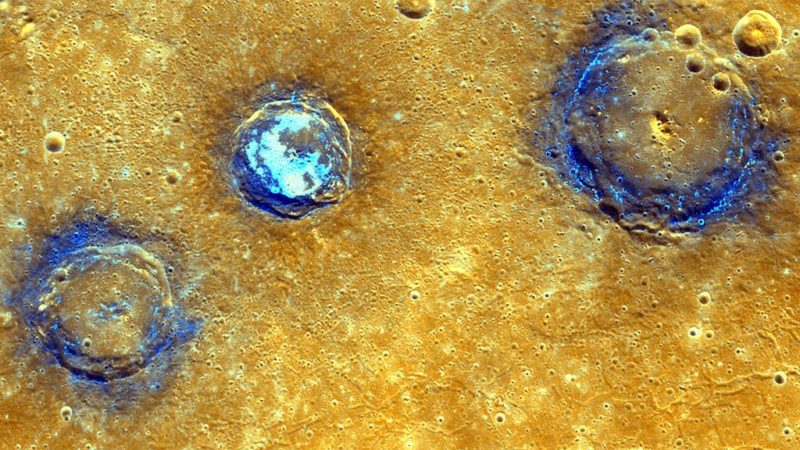
There are two main types of terrains on Mercury’s surface: heavily cratered and smooth plains. The age of the heavily cratered terrain suggests it formed during the period of intense bombardment in the early solar system.
The smooth plains, on the other hand, are thought to have formed from volcanic activity that occurred later in Mercury’s history. Due to the small size of the planet, tectonic activity and volcanism ceased early in the planet’s history. As Mercury cooled over time, the entire planet contracted, forming large cliffs known as lobate scarps. This global contraction further shaped the surface but did little to erase existing craters.
Understanding the age of the surface helps scientists to estimate how many impacts the planet has experienced and how frequently they occurred.
Conclusion
In essence, studying planets like Mercury provides us with a deeper understanding of our solar system. By exploring the origins of Mercury and examining how it accumulated craters, we have gained valuable insights into the planet’s unique characteristics. Mercury’s heavily cratered appearance is not just the result of frequent impacts. It is also the lack of atmospheric and geological processes that would otherwise erase them. Ultimately, the study of planets like Mercury allows us to better comprehend the complexities of our solar system and the wonders it holds.
Would you like to receive similar articles by email?

Paul Tomaszewski
Paul Tomaszewski is a science & tech writer as well as a programmer and entrepreneur. He is the founder and editor-in-chief of CosmoBC. He has a degree in computer science from John Abbott College, a bachelor's degree in technology from the Memorial University of Newfoundland, and completed some business and economics classes at Concordia University in Montreal. While in college he was the vice-president of the Astronomy Club. In his spare time he is an amateur astronomer and enjoys reading or watching science-fiction. You can follow him on LinkedIn and Twitter.


You May Also Like
Europa vs. Enceladus: Subsurface Ocean Evidence Comparison
Centaurus Constellation Guide