Why Are Satellites So Important?
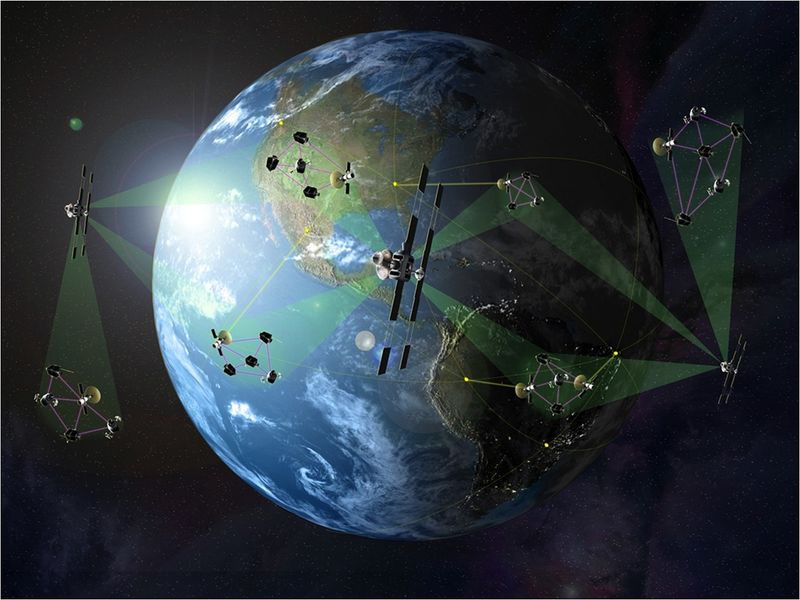
SpaceX has been launching dozens of satellites per mission. They often use their Falcon 9 rocket as part of their Starlink constellation. This growing network already provides high-speed, low-latency internet to many parts of the world. It continues to expand as well.
However, people have started to express concerns about the sheer number of satellites that will be orbiting the planet by the late 2020s and beyond. Starlink eventually aims to deploy up to 42,000 satellites. Several thousand Starlink satellites are already operational. Other companies and countries are also planning or launching large satellite constellations. This project provides one example of a type of satellite orbiting at various heights above the planet’s surface. Why are satellites so important?
What Is a Satellite?
Most people have heard the word “satellite” thrown around. For those who don’t work in the industry, it is a very broad term that can mean many different things. In astronomy, satellite encompasses any celestial body orbiting a planet. It can also refer to “an artificial body placed in orbit around the Earth or moon or another planet to collect information or for communication.”
That’s a whole lot of words to sum up an otherwise simple concept. Anything the human race sends into space intending to set up a stable orbit around Earth or any other celestial body is a satellite. And yes, by that logic, the International Space Station and in-development Gateway station are also both satellites. Any spacecraft currently in orbit counts as a satellite too.
Satellites can be massive—the size of a school bus or tractor-trailer. Alternatively, they can be small enough to fit in the palm of the average person’s hand. Technology is getting smaller and smaller every year. Engineers are exploring construction and manufacturing on the microscopic level. SpaceX previously launched up to 60 small Starlink satellites at once. However, newer satellites are larger and launch counts now vary per mission. That number could double, triple or grow even higher in the coming years. It depends on these devices’ eventual final size. Engineers are also increasingly using small satellites and CubeSats for scientific research, communications and technology demonstrations.
Looking Down
It would be nearly impossible to catalog all satellites in orbit right now, with more than 25,000 craft dotting the night sky. More than 60% of them are defunct, circling the planet until they fall from the sky and burn up in Earth’s atmosphere, but groups like NASA, SpaceX and others are launching more every year. There are five major classifications of satellites, and four of them spend their time looking down toward the ground. Many satellites can also fit into multiple categories depending on their mission.
First, there are the Earth-observing satellites. These come in two flavors—military and civilian—but their function is essentially the same. They use high-resolution cameras pointed at the Earth’s surface to monitor everything from pollution to erosion. The main difference between the two flavors of Earth-observing satellites is who has access to the collected information. These satellites also help scientists monitor climate change, natural disasters, wildfires and deforestation.
Communication satellites provide signals to satellite phones and other forms of satellite communication. Anyone who has ever used in-flight Wi-Fi on an airplane at 30,000 feet has tapped into a communication satellite. They also support internet access in remote areas and help maintain communications during emergencies and natural disasters.
Navigation satellites make up the massive network of GPS devices that circle the globe. Google Maps, Garmin and others all use these satellites to tell drivers where they’re going and how to get there. Other global navigation systems include GLONASS (Russia), Galileo (EU), and BeiDou (China). Modern smartphones and navigation systems often use signals from several satellite navigation networks simultaneously for greater accuracy.
Finally, on the Earth-facing side of things, there are weather satellites. These monitor weather and atmospheric conditions worldwide. In addition, they report them to meteorologists to help them build their weather forecasts.
Looking Toward the Stars
The final satellite classification is the kind that points out into the cosmos. Ground-based telescopes are a fantastic tool, but the atmosphere obscures the view. It’s the same reason stars appear to twinkle when observed from the ground with the naked eye. Space telescopes, like the Hubble and others, orbit the planet. Therefore, they offer astronomers an unobstructed view of the universe.
The majority of satellites point down toward Earth. However, a small number of them aim to help the human race expand its understanding of the universe.
Future Applications of Satellites
Satellites are vital for various reasons, but the current applications only represent a fraction of this technology’s possible uses.
As more autonomous vehicles roll off the assembly line, satellites will become even more important. They will help self-driving cars and trucks navigate the world’s highways and byways by providing positioning, navigation and timing information alongside onboard sensors and computer systems.
Small satellites could help support future space exploration and travel as well. Instead of sending human astronauts to explore a new world, NASA and other space agencies can “call ahead”—so to speak—by sending dozens or even hundreds of small satellites that can give explorers an aerial view of their destination before they ever arrive.
As more satellites go up, however, space debris and orbital traffic are growing concerns. Many new satellites—like those in the Starlink network—are designed to deorbit safely within a few years after service ends. Scientists and engineers are also studying ways to reduce orbital congestion and prevent cascading collisions, sometimes referred to as the Kessler syndrome. Astronomers have additionally raised concerns about bright satellite constellations affecting observations of the night sky.
Growing Humanity’s Understanding of the Cosmos
Satellites are invaluable tools, helping us with everything from space exploration to predicting the weather. They also support banking systems, agriculture, shipping, disaster response, internet connectivity and climate research around the world. The technology may be getting smaller, but the potential applications will continue to grow and change in the coming decades. Starlink alone will more than triple the number of satellites orbiting Earth, and that’s only the beginning.
Would you like to receive similar articles by email?

Emily Newton
Emily Newton is the Editor-in-Chief of Revolutionized as well as a contributor to CosmoBC. She specializes in writing in-depth articles and blog posts for the industrial and sci/tech sectors. You can follow her on LinkedIn.


You May Also Like
Panoramic Imaging for Space Telescopes: Explained

Stargazing Calendar for May 2026