Where Are Most Asteroids Found?
Have you ever looked up at the night sky and wondered where the countless asteroids in our solar system are located?
These celestial objects have long captivated the curiosity of scientists and astronomers alike. In this article, we will delve into the depths of space to uncover the mysterious locations where these captivating asteroids can be found. So fasten your seatbelts as we embark on an astronomical journey!
The Main Asteroid Belt
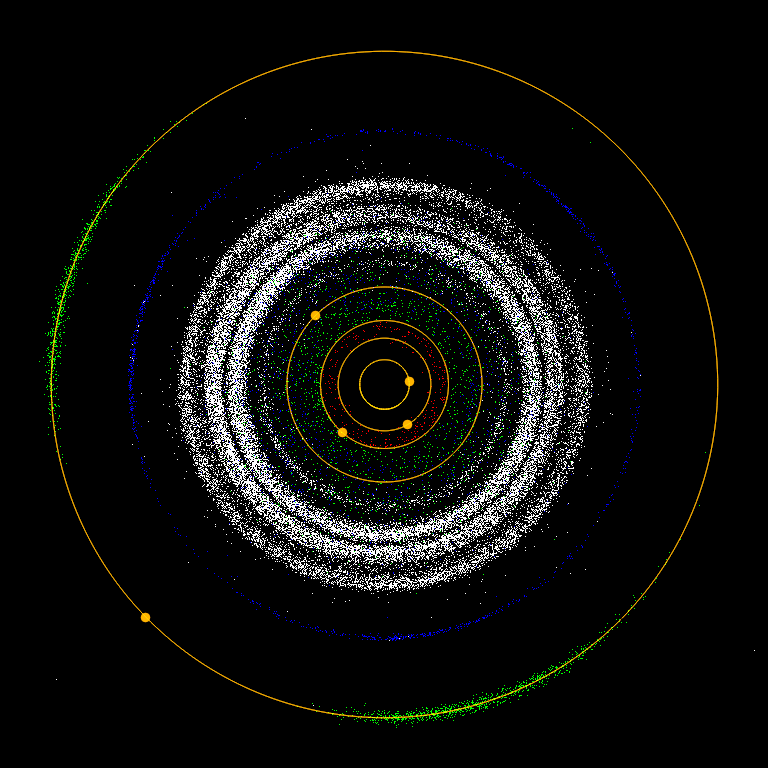
Most asteroids within our solar system are found in the asteroid belt, located between the orbits of Mars and Jupiter. As of 2026, astronomers have identified more than 1.4 million asteroids in this vast region. More are being discovered regularly thanks to advanced surveys and telescopes. This vast and captivating cosmic playground is home to the majority of known rocky asteroids that have been discovered thus far. Asteroids vary widely in composition. For example, carbon-rich, rocky, and metallic types are among the most common.
Stretching across millions of kilometers, the asteroid belt is divided into three main regions: the inner asteroid belt, the middle asteroid belt, and the outer asteroid belt. These regions are separated by Kirkwood gaps, named after American astronomer Daniel Kirkwood who first noticed them in 1866. These gaps are areas where there are very few asteroids due to orbital resonances with Jupiter. Repeated gravitational interactions with Jupiter destabilize asteroid orbits in these regions over long periods of time. Meanwhile, thermal forces such as the Yarkovsky effect can slowly shift asteroids into these resonances.
Near-Earth Asteroids
While the asteroid belt steals the spotlight, there are also significant populations of asteroids known as near-Earth asteroids (NEAs). As the name suggests, these asteroids orbit in close proximity to our own planet. NEAs pose a unique interest to astronomers due to their nearness. This is because they have the potential to stray into Earth’s orbit and, in rare cases, collide with our planet.
NEAs are part of a broader category called near-Earth objects (NEOs), which includes both asteroids and comets whose orbits bring them close to Earth.
As of 2026, scientists are tracking more than 41,000 NEAs, and upcoming missions such as NASA’s NEO Surveyor (planned for launch in 2027) aim to detect many more.
Trojan Asteroids
Another intriguing group of asteroids can be found at the Lagrange points of Jupiter’s orbit around the Sun. These regions, known as “Trojans,” are stable gravitational pockets (known as L4 and L5) where asteroids gravitate to the same orbital path as Jupiter. This captivating phenomenon results in clusters of asteroids located approximately 60 degrees ahead or behind Jupiter in its orbit. These celestial objects are named after the mythical Trojan War.
While Jupiter Trojans have remained the primary focus of research, recent observations have unveiled the presence of Trojans in the orbit of Mars, the other gas giants, and even Earth and Venus. NASA’s Lucy mission, launched in 2021, is currently en route to study several Jupiter Trojans. The spacecraft successfully flew past asteroid Dinkinesh in 2023 during its journey. It is expected to begin close-up observations of Jupiter Trojans in 2027.
Hilda asteroids
There is one more significant concentration of asteroids in the solar system known as the Hilda group. These are asteroids located beyond the main asteroid belt but within Jupiter’s orbit, in a 3:2 orbital resonance with the gas giant. The group is named after asteroid 153 Hilda.
Conclusion
In our quest to understand the enigmatic nature of asteroids, we have explored their elusive locations throughout our vast solar system. From the captivating asteroid belt between Mars and Jupiter to the near-Earth asteroids lurking in our cosmic backyard, these celestial objects continue to captivate our scientific curiosity.
See also: Why Didn’t a Planet Form Where the Asteroid Belt Is Now Located?
Would you like to receive similar articles by email?

Paul Tomaszewski
Paul Tomaszewski is a science & tech writer as well as a programmer and entrepreneur. He is the founder and editor-in-chief of CosmoBC. He has a degree in computer science from John Abbott College, a bachelor's degree in technology from the Memorial University of Newfoundland, and completed some business and economics classes at Concordia University in Montreal. While in college he was the vice-president of the Astronomy Club. In his spare time he is an amateur astronomer and enjoys reading or watching science-fiction. You can follow him on LinkedIn and Twitter.


You May Also Like
Chi Cygnid Meteor Shower Guide

Why Scientists Need Clear Imaging to Solve Medical Mysteries