What Separates the Inner and Outer Solar System?
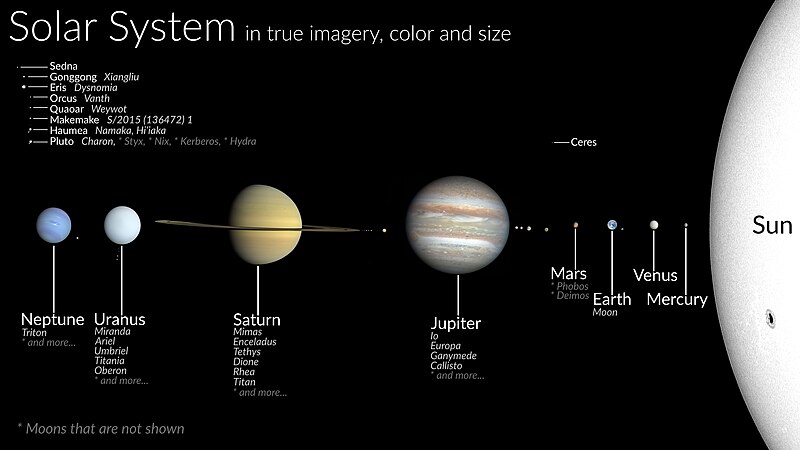
The solar system, with its mesmerizing array of planets, moons, and other celestial bodies, is a vast and captivating expanse. Within this expansive system, we can discern a clear distinction between the inner and outer solar system. While the outer solar system showcases gas giants and icy dwarf planets, the inner solar system showcases rocky planets and other smaller bodies.
The inner and outer solar system are commonly separated by the main asteroid belt. This belt lies near the “frost line”—the distance from the Sun where temperatures were low enough for volatile compounds like water to condense into ice during the solar system’s formation.
Inner Solar System
The inner solar system is relatively close to the Sun. It is predominantly occupied by four rocky terrestrial planets: Mercury, Venus, Earth, and Mars. Each of these planets has distinct characteristics that set them apart.
- Mercury: It is the closest planet to the Sun and is characterized by extreme temperatures due to its proximity to the Sun. It is a small and rocky planet with a limited atmosphere. Its surface exhibits an extensive cratering pattern, suggesting a history of intense bombardment.
- Venus: Known for its vibrant and dense atmosphere, Venus is enveloped in a thick layer of carbon dioxide with clouds of sulfuric acid. It experiences a runaway greenhouse effect, leading to surface temperatures hot enough to melt lead. Venus also has a volcanic terrain, with numerous volcanoes and lava flows.
- Earth: Our home planet, Earth, possesses a diverse ecosystem and supports a wide array of life forms. It boasts a life-sustaining atmosphere, mild temperatures, and abundant liquid water—essential ingredients for the existence of life as we know it. Earth’s dynamic surface, with its continents, oceans, and ever-changing climate, make it a distinct and vibrant place in the solar system.
- Mars: Often referred to as the “Red Planet” due to its rusty appearance, Mars captivates scientists with its potential for supporting past or present microbial life. With its polar ice caps, ancient riverbeds, and possible signs of briny liquid water that may occasionally form today under the right conditions, Mars is a planet of great interest for future exploration and potential colonization.
Outer Solar System
As we move farther away from the Sun, we encounter the outer solar system. Here, gas giants, ice giants, and distant dwarf planets prevail. This region hosts vast distances and frigid temperatures. Additionally, there is a variety of interesting celestial bodies.
- Jupiter: The largest planet in our solar system, Jupiter is composed mainly of hydrogen and helium. Its iconic swirling clouds and the mesmerizing Great Red Spot make it a true spectacle. Jupiter has a collection of more than 90 known moons, including the four Galilean moons—Io, Europa, Ganymede, and Callisto—each with its distinctive features. Europa, in particular, is believed to harbor a subsurface ocean beneath its icy crust, making it a prime candidate in the search for extraterrestrial life.
- Saturn: Known for its stunning ring system, Saturn is a gas giant with exquisite beauty. The rings, comprising countless particles of rock and ice, encircle its equator, making it an object of fascination for astronomers and space enthusiasts alike. Saturn also boasts numerous moons, with Titan being the most fascinating due to its thick atmosphere, methane lakes, nitrogen-rich atmosphere, and complex organic chemistry. NASA’s Dragonfly mission, planned for the late 2020s, aims to explore Titan’s surface and atmosphere.
- Uranus: Distinctive for its sideways orientation, Uranus is an ice giant has a pale blue color due to methane in its atmosphere. Uranus has several rings but lacks the prominent feature of Saturn’s magnificent rings. It also has a collection of moons, with Titania and Oberon being the largest. NASA has identified Uranus as a top target for a future flagship mission due to its underexplored nature.
- Neptune: Furthest from the Sun, Neptune is another ice giant in our outer solar system. It exhibits striking blue hues due to the presence of methane gas. Neptune’s tumultuous atmosphere, marked by striking storms and the Great Dark Spot, reveals its dynamic nature. It also has a collection of fascinating moons, including Triton, a unique world with cryovolcanoes and a retrograde orbit. Triton may be a captured Kuiper Belt object and shows signs of active geysers, making it a candidate for future exploration.
Beyond the gas giants, we encounter icy dwarf planets such as Pluto, Eris, Haumea, and Makemake. We also find a multitude of smaller bodies residing in the Kuiper belt and Oort cloud. New Horizons’ 2015 flyby of Pluto revealed a surprisingly complex world with nitrogen glaciers and towering ice mountains. Furthermore, Pluto has a thin, layered atmosphere.
Bridging the Gap and Unlocking Mysteries
The distinction between the inner and outer solar system goes beyond the compositional differences of their celestial bodies. It also encompasses a contrast in environmental conditions, atmospheric compositions, and the spacing of planets—distances between worlds increase dramatically beyond Mars. In addition, there are differences in scientific exploration prospects. Understanding these disparities allows us to appreciate the vastness and diversity of our solar system. This knowledge sparks curiosity and inspires further exploration.
As humans, we continue to push the boundaries of knowledge and stretch our reach towards the outer regions of the solar system. We also strive to reach beyond. From ongoing missions such as NASA’s Voyager spacecraft (now in interstellar space and still transmitting limited data) and New Horizons (currently exploring the Kuiper Belt) to upcoming endeavors like the Europa Clipper, we are gradually uncovering the mysteries of both the inner and outer solar system. As a result, we are deepening our understanding of our celestial neighborhood.
Conclusion
Understanding what separates inner and outer solar system regions comes down to more than just distance from the Sun. The inner solar system is defined by small, rocky planets and leftover debris. In contrast, the outer solar system is home to massive gas and ice giants, distant dwarf planets, and icy reservoirs like the Kuiper Belt and Oort Cloud. The boundary between them—the asteroid belt near the frost line—marks a key shift in temperature and materials. This shift shaped how planets formed.
By exploring these differences in composition, structure, and scale, we gain a clearer picture of how our solar system evolved and why it looks the way it does today.
Would you like to receive similar articles by email?

Paul Tomaszewski
Paul Tomaszewski is a science & tech writer as well as a programmer and entrepreneur. He is the founder and editor-in-chief of CosmoBC. He has a degree in computer science from John Abbott College, a bachelor's degree in technology from the Memorial University of Newfoundland, and completed some business and economics classes at Concordia University in Montreal. While in college he was the vice-president of the Astronomy Club. In his spare time he is an amateur astronomer and enjoys reading or watching science-fiction. You can follow him on LinkedIn and Twitter.


You May Also Like
How Comet Nucleus Ice Sublimates Into Coma And Tails
Eta Aquariid Meteor Shower Guide