What Is a Wolf-Rayet Star?
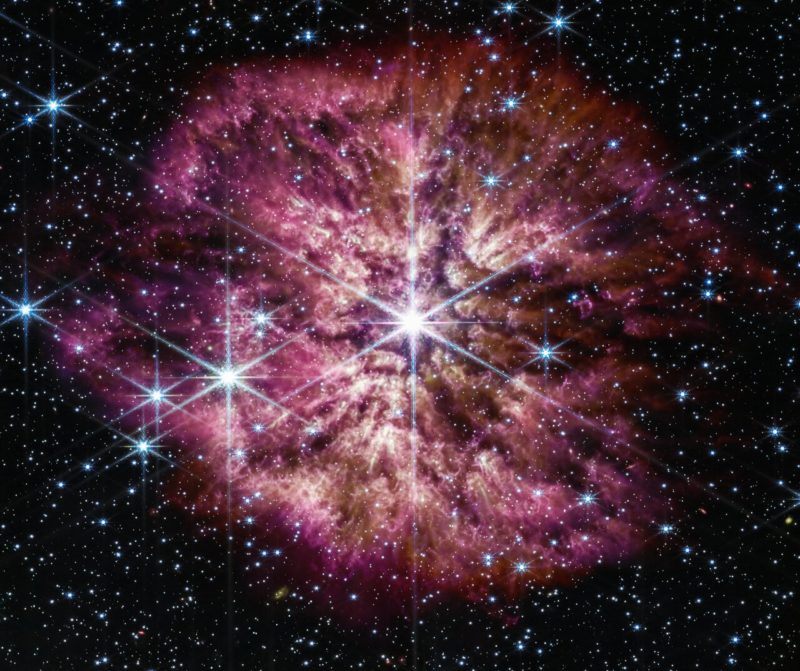
In the vast cosmos, where stars illuminate the darkness, lies a celestial mystery. What is a Wolf-Rayet star, and why does it hold astronomers in awe?
Unveiling the enigma of these cosmic giants is a journey into the heart of stellar marvels. We explore their discovery, unique characteristics, and the pivotal role they play in shaping the cosmos. Join us as we unravel the secrets of Wolf-Rayet stars. Moreover, we cast light on the celestial wonders that continue to defy our understanding of the universe.
What Is a Wolf-Rayet Star?
A Wolf-Rayet star is a massive, hot, and luminous stellar giant characterized by intense stellar winds and strong emission lines in its spectra. Additionally, it has a surface temperature hotter than almost all other kinds of stars. These enigmatic stars play a crucial role in the evolution of massive stars. They enrich the interstellar medium with heavy elements through their powerful stellar winds. Ultimately, they culminate in a supernova explosion or, in some cases, collapse directly into a black hole without a bright supernova event.
Wolf-Rayet stars are typically evolved massive stars that have shed much of their outer hydrogen layers. As a result, they expose deeper fusion products such as helium, nitrogen, carbon, and oxygen. They are commonly classified into WN (nitrogen-rich), WC (carbon-rich), and the rarer WO (oxygen-rich) spectral types.
Discovery of Wolf-Rayet stars
The discovery of Wolf-Rayet stars in the 19th century by astronomers Charles Wolf and Georges Rayet represents a significant milestone in the annals of astronomy. In 1867, their systematic observations revealed a group of stars displaying distinctive spectral features. Particularly, they noticed strong emission lines rather than the absorption lines expected from ordinary stars.
Edward Charles Pickering, a prominent astronomer in the late 19th century, played a crucial role in deciphering the nature of Wolf-Rayet stars. He theorized that the mysterious emission bands in their spectra were linked to an unusual state of hydrogen. The subsequent identification of the “Pickering series” revealed a pattern similar to the Balmer series. Ultimately, this established that these lines resulted from the presence of helium.
These peculiar characteristics prompted the recognition of a new class of massive stars, later designated as Wolf-Rayet stars in honor of their discoverers. The meticulous work by Wolf and Rayet laid the groundwork for a deeper understanding of these luminous entities. This marked a crucial development in our comprehension of stellar astrophysics.
The discovery posed fundamental questions about the unique spectral signatures exhibited by these stars. This prompted subsequent investigations into the underlying astrophysical processes governing Wolf-Rayet stars and their role in the broader context of stellar evolution. The historical narrative of their identification has since guided ongoing research. Thus, it shapes our knowledge of the universe’s intricate cosmic tapestry.
Characteristics of Wolf-Rayet Stars
Wolf-Rayet stars exhibit a distinctive set of characteristics that define them as celestial powerhouses. These massive luminaries command attention for their extraordinary features.
Temperature Range
These stars boast surface temperatures ranging from 20,000 K to around 210,000 K, ranking among the hottest in the cosmos. This intense heat plays a pivotal role in shaping their unique spectral features. Because of this, they are a fascinating subject of study in the realm of astrophysics.
Mass and Size Compared to the Sun
In the cosmic hierarchy, Wolf-Rayet stars reign as giants. Their masses range between 10 to 200 solar masses. Their substantial sizes dwarf our Sun. Hence, they are colossal entities that play a vital role in shaping their cosmic surroundings.
Strong Emission Lines in Their Spectra
The spectra of Wolf-Rayet stars are characterized by strong and broad emission lines, a defining feature that puzzled astronomers for years. Unraveling this mystery led to the identification of highly ionized elements. As a result, we have cast light on the intricate chemistry within these celestial giants.
These emission lines commonly arise from helium, nitrogen, carbon, and oxygen, reflecting the exposed inner layers of the stars and the effects of their extreme stellar winds.
Intense Stellar Winds and Mass Loss
Wolf-Rayet stars are not just cosmic luminaries; they are also cosmic sculptors. Intense stellar winds, driven by their extreme temperatures, cause significant mass loss. This phenomenon enriches the surrounding interstellar medium with heavy elements, contributing to the complex cycle of stellar evolution.
Wolf-Rayet Stars and Nebulae
The relationship between Wolf-Rayet stars and nebulae is profound. These stars are often found at the hearts of nebulae, and their intense stellar winds play a crucial role in shaping and illuminating these cosmic clouds of gas and dust. The interaction results in the creation of intricate structures such as bubbles and ring nebulae. Moreover, it contributes to the enrichment of the interstellar medium.
Evolution of Wolf-Rayet Stars
The life cycle of Wolf-Rayet stars unfolds as a captivating cosmic saga. This phase in the existence of massive stars involves a series of intricate transformations, charting their evolutionary journey through the cosmos.
Transition to the Wolf-Rayet Phase
The journey toward becoming a Wolf-Rayet star is marked by a transition from earlier stellar phases. As massive stars exhaust their nuclear fuel, they undergo profound changes, ultimately leading them to the Wolf-Rayet phase.
Role in the Life Cycle of Massive Stars
Wolf-Rayet stars play a vital role in the intricate tapestry of massive star evolution. Their formation and subsequent stellar winds contribute to the enrichment of the interstellar medium with heavy elements, influencing the conditions for future star and planetary system formation.
Relationship to Supernova Explosions
The Wolf-Rayet phase culminates in a spectacular stellar event – a supernova explosion. This explosive end marks the final chapter in the life of these massive stars. Scattering elements across the cosmos, they contribute to the dynamic processes that shape galaxies.
However, in some cases, WR stars may bypass a bright supernova and collapse directly into a black hole, depending on their mass and metallicity. Some rapidly rotating Wolf-Rayet stars have also been proposed as possible progenitors of long-duration gamma-ray bursts.
Conclusion
In short, the exploration into what is a Wolf-Rayet star has illuminated the cosmos with the brilliance of these celestial giants. From their discovery by Charles Wolf and Georges Rayet to their role as stellar architects shaping nebulae, Wolf-Rayet stars stand as enigmatic luminaries, leaving an indelible mark on our understanding of the universe. As we delve into their characteristics and intricacies, including their stripped outer layers and extreme stellar winds, we see their role in explosive stellar deaths. These stars emerge not just as astronomical phenomena but as cosmic storytellers of transformation and enrichment.
Would you like to receive similar articles by email?

Paul Tomaszewski
Paul Tomaszewski is a science & tech writer as well as a programmer and entrepreneur. He is the founder and editor-in-chief of CosmoBC. He has a degree in computer science from John Abbott College, a bachelor's degree in technology from the Memorial University of Newfoundland, and completed some business and economics classes at Concordia University in Montreal. While in college he was the vice-president of the Astronomy Club. In his spare time he is an amateur astronomer and enjoys reading or watching science-fiction. You can follow him on LinkedIn and Twitter.


You May Also Like

Why Family Nurse Practitioners Are Becoming the Backbone of Primary Care
Southern Taurid Meteor Shower Guide