What Do Astronauts Eat in Space?
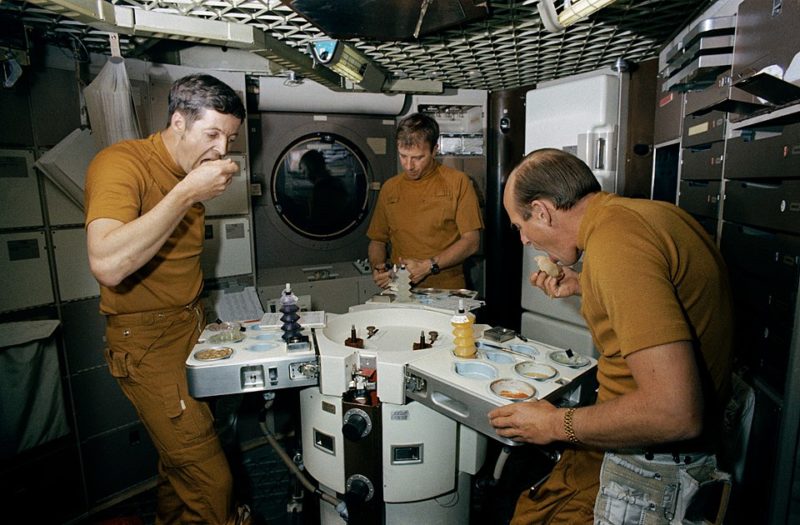
When you think of eating food in space, what foods come to mind? Chances are, it’s that freeze-dried ice cream that you tried once as a kid during a science field trip, right? During the early part of the space race, that would have been a staple, but astronaut food doesn’t look like that anymore. What is on the menu for modern astronauts, and how has it changed since we first started setting out into the cosmos?
Early Astronaut Food
During the early years of manned space flight, the food that the astronauts were able to take into space with them greatly resembled the tube of toothpaste on your bathroom counter. It had the consistency of baby food. However, it was packed full of all the nutrients and vitamins the astronauts needed to stay healthy in space.
That doesn’t mean they enjoyed eating it though.
During the Apollo missions in the late 1960s and early 1970s, NASA engineers introduced a new kind of space food—the freeze-dried meals you know and love. Astronauts could rehydrate these foods with a specialized water gun, making them ready to eat in a few minutes. As a result, this option also increased the variety of food. Astronauts could take more food to space with them.
It wasn’t until the late 1970s that NASA came up with a space-safe TV dinner. Around this time, refrigerators started getting installed on Skylab and subsequent space stations to enable the astronauts to store and enjoy things like fresh fruits and vegetables.
Modern Astronaut Menus
So what does a modern astronaut menu look like?
That really depends on the time of year, but the current menu looks a lot like what you’re making at home. There are scrambled eggs and oatmeal for breakfast. In addition, astronauts enjoy spaghetti and chicken teriyaki with broccoli for dinner. Around Thanksgiving, for astronauts that are in space during the holiday, dinner includes turkey, stuffing, candied yam—everything that you’d expect to find at a home-cooked Thanksgiving dinner.
Modern astronaut food also isn’t limited to freeze-dried meals. Today’s menus include a mix of freeze-dried foods, thermostabilized pouches, irradiated meats and fresh foods delivered aboard cargo spacecraft.
The trick is to develop foods that taste good after being freeze-dried and rehydrated. It can take months to develop a good recipe before it’s finally mass produced and taken into orbit.
Astronauts also experience changes in their sense of taste in microgravity because bodily fluids shift toward the head. As a result, foods taste blander. That’s one reason spicy foods and strong seasonings are popular aboard the International Space Station.
One problem, even with these multi-course holiday meals, is that you can’t load up your plate and feast—you have to eat one item at a time, or the rest of your meal will float away while you’re trying to enjoy it. That might be a downside if you like eating your turkey, stuffing, mashed potatoes and cranberry sauce all in one bite. Still, it’s pretty cool that the astronauts get to enjoy holiday dinner. They’re thousands of miles away from home.
Commercial astronauts are also getting to enjoy increasingly varied menus. Private missions aboard spacecraft operated by companies like SpaceX and Axiom Space have featured specially prepared meals. These meals are designed to make life in orbit feel a little more like home.
Space Food Experiment
If you’ve ever wondered what modern space food tastes like, here’s a fun experiment for you. Make your own space pudding!
Start with your favorite flavor of instant pudding mix. You’ll also need powdered milk, water and a container to mix it in. If you want to make these for a group, you’ll need individual zip lock bags. Mix equal parts pudding mix and powdered milk, then add water according to the pudding’s directions.
Mix it together, and you’ve got your very own space pudding! The powdered milk makes it a little thicker than standard instant pudding. This is similar to the kind of food that the astronauts will be enjoying on the International Space Station.
Growing Space Food
We can shuttle fresh fruits and vegetables up to the International Space Station on things like SpaceX’s Dragon capsule, but even when refrigerated, many fresh fruits and vegetables have a limited shelf life. They can only remain usable for several weeks. Therefore, why not have astronauts grow their own food?
Most science fiction spaceships have a hydroponics department where fresh food can be grown. This area doubles as an oxygen producer, which can be invaluable for deep space voyages. In 2015, members of Expedition 44 on the International Space Station were able to enjoy leafy greens that were grown in microgravity aboard the station for the first time. They used LEDs to provide the light wavelengths needed for the plant growth. Since then, astronauts have continued growing food in space, including Mizuna mustard, a leafy green crop. This work is part of the VEG-05 experiment. NASA’s Advanced Plant Habitat is used to study crops in microgravity.
Astronauts have also successfully grown and eaten chile peppers and harvested dwarf tomatoes aboard the International Space Station. These experiments are helping researchers determine which crops may someday sustain crews. Crews may live and work far from Earth.
While some fruits and vegetables won’t grow well in space—like those that grow on trees, such as apples—researchers are primarily focusing on compact, fast-growing crops that are well suited to hydroponic systems, such as leafy greens, peppers and tomatoes on ships with artificial gravity (which we haven’t figured out yet) or even on colonies like those that we’re planning to make on Mars.
The ability to grow food in space will also be important for NASA’s Artemis program and future lunar habitats. These will be places where astronauts may spend weeks or months away from Earth. Eventually humanity will head to Mars.
Conclusion
NASA hasn’t totally abandoned freeze dried foods—they just don’t taste as good as the real thing. The recipes that are currently being developed might even follow us to Mars when the first astronauts set foot on the Red Planet during future crewed missions. Who knows—maybe we’ll even develop tastier space food for the future Martians that we can’t even imagine yet. For now, though, freeze-dried ice cream and space pudding sound pretty good to us!
Would you like to receive similar articles by email?

Megan Ray Nichols
Megan Ray Nichols is a freelance writer, amateur astronomer, and science enthusiast. She loves to travel and read books.


You May Also Like
How Did Celestial Bodies Get Their Names
Hydra Constellation Guide