Volcanism on Earth, Venus, Mars, Io, and Icy Moons
Earth, Venus, Mars, Io, and the icy moons erupt differently because each one runs on a different internal heat engine, carries different materials to the surface, and traps that energy under a crust that behaves in its own stubborn way. Earth leaks heat through plate tectonics and gas-rich magma. Venus seems to brood under a stagnant lid, then bleed out vast basalt plains. Mars built oversized shield volcanoes above static hot spots and then mostly cooled into silence. Io gets kneaded by Jupiter until rock melts constantly. Icy moons do something stranger still, venting water, salts, and other volatiles in cryovolcanic plumes instead of ordinary lava.
That comparison matters because volcanism is one of the cleanest ways to read a world’s interior. You cannot drill into Venus. You are not strolling across Io. So planetary science does what it always does when the ground is out of reach, it reads the scars, the gases, the heat flow, the colors, the plume heights, the way surfaces get buried and renewed. The terrain tells on the engine below it.
Why do these worlds erupt differently?
A decent shortcut is to track four controls:
- How much internal heat the body still has
- Whether the crust moves, bends, or just sits there
- What melts, rock or ice
- How gravity and atmosphere shape the rising material
| World | Main heat source | Crust style | Main erupted material | Typical volcanic expression |
|---|---|---|---|---|
| Earth | Primordial heat, radiogenic heat | Moving plates | Silicate magma | Arc volcanoes, rifts, hot-spot chains |
| Venus | Primordial heat, radiogenic heat | Stagnant lid | Mostly basaltic lava | Broad volcanic edifices, lava floods, plains resurfacing |
| Mars | Residual internal heat, mantle plumes | Static lithosphere | Basaltic lava | Giant shields, long lava flow fields |
| Io | Tidal heating from Jupiter resonance | Continuously stressed | Sulfur compounds and silicate magmas | Violent lava fountains, huge plumes, active lava lakes |
| Icy moons | Tidal heating, some radiogenic heat | Brittle ice shell over liquid layers | Water, salts, ammonia, organics | Cryovolcanic jets, fissure plumes, resurfaced ice |
Heat sources
Earth, Venus, and Mars mainly rely on leftover formation heat plus radioactive decay. Same family, different endurance. Earth and Venus are large enough to stay active for a long time. Mars is smaller, so the planet lost heat faster, even though some deep regions stayed warm enough to feed the Tharsis volcanoes for ages.
Io breaks that pattern. Its furnace is external. Jupiter’s gravity, plus the orbital resonance with Europa and Ganymede, flexes Io over and over, converting orbital energy into heat. NASA’s Juno team has a useful breakdown of how tidal heating drives Io’s interior. It is relentless.
Icy moons borrow the same trick, just with colder ingredients.
Crust behavior
Earth’s crust is mobile. Subduction, seafloor spreading, rifting, all of it creates fresh pathways for magma chambers and volcanic vents. Venus appears locked under a stagnant lid. That means heat is not released by mobile plates, so stress and melt may accumulate until large-scale outpourings happen. Mars also has a static lid, but colder and thicker. Once a hot spot forms, the crust does not slide away, so one volcanic place can keep stacking lava in the same spot for millions of years.
Eruption materials
On Earth, you mostly get silicate lava, with eruption style controlled by silica content, dissolved water, and volcanic gas. On Venus and Mars, basalt dominates much of the story. Meanwhile on Io, the chemistry gets exotic at the surface, sulfur everywhere, but the deepest and hottest activity still points to silicate volcanism and very hot lava. Icy moons flip the script entirely. Their cryomagma can include water, brines, ammonia, methane, and dissolved organics.
Earth
Plate boundaries
Earth’s volcanoes are busy because plates move. Subduction zones generate gas-rich magma that can explode catastrophically, while mid-ocean ridges keep producing basaltic lava flows more quietly. This split is a big deal. Earth does not have one universal eruption style. It has a system.
Mantle plumes
Hot spots complicate the picture in a good way. Hawaii is the classic case: a mantle plume punches through moving crust, leaving a chain rather than one fixed giant mountain. That is why Earth rarely builds anything like Olympus Mons. The conveyor belt keeps shifting.
Gas-rich magma
Earth’s atmosphere and hydrosphere matter too. Water recycled into the mantle lowers melting temperatures. Dissolved gases can turn rising magma into a pressure bomb. That is why Earth can produce both gentle basalt flows and explosive ash columns. Among the rocky planets, Earth is the most compositionally and tectonically mixed.
Venus
Stagnant lid
Venus is the uncomfortable twin. Similar size to Earth, very different surface behavior. No confirmed modern plate tectonics, no oceans to lubricate the system, and a lithosphere that seems more like a single lid than a broken shell. So volcanism on Venus likely comes from mantle plumes, localized upwellings, and maybe periodic overturns.
Basalt plains
Much of the surface is basalt surface terrain, broad plains, shields, coronae, and extensive lava flows. The atmosphere is crushing, about 90 times Earth’s surface pressure, and the ground hovers near 467 degrees Celsius. That environment suppresses some explosive behavior and favors widespread effusive volcanic lava flows, though the details are still argued over.
Resurfacing clues
The fight over active Venus is interesting because the evidence is real, but the interpretation still needs caution. A reanalysis of Magellan radar data found a vent on Maat Mons that appears to have changed shape, and the underlying paper in Science laid out the surface-change case in detail. That does not settle every argument about present-day eruptions, but it strongly suggests Venus is not geologically dead. Not even close.
Mars
Static hot spots
Mars kept its crust parked over mantle plumes. That single fact explains a lot. Instead of a Hawaiian chain, you get one source feeding the same site again and again. The result is the Tharsis bulge and the tharsis volcanoes, a spectacular overachievement by a cooling world.
Giant shields
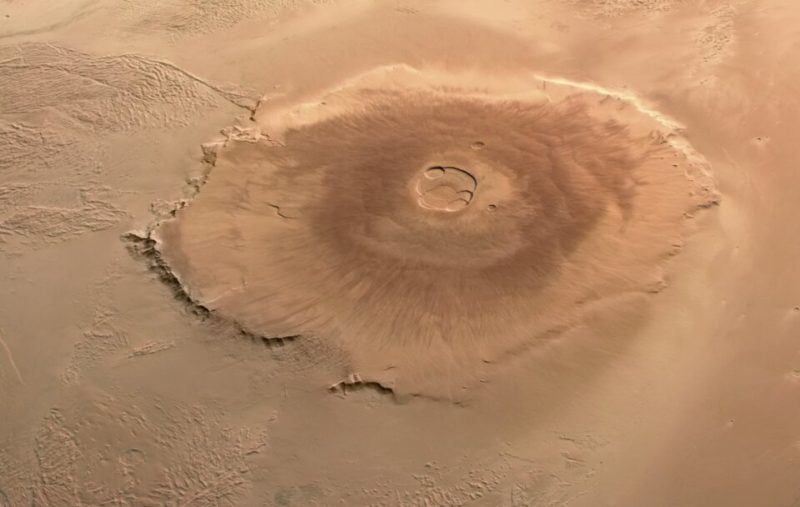
Olympus Mons is the celebrity, around 26 km high above the surrounding plains, with a huge footprint and long basaltic lava flow fields. Low gravity helped. So did the lack of plate motion. So did limited erosion. Mars let its shield volcano grow old in peace, which is not a phrase you get to use much in geology.
Long cooling
Mars cooled faster than Earth and Venus, but not instantly. That is the subtle part. The planet had enough residual heat for prolonged, localized volcanic activity, including flood basalts and fresh lava flows in some relatively young regions. USGS offers a clean summary of how Martian volcanoes compare with Earth’s. Ancient does not always mean simple.
Io
Tidal flexing
Io is the maniac of the group. Its volcanism is not mainly about leftover heat. Jupiter stretches and squeezes it continuously, and orbital resonance keeps that stress from fading out. This is why Io can outdo Earth despite being far smaller.
Sulfur and silicate
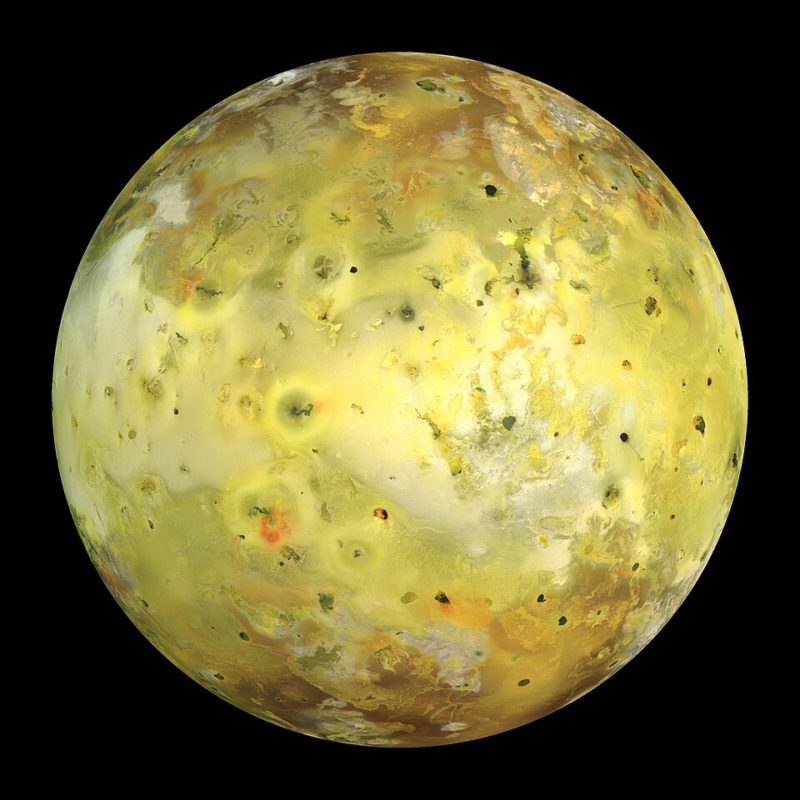
The yellow, red, black, and white colors come from sulfur, sulfur dioxide frost, and fresh deposits around ionian volcanoes. Yet beneath that flashy surface, the hottest ionian lavas are probably ultramafic or at least extremely hot silicate lava flows. Some plumes are sulfur-rich. Some are fed by hot silicate magma. Same moon, different surface expressions.
Extreme heat flow
Juno’s close passes delivered high-resolution volcanic views of Io, and recent reporting on a massive multi-volcano event drives home the scale. Io has lava lakes, towering plumes, outburst eruptions, and heat flow that makes the rest of the solar system look half-asleep.
Icy moons
Cryomagma
Icy moons erupt, but usually not with rock. Their cryomagma is a slush or brine, sometimes mixed with salts, ammonia, methane, or organics. So the “lava” is cold by terrestrial standards and still mobile by local standards. Strange chemistry, same physical logic: pressure finds a crack.
Tidal heating
Enceladus and Europa are the headline acts because tidal flexing keeps subsurface oceans or warm pockets from freezing solid. The shell fractures, stress concentrates, and material gets pushed upward through fractures instead of classic volcanic cones.
Plume evidence
Enceladus gave the game away with south polar jets from the tiger stripes. Europa may also vent plumes, though the evidence is less settled. One useful caution: Ahuna Mons is often mentioned in cryovolcanism discussions, but it sits on Ceres, a dwarf planet, not one of the icy moons. Still, it is an offbeat cousin in the same broader conversation about cold-world geology.
What do color, gas, and plumes reveal?
Planetary volcanism is readable if you know what to stare at.
- Dark basalt plains on Venus and Mars usually point to low-viscosity lava floods
- Sulfur colors on Io hint at sulfur-rich volcanic gases and rapid surface recycling
- Water-vapor plumes on Enceladus point to subsurface liquid reservoirs
- Gas content on Earth often predicts whether a volcano oozes or detonates
Plumes tell you pressure. Color tells you chemistry. Surface freshness tells you age. And when impact craters are scarce, as on large parts of Venus and Io, resurfacing has probably been vigorous enough to erase old terrain.
FAQ
Which world is the most volcanically active?
Io, by a wide margin. It is the most persistently active volcanic body known because tidal heating keeps feeding melt and stress.
Why are Venus and Earth so different if they are nearly the same size?
Size helps both retain heat, but Earth has plate tectonics, abundant water, and active crustal recycling. Venus appears to have a stagnant lid, a dry surface, and a radically different atmosphere, so heat escapes in a different rhythm.
Why are Martian volcanoes so huge?
Because Mars has low gravity, limited erosion, and a static crust over long-lived hot spots. Lava could pile up into giant shield volcanoes instead of getting carried away on moving plates.
Conclusion
Comparative volcanism gives away a hard truth about planets and moons: eruption style is never just about melt. It is about the whole machine, heat budget, crust mechanics, gravity, chemistry, atmosphere, even orbital architecture.
Earth is dynamic because plates move. Venus stores stress under a lid. Mars built tall mountains over fixed plumes and then cooled. Io is tortured into constant silicate fury. Icy moons vent hidden oceans through frozen shells.
Same broad process, wildly different worlds. That is the fun of it, and also the science.
Would you like to receive similar articles by email?

Paul Tomaszewski
Paul Tomaszewski is a science & tech writer as well as a programmer and entrepreneur. He is the founder and editor-in-chief of CosmoBC. He has a degree in computer science from John Abbott College, a bachelor's degree in technology from the Memorial University of Newfoundland, and completed some business and economics classes at Concordia University in Montreal. While in college he was the vice-president of the Astronomy Club. In his spare time he is an amateur astronomer and enjoys reading or watching science-fiction. You can follow him on LinkedIn and Twitter.


You May Also Like
What Are Herbig-Haro Objects
Sustainable Practices in Mining: How Modern Mining Pumps Reduce Environmental Impact