Why Do We Think Triton Is a Captured Moon?
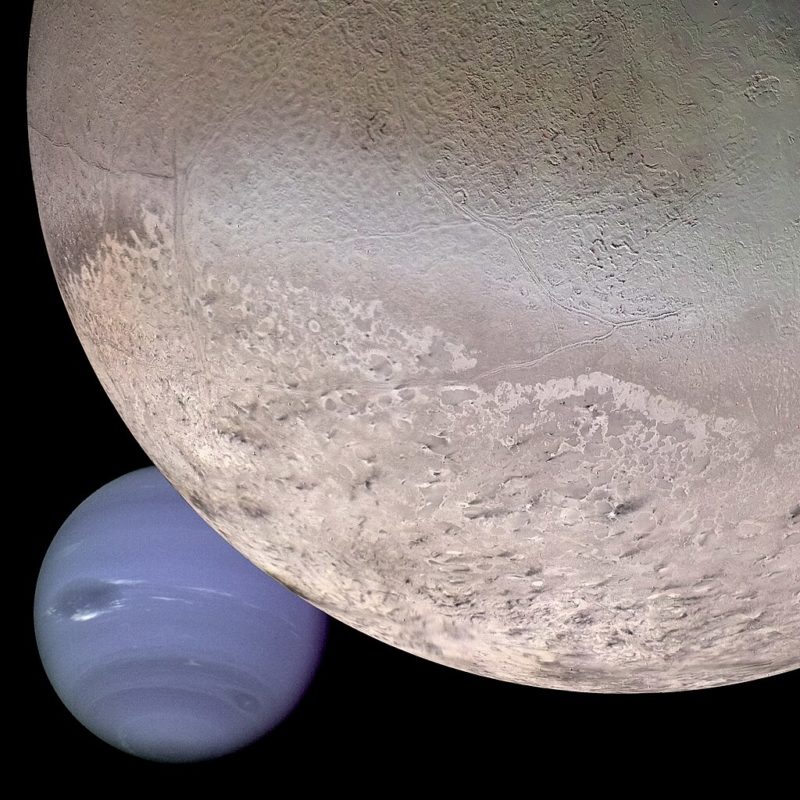
Have you ever wondered why scientists believe that Triton, one of Neptune’s moons, is a captured moon?
In this article, we will explore the key evidence and reasons that support this intriguing hypothesis. From its unusual orbit to its composition, Triton presents a wealth of compelling clues that suggest it was not born in its current location. Let’s delve deeper into the fascinating world of Triton and uncover the mystery behind its origins.
Triton’s Retrograde Orbit
One of the primary reasons why scientists believe Triton is a captured moon lies in its unconventional orbit around Neptune. Unlike most moons that orbit their host planets in the same direction as the planet’s rotation (prograde motion), Triton orbits Neptune in the opposite direction (retrograde motion). This retrograde orbit is highly unusual. Therefore, it suggests that Triton did not form alongside Neptune. Instead, it was captured from somewhere else.
Scientists also believe Triton’s capture likely disrupted Neptune’s original satellite system. It potentially destroyed or rearranged earlier moons. Triton’s orbit was probably far more elongated after capture. Afterward, it gradually became more circular through tidal interactions with Neptune over millions of years.
Unusual Composition
Triton has a composition similar to Pluto and other objects in the Kuiper Belt, a region of the outer solar system beyond Neptune that contains many icy bodies. Its surface contains nitrogen, methane, and carbon monoxide ices similar to those found on Pluto and other Kuiper Belt objects. Observations using advanced telescopes, including studies of Triton’s surface chemistry and atmosphere, continue to support its similarities to Kuiper Belt objects. Thus, this evidence reinforces its likely origin as one of them.
How Was Triton Captured?
The most likely current hypothesis is that the moon was originally part of a binary system with another object and was eventually captured by Neptune due to gravitational interactions. This is known as a three-body gravitational encounter. The binary system could have been similar to the one that currently exists between Pluto and Charon. Craig B. Agnor and Douglas P. Hamilton proposed this model in the early 2000s. It remains a leading explanation as of 2025.
This capture was most likely very violent. Before Triton’s orbit stabilized, it probably collided with at least one other moon and caused collisions between other moons around Neptune. Raluca Rufu and Robin M. Canup (2017) proposed that Triton’s capture would have destabilized pre-existing moons. As a result, it potentially triggered massive collisions and the creation of a debris disk.
Some models suggest it may have taken hundreds of millions of years for Triton’s orbit to fully stabilize through tidal evolution. It gradually shrunk and circularized its orbit around Neptune. This disruption may also help explain Neptune’s relatively sparse system of regular moons today.
Conclusion
Through analyzing the key evidence, such as Triton’s unusual orbit and composition, scientists have formulated a strong case suggesting that Triton is indeed a captured moon. The combination of these compelling factors provides valuable insights into the formation and evolution of moons in our solar system.
Triton also displays remarkable features such as nitrogen plumes observed by Voyager 2 and a distinctive “cantaloupe terrain,” offering further clues into its post-capture evolution and internal activity. By unraveling the mysteries of Triton, we gain a deeper understanding of the dynamic nature of the cosmos and the captivating forces at play. Although Triton is far beyond the reach of casual stargazing, its story remains one of the most fascinating examples of cosmic capture in our solar system.
Would you like to receive similar articles by email?

Paul Tomaszewski
Paul Tomaszewski is a science & tech writer as well as a programmer and entrepreneur. He is the founder and editor-in-chief of CosmoBC. He has a degree in computer science from John Abbott College, a bachelor's degree in technology from the Memorial University of Newfoundland, and completed some business and economics classes at Concordia University in Montreal. While in college he was the vice-president of the Astronomy Club. In his spare time he is an amateur astronomer and enjoys reading or watching science-fiction. You can follow him on LinkedIn and Twitter.


You May Also Like
What Is the Antihelion Source Meteor Shower?
Auriga Constellation Guide