How Do Spacecraft Withstand Re-Entering Earth’s Atmosphere?
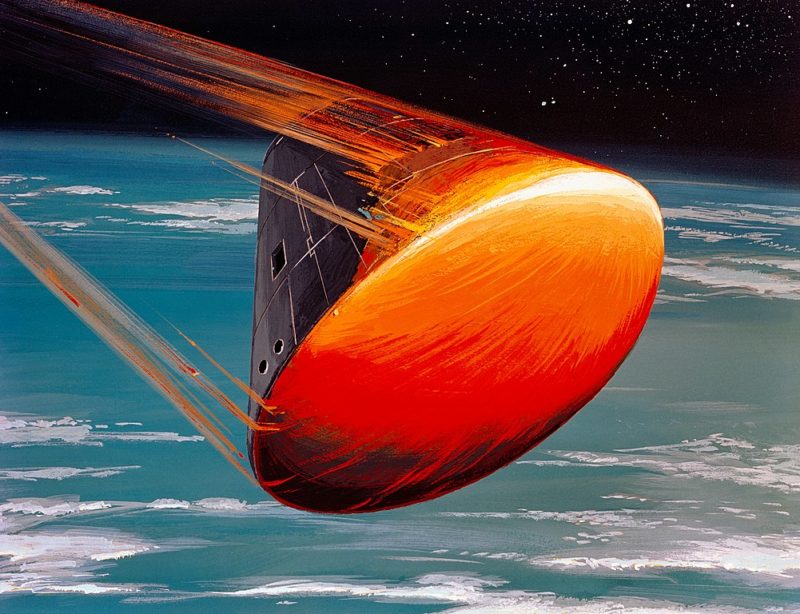
If you’re lucky when you look up in the sky at night, you might see a shooting star. As you’re making your wish, what you’re actually seeing is a small piece of rock or space junk burning up in the atmosphere. The intense compression of air in front of the object as it slams into the atmosphere at high speed causes the air to become superheated into a plasma, which produces the bright streak of ligh.
This begs the question: How do our spacecraft withstand that level of heat, friction and extreme aerodynamic heating re-entering Earth’s atmosphere?
Friction = Drag (And What Actually Causes Heating)
The fireball you see when something re-enters Earth’s atmosphere is caused by friction as well as air compression and shock heating. As the spacecraft moves through the air molecules that make up the atmosphere, it forces them to rapidly compress in front of it, forming a powerful shockwave. This action creates drag, which slows the spacecraft down.
Drag is essential: it slows the spacecraft from orbital speeds (about 17,500 mph / 28,000 km/h for low Earth orbit) to safe landing speeds. The space shuttles, which carried astronauts into orbit, to the MIR station (which was decommissioned in 2001) and the International Space Station from 1981 to 2011, re-entered the atmosphere at a mind-blowing 17,500 mph. The drag generated by re-entry helps slow the craft so it can make a safe landing.
Modern crewed spacecraft include examples like:
- SpaceX Dragon
- Orion spacecraft (used by the Artemis program)
These vehicles are designed specifically to survive controlled, predictable re-entry profiles.
Re-Entry Trajectory Matters
A spacecraft must also enter the atmosphere at a very precise angle. If the angle is too steep, it can burn up due to excessive heating. If it is too shallow, it may “skip” off the atmosphere like a stone on water and re-enter space. Engineers carefully calculate this trajectory to balance heat load and deceleration.
Surviving Extreme Heat
The amount of heat a space shuttle or other spacecraft has to survive is astonishing. On average, a spacecraft re-entering the atmosphere experiences surrounding shock-layer temperatures of several thousand degrees Fahrenheit, with some estimates reaching ~7,000–12,000°F in the plasma around the vehicle, not necessarily on its surface.
There are two main protection strategies: spacecraft shape and heat shield materials.
Blunt Body Design
Most re-entry-capable spacecraft are designed with a blunt body design. This design forces the shockwave to form away from the vehicle’s surface, keeping the hottest gases separated from the spacecraft itself.
Without that shockwave, the heat transfer to the spacecraft would be closer to 12,000 degrees Fahrenheit, making survival impossible at orbital speeds.
Thermal Protection Systems
The exterior of spacecraft is protected using specialized heat shield materials designed to absorb, reflect, or ablate heat. Modern thermal protection systems include a range of reusable and ablative materials depending on the mission:
- Reinforced Carbon-Carbon (RCC): This composite material was used around the nose cone and leading wing edges of the space shuttles. Damage to RCC tiles during launch was the cause of the Columbia’s failure during re-entry in 2003.
- High-Temperature Reusable Surface Insulation (HRSI): This used to be the insulation used on the belly of the space shuttle, but was retired in favor of other materials and are no longer used on modern spacecraft.
- Fibrous Refractory Composite Insulation (FRCI): This is what replaced the HRSI because it could handle higher temperatures while weighing less. Also specific to the retired Space Shuttle program.
- Felt Reusable Surface Insulation (FRSI): While this doesn’t protect the exterior of the shuttle, this material helps keep astronauts safe. It is made of the same sort of Nomex heat-treated felt that is used to make equipment for firefighters.
- Phenolic Impregnated Carbon Ablator (PICA): This is a lightweight, heat-resistant material that was originally designed by NASA. A custom version of this material, dubbed PICA-X, is currently being used by SpaceX on its Dragon capsules. PICA-X is also part of SpaceX’s Starship heat shield.
- Avcoat: A modern ablative material used on the heat shield of the Orion spacecraft, designed for deep-space return velocities.
Future vehicles like Starship are testing reusable metallic and tile-based thermal protection systems designed for repeated atmospheric re-entry.
Communications Blackout
During re-entry, spacecraft often experience a temporary loss of radio communication known as a communications blackout. This happens because the ionized plasma surrounding the vehicle blocks radio signals. The blackout typically lasts several minutes and is a normal part of high-speed re-entry.
Why re-entry is so dangerous
Spacecraft re-entry is a balance of physics, engineering, and precision. The spacecraft must:
- Enter at the correct angle
- Survive extreme heating from shock-compressed air
- Manage rapid deceleration from orbital velocity
- Maintain structural integrity under intense thermal stress
Modern spacecraft are designed to make this process predictable and survivable, but it remains one of the most demanding phases of any mission.
Conclusion
Space travel is still a dangerous endeavor, which is why the minds at NASA, SpaceX and other spacefaring companies are still working toward finding the best thermal protection material possible to keep our astronauts safe during spacecraft re-entering Earth’s atmosphere and enable us to explore space beyond Earth.
Would you like to receive similar articles by email?

Megan Ray Nichols
Megan Ray Nichols is a freelance writer, amateur astronomer, and science enthusiast. She loves to travel and read books.


You May Also Like

Roche Lobe: A Closer Look at Binary Star Systems

Where Are Most Asteroids Found?