
Five Simple Terms of Geriatric Medicine
Many elements impact the effectiveness of a medical consultation. For instance, it has been demonstrated that the number of medical recommendations predicts compliance. It is advisable to focus on five or fewer suggestions and to closely follow-up on their implementation. Different models have been developed to assist physicians and medical trainees in providing structure to their consultations by focusing on five most relevant spheres of geriatric care. This is especially important in geriatric medicine.
5 Ms of Geriatrics
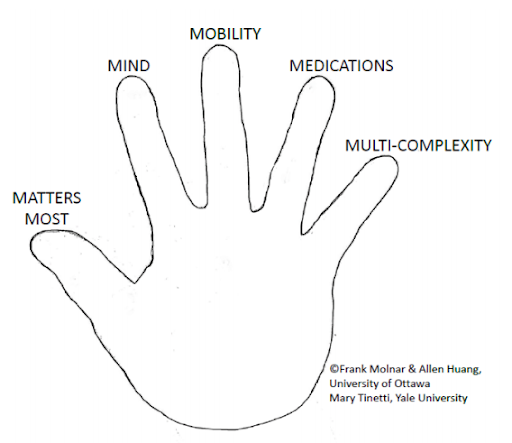 The Geriatric 5 Ms represent an easy-to-remember approach to geriatric consultations, addressing the following aspects: mind, mobility, medications, multicomplexity, and what matters most. These categories also serve as the outline of our teaching website. The 5 Ms have been officially launched in 2017 by Canadian and US specialists in geriatric medicine. Since then, this approach has been implemented in many geriatric programs across the United States, Canada, Australia and New Zealand.
5 Ds of Geriatrics
An alternative way to organize our approach to common geriatric syndromes includes the use of Ds. The original acronym of 3 Ds stands for: dementia, delirium, depression. It is specifically helpful for geriatric psychiatry assessments focusing on issues of the “mind”, however it does not address the multi-complexity aspect. Therefore, to parallel the 5 Ms’ model, different versions have added “drug-related problems”, “disease”, and/or “disposition” with an early exploration of goals of care. Another potential element worth mentioning is “driving” as part of safety optimization in patients with cognitive decline. In summary, the 5 Ds are an integral framework in geriatric medicine.
5 Fs of Geriatrics
Another tool, known as the 5 Fs, was designed for primary care providers and trainees as a framework for comprehensive assessment of seniors. It is specific to frailty-related issues, such as: feelings, flow, function and falls, “farmacy”, as well as future and family. Notably, geriatric medicine utilises a variety of assessment frameworks to cover the complexity of elder care.
References:
- Sears CL, Charlson ME. The effectiveness of a consultation: Compliance with initial recommendations. The American Journal of Medicine. 1983;74(5):870-876.
- Molnar F, Frank CC. Optimizing geriatric care with the GERIATRIC 5Ms. Can Fam Physician. 2019;65(1):39.
- Molnar F, Huang A, Tinetti M. Update: the public launch of the geriatric 5Ms. Can Geriatr Soc J CME. 2017.
- Wong RY. GUEST EDITORIAL: CARING FOR OLDER ADULTS, PART 2: THE FOUR DS IN GERIATRICS. BCMJ, 2017;59(3):156-157.
- Freedman A, McDougall L. Frailty 5 Checklist. Teaching primary care of frail older adults. Canadian Family Physician. 2019;65(1):74-76.
Would you like to receive similar articles by email?


You May Also Like

5 Simple Tips for A Happier, Healthier You

What Your Annual Checkup Should Actually Include
