September Lyncid Meteor Shower Guide
A September night can feel packed with promise: clear air, a dark horizon, one bright streak, and suddenly every faint flash looks like a named event. The September Lyncid meteor shower deserves a cooler reading. It is a minor, poorly understood stream associated with the constellation Lynx, generally listed from about September 10 through October 8, but major observing organizations report little or no dependable visual activity. In practical terms, it is a research entry and a faint observing possibility, not a reliable spectacle like the Perseids or Geminids.
That distinction matters. A meteor is a brief streak created when a meteoroid heats the atmosphere. It does not usually reach the ground; if a surviving fragment lands, it becomes a meteorite. Most sightings during this period will be sporadic meteors or members of stronger autumn showers.
What Is This Minor Meteor Shower?
Classification
The September Lyncids are classified as a minor stream, and in many public observing resources they are treated as inactive or negligible. The American Meteor Society’s September Lyncid archive does not present them as a productive annual meteor shower with a meaningful hourly rate.
Activity Window
The International Meteor Organization’s meteor shower list gives the September Lyncids a broad activity interval extending from September 10 to October 8. That window should be read cautiously. It describes when the stream may intersect Earth’s observing geometry, not a promise of strong activity every night.
When Does It Reach Its Peak?
Historical Dates
The September Lyncids usually peaks on September 13. Some calendars assign an approximate peak within the September 10 to October 8 interval, but the date is less useful than the warning attached to it: activity is weak and historical observations are sparse.
Expected Rates
Expectations should be modest. The Zenithal Hourly Rate, or ZHR, is of about 4 meteors. Under suburban skies, you may see nothing attributable to the Lyncids. Under a dark sky, you might catch a slow, faint streak, though identifying it requires plotting its path backward toward the radiant.
September Sky Context
The Moon often determines whether a marginal shower is visible at all. A bright gibbous moon can wash away the faint meteors that define weak streams, while a crescent moon or moonless interval gives the experiment a fairer chance. September also contains plenty of sporadic meteors, so one impressive flash does not automatically belong to the Lyncids.
Where Does Its Radiant Appear?
Lynx Location
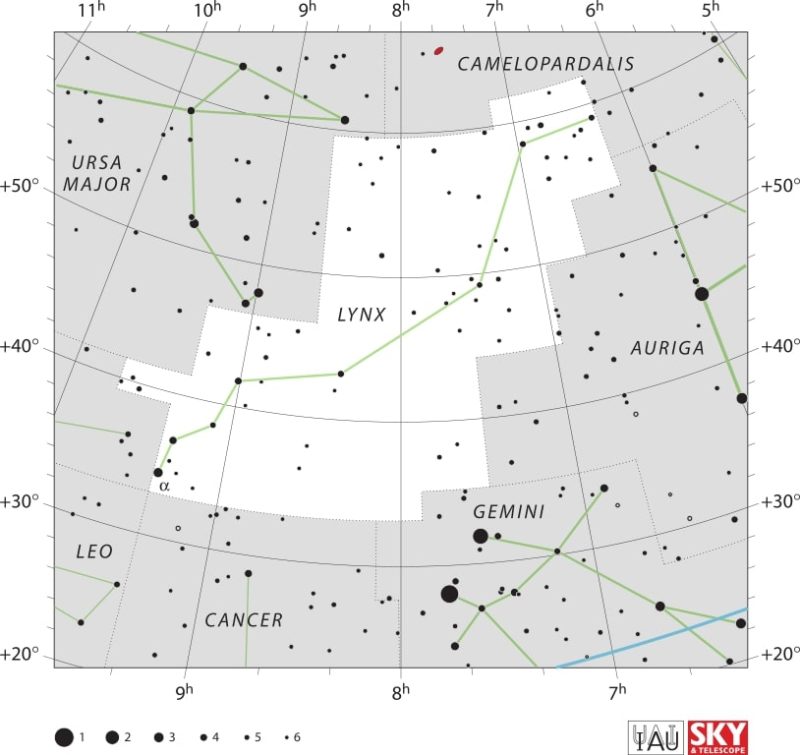
The radiant is associated with Lynx, a faint northern constellation positioned between Ursa Major and Auriga. Lynx contains few bright stars, which makes the region awkward to locate without a planisphere or interactive meteor shower sky map.
Radiant Visibility
For observers in the Northern Hemisphere, the radiant should be more favorably placed than for many southern locations. It rises higher during the night, particularly toward the early morning hours. Even then, the radiant is only a directional marker. Meteors can appear across a wide portion of the sky, and the streaks look shorter when they pass close to that point.
Shower Identification
To test a suspected Lyncid, trace the meteor’s path backward. If it points toward Lynx, it may be a candidate. A meteor moving away from the radiant belongs to another stream or to the sporadic background. Record the time, direction, brightness, color, duration, and whether it left a persistent train. This is useful data, even when the result is inconclusive.
What Causes Its Meteors?
Possible Debris Stream
Meteor showers form when Earth crosses dust and rocky particles distributed along an orbit, usually left behind by a comet or an asteroid. The particles enter the atmosphere at high speed and produce ionized trails. The September Lyncids’ suspected stream is too faint and uncertain for its structure to be described with confidence.
Parent Body
No secure parent comet or asteroid is widely accepted for the September Lyncids. Do not confuse them with the Lyrid meteor shower, which is linked to Comet C/1861 G1 Thatcher, or with other famous streams whose parent bodies are better established.
Research Uncertainty
Meteor-stream work combines optical observations, video networks, radar, and orbital modeling. A handful of meteors can suggest a pattern; they cannot, by themselves, prove a durable stream.
How Can You Observe It?
Best Viewing Time
Try after midnight and before dawn, when the radiant has climbed higher and the observing side of Earth faces into the incoming particle flow. Choose a night with little moonlight and check the forecast for cloud, haze, and humidity.
Dark-Sky Location
Leave city lights behind if possible. A rural field, elevated overlook, or officially protected dark-sky site will reveal far more stars and faint meteors than an urban backyard. Face generally away from Lynx so the streaks appear longer, while keeping the radiant within your wider view.
Essential Equipment
You need remarkably little:
- A reclining chair or sleeping pad
- Warm clothing, even in late summer
- A red flashlight
- A watch, notebook, and simple sky map
Avoid staring at a phone. Its white screen damages dark adaptation, which can take twenty minutes or more to develop. Binoculars are unnecessary for meteors, and never use an unfiltered telescope toward the Sun while preparing for an evening session.
What Should You Expect During Observation?
Treat the September Lyncids as a patient field test, not a guaranteed fireworks display. You may watch for an hour and see only a few sporadic meteors. That is normal. A bright fireball would be memorable, but it would not prove the Lyncids produced it.
Record observations consistently, including the limiting magnitude and cloud coverage. Video observers can contribute more precise trajectories, while visual observers provide valuable timing and brightness estimates.
FAQ
Is the September Lyncid meteor shower active?
It may be listed as active across a broad seasonal window, but observed activity is negligible and unreliable.
Can I see it from the United States?
Northern U.S. observers have the best geometry because Lynx is a northern constellation. Light pollution and moonlight remain the larger obstacles.
Does it have a known parent comet?
No securely identified parent body is generally accepted.
Is one bright shooting star a Lyncid?
No. A meteor must be traced back toward the Lynx radiant, and even then the identification is provisional.
Conclusion
The September Lyncids are worth exploring for observers who enjoy careful science rather than guaranteed spectacle. Their weak activity, uncertain source, and faint radiant make them a poor choice for a casual meteor-counting night, but a useful reminder that the night sky contains unfinished classifications as well as famous shows. Clear skies help. Skepticism helps more.
See also:
- Previous meteor shower: Epsilon Eridanid Meteor Shower
- Next meteor shower: Chi Cygnid Meteor Shower
Would you like to receive similar articles by email?

Paul Tomaszewski
Paul Tomaszewski is a science & tech writer as well as a programmer and entrepreneur. He is the founder and editor-in-chief of CosmoBC. He has a degree in computer science from John Abbott College, a bachelor's degree in technology from the Memorial University of Newfoundland, and completed some business and economics classes at Concordia University in Montreal. While in college he was the vice-president of the Astronomy Club. In his spare time he is an amateur astronomer and enjoys reading or watching science-fiction. You can follow him on LinkedIn and Twitter.


You May Also Like
Stargazing Calendar for September 2022
How Did Phobos and Deimos Get Their Names