
Pyxis Constellation Guide
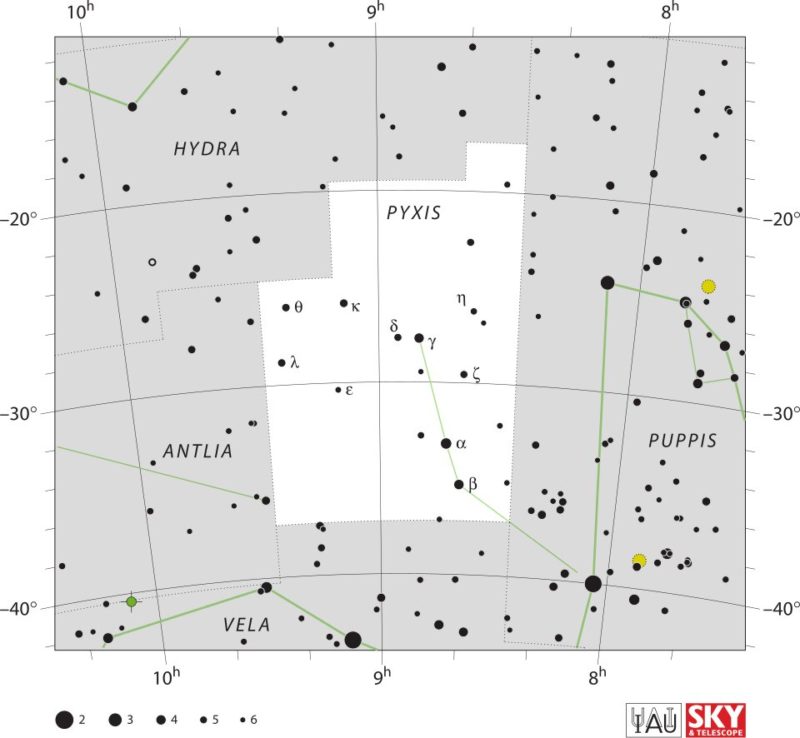
Pyxis is a small, faint southern constellation that represents a mariner’s compass, though its position beside the pieces of an ancient Greek ship gives the name an awkward historical twist. Its brightest stars are modest, and most of its best targets call for binoculars or a telescope. Still, Pyxis rewards a closer look: it holds a recurrent nova and a planetary nebula unusually associated with a star cluster.
What Is the Mariner’s Compass?
Official status
Pyxis is one of the 88 modern constellations recognized by the International Astronomical Union. Its standard abbreviation is Pyx, and Pyxidis is the Latin genitive used in star names such as T Pyxidis. The IAU’s constellation records set its official boundaries, which matter because constellations are defined patches of sky, not physical groups of stars.
Size and boundaries
At about 221 square degrees, Pyxis ranks 65th in area among the 88 constellations. It borders Hydra, Antlia, Puppis, and Vela. Those boundaries place it in a busy part of the southern sky, but the constellation itself is easy to overlook: no bright, unmistakable pattern announces its presence.
Southern-sky position
Pyxis lies south of the celestial equator and is best placed for observers in the Southern Hemisphere. From locations north of about 50 degrees latitude, it does not rise above the horizon; farther south, it can be seen, though often low in the sky. Its location near the Milky Way’s plane adds a scattering of background stars, not a bold outline.
How Can You Find It in the Night Sky?
Nearby constellations
Start with the brighter southern constellations. Pyxis sits between Vela and Puppis, with Hydra stretching along its northern side and Antlia nearby. If you can identify Canopus, the bright star in Carina, use it as a broad landmark: Pyxis is to its north, though the gap is large enough that a constellation chart will help.
Star-hopping clues
Look for a faint, loose line of stars rather than a compass-shaped figure. Alpha Pyxidis, the brightest star in the constellation, shines around magnitude 3.7; Beta and Gamma Pyxidis are close to magnitude 4. That’s visible under dark skies, but city lights can wash the pattern away. A phone sky map is useful, though an ordinary printed chart works perfectly well (and won’t dim when your battery does).
Seasonal visibility
Pyxis is easiest to observe on evenings in the Southern Hemisphere’s late summer and autumn, roughly February through April. In the Northern Hemisphere, the same months offer the best chance, but the constellation stays low for many observers. A clear southern horizon matters more than a powerful telescope.
How Bright Is It, and What Can You See?
Naked-eye limits
Pyxis is a faint constellation, not a showpiece. Its brightest stars are visible to the unaided eye under reasonably dark skies, but they do not form a crisp, familiar shape. Give your eyes time to adjust and use a chart to connect the stars; without those aids, the compass can feel like a few scattered sparks.
Binocular targets
Binoculars reveal more of the star field, including the loose grouping around NGC 2818. Be aware that catalogs use similar names for the nebula and its associated cluster, NGC 2818A. They are a worthwhile paired target, though neither looks like a dramatic naked-eye object.
Telescope targets
A small telescope can begin to separate star clusters and resolve brighter stellar fields. Larger amateur instruments are more useful for teasing out galaxies and planetary nebulae, but Pyxis’s best-known planetary nebula, NGC 2818, remains challenging visually. Astrophotography can bring out its shape and color far more readily than a quick eyepiece view.
How Did Pyxis Get Its Name?
Lacaille’s charts
French astronomer Nicolas-Louis de Lacaille added Pyxis to his southern-sky charts in the 18th century, during a systematic effort to map stars less familiar to European observers. The name is short for Pyxis Nautica, Latin for the mariner’s compass. The NOIRLab history of Pyxis describes its origins and place in the southern sky.
Argo Navis
Here’s the historical oddity: Pyxis lies beside Carina, Puppis, and Vela, the three constellations that represent parts of the former Argo Navis, the ship of Jason and the Argonauts. A magnetic compass belongs to a much later era than the ancient Greek tale. The Britannica account notes the mismatch, and it’s hard not to see the name as an awkward bit of celestial cartography.
The Malus proposal
In 1844, English astronomer John Herschel proposed that Pyxis’s stars should instead represent Malus, Latin for “mast,” restoring them to the ship’s structure. The idea had a certain neatness. It didn’t last: modern charts kept Pyxis as an independent constellation, and the compass still sits beside the mythological vessel.
Which Stars and Deep-Sky Objects Stand Out?
Alpha Pyxidis is a hot, blue-white giant star and the constellation’s brightest point. Beta and Gamma Pyxidis help mark its loose outline, but Pyxis has no famous beacon comparable to Sirius or Canopus.
The more intriguing objects lie beyond the naked-eye pattern. NGC 2818 is a planetary nebula, the glowing shell shed by a dying star, located within the field of an open star cluster. The cluster and nebula make a rare visual pairing, though they are not a single object bound together in the simple way their shared designation might suggest. NASA’s Hubble feature explores this unusual setting.
What Makes T Pyxidis and NGC 2818 Noteworthy?
T Pyxidis is a recurrent nova: a white dwarf in a close binary system draws gas from a companion star, then erupts when material on its surface ignites. Its eruptions have been observed several times, most recently in 2011. That history makes it scientifically valuable, but “recurrent” does not mean an eruption arrives on a dependable schedule. The AAVSO’s overview of T Pyxidis tracks its changing brightness and observing history.
NGC 2818 earns attention for a different reason. A planetary nebula inside an open cluster is an uncommon combination, and Hubble imagery shows delicate structures that are difficult to see through a backyard telescope. The ESA image offers a striking view of the nebula and its surrounding stars.
What Should You Know Before Observing Pyxis?
Choose a dark site, wait until Pyxis is high enough above the southern horizon, and bring a chart. Binoculars are a sensible first tool; a telescope helps with faint nebulae and galaxies, but it won’t turn Pyxis into a bright constellation. For variable-star work, don’t assume T Pyxidis is visibly erupting: consult current observing reports before you point your equipment.
FAQ
Can you see Pyxis with the naked eye?
Yes, under dark skies. Its main stars are visible, but the pattern is faint and may be lost to light pollution.
Is Pyxis part of Argo Navis?
No. Pyxis is a separate constellation next to Carina, Puppis, and Vela, which are the recognized divisions of Argo Navis.
Conclusion
Pyxis is a modest patch of sky with a slightly absurd name and a couple of genuinely compelling science targets. Find its faint stars beside the old ship, then linger on T Pyxidis or NGC 2818. The compass may not belong in Jason’s story, but it gives curious observers another corner of the southern sky to explore.
Would you like to receive similar articles by email?

Paul Tomaszewski
Paul Tomaszewski is a science & tech writer as well as a programmer and entrepreneur. He is the founder and editor-in-chief of CosmoBC. He has a degree in computer science from John Abbott College, a bachelor's degree in technology from the Memorial University of Newfoundland, and completed some business and economics classes at Concordia University in Montreal. While in college he was the vice-president of the Astronomy Club. In his spare time he is an amateur astronomer and enjoys reading or watching science-fiction. You can follow him on LinkedIn and Twitter.

You May Also Like
Use of Satellites in Wireless Communication
Pelican Nebula Unveiled: A Stellar Odyssey through Cygnus
