Puppis Constellation Guide
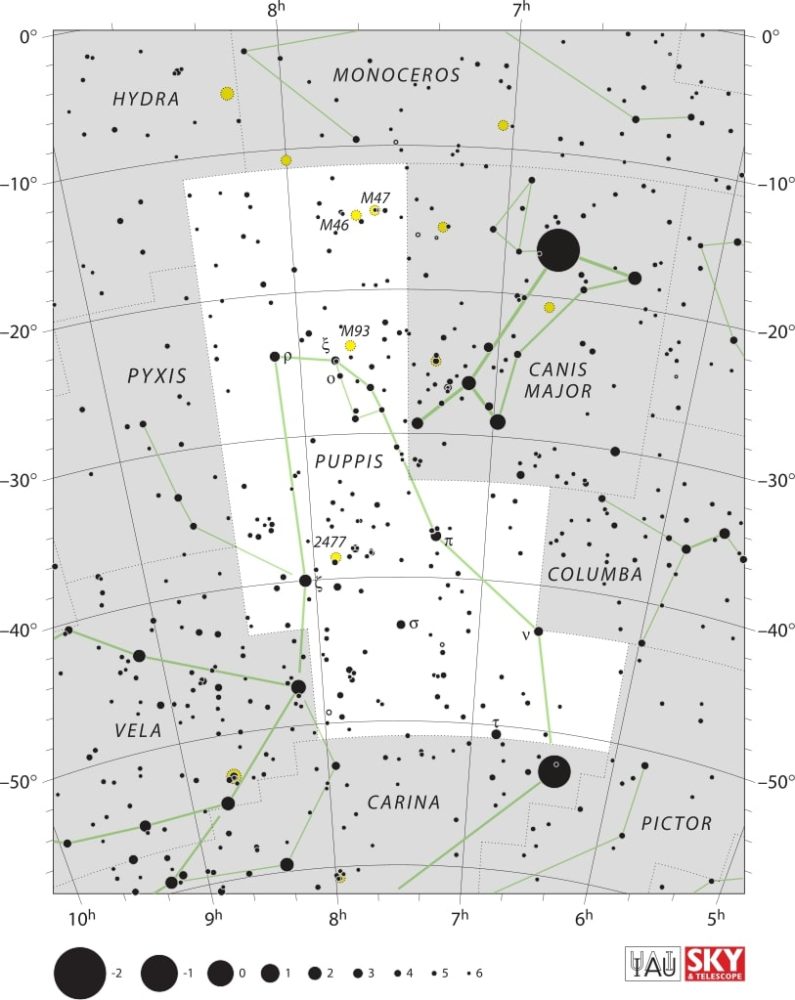
Puppis is a southern-sky constellation best known for its rich Milky Way star fields, the paired open clusters Messier 46 and Messier 47, and its history as part of the ship Argo Navis. It covers about 673 square degrees, making it the 20th-largest of the 88 constellations recognized by the International Astronomical Union. The outline of the stern can be hard to pick out, frankly. The deep-sky sights are the better reason to explore it.
Where Is Puppis, and When Can You See It?
Puppis lies in the southern half of the sky, between Canis Major and Vela, with Carina farther along the Milky Way. Its declination range means observers well south of the equator see it high overhead, while it remains visible from many locations in the Northern Hemisphere, though lower above the horizon.
For most observers, February and March are the best months to look in the evening. Dark skies help: Puppis sits in a crowded stretch of the Milky Way, and light pollution washes out the fainter clusters first. A clear southern horizon matters, too, especially at northern latitudes. The familiar shape may not leap out at you, but binoculars can reveal a surprisingly busy region of the sky.
How Did Puppis Split From Argo Navis?
In Greek myth, Argo Navis was the ship that carried Jason and the Argonauts on their quest for the Golden Fleece. The ancient constellation was enormous, which made it awkward to map and describe. In the 18th century, French astronomer Nicolas-Louis de Lacaille divided it into Puppis, the stern; Carina, the keel; and Vela, the sails. That history is laid out in this account of Argo Navis and its divisions.
There’s a small cartographic oddity left behind: Puppis has no Alpha or Beta star. The Greek Bayer letters were assigned to the original ship before its pieces became separate constellations, so the sequence runs across Puppis, Carina, and Vela. The stern joins the keel in the old imagined ship, but the sky’s boundaries are modern conventions.
Which Stars Stand Out in Puppis?
The brightest star in Puppis is Zeta Puppis, better known as Naos. It shines at about magnitude 2.2 and is a hot, blue supergiant, far more luminous than the Sun. Naos is also an O-type star, a rare class whose intense radiation and stellar winds shape the gas around it.
Pi Puppis, also called Ahadi, is a bright orange supergiant, a very different character from Naos. Rho Puppis, or Tureis, is a yellow-white giant and a variable star. Its name sounds like a navigational instrument, which suits the old ship story, though no telescope is needed to appreciate its warm color.
RS Puppis deserves a mention for a less obvious reason. It is a Cepheid variable, a pulsating star whose changing brightness helps astronomers measure cosmic distances. NASA’s RS Puppis profile describes the star’s dusty surroundings, where light echoes create the illusion of ripples moving outward.
What Deep-Sky Objects Can You Observe?
Messier 46
M46 is a rich, relatively faint open cluster about 5,500 light-years away. A telescope resolves its packed stars; binoculars under dark skies may show a soft patch. A planetary nebula, NGC 2438, appears superimposed on the cluster, but it is not physically part of it. That chance alignment is one of those small astronomical tricks that rewards a closer look.
Messier 47
M47 sits close by and makes an easy counterpoint: brighter, looser, and more readily visible in binoculars. Together, M46 and M47 form a standout pair in Puppis, with one looking dense and subdued and the other more scattered.
NGC 2467
NGC 2467 is a star-forming region sometimes nicknamed the Skull and Crossbones Nebula. Long-exposure images show glowing gas and young stars, but visual observers shouldn’t expect the same vivid colors through an eyepiece.
How Can You Get the Best Views?
Pick a moonless night and let your eyes adjust for at least 20 minutes. Start with binoculars to locate the broad Milky Way field, then use a low-power telescope eyepiece for M46 and M47. A star chart or astronomy app can help, but keep the screen dim; bright phone light is remarkably good at undoing dark adaptation.
For a northern observer, Puppis may skim low and suffer from haze near the horizon. Wait until it reaches its highest point, and choose a site with an open view to the south. Observers farther south have the easier geometry, though dark skies still make the difference between a faint smudge and a field full of stars.
Which Meteor Showers Come From Puppis?
The Pi Puppids are a minor meteor shower with a radiant in Puppis, usually active in April. They are best seen from the Southern Hemisphere, and their rates can be low or variable. The Puppid-Velids are another southern shower complex, with activity around December. For either one, a dark sky and patience matter more than equipment; meteors are easiest to catch with the unaided eye.
How Do You Find the M46–M47 Pair?
Use Sirius, the bright star in Canis Major, as a starting point. From there, trace the Milky Way southeast toward Puppis and look for the clusters roughly 15 degrees from Sirius. M47 is the brighter patch; M46 lies about a degree away. Binoculars make the pair straightforward to spot, while a telescope reveals the contrast between M47’s loose stars and M46’s tighter grain.
FAQ
Can you see Puppis from the Northern Hemisphere?
Yes, from many northern locations, though the constellation sits low in the southern sky. The farther north you are, the more important a clear horizon becomes.
Why does Puppis have no Alpha or Beta star?
Its Bayer designations were inherited from the larger Argo Navis before Lacaille divided that constellation into Puppis, Carina, and Vela.
Is M46 or M47 easier to see?
M47 is brighter and easier in binoculars. M46 is dimmer but richer, and its apparent overlap with NGC 2438 adds an unusual detail.
Conclusion
Puppis may not draw a neat ship across the sky, and “poop deck” is hardly a stirring name for a constellation. Still, its clusters, variable stars, and Milky Way setting make it a fine place to linger. Find M46 and M47 first; the old map can wait.
Would you like to receive similar articles by email?

Paul Tomaszewski
Paul Tomaszewski is a science & tech writer as well as a programmer and entrepreneur. He is the founder and editor-in-chief of CosmoBC. He has a degree in computer science from John Abbott College, a bachelor's degree in technology from the Memorial University of Newfoundland, and completed some business and economics classes at Concordia University in Montreal. While in college he was the vice-president of the Astronomy Club. In his spare time he is an amateur astronomer and enjoys reading or watching science-fiction. You can follow him on LinkedIn and Twitter.

You May Also Like
Octans Constellation Guide
How Did the Milky Way Galaxy Get Its Name