A Pulsar With Planets
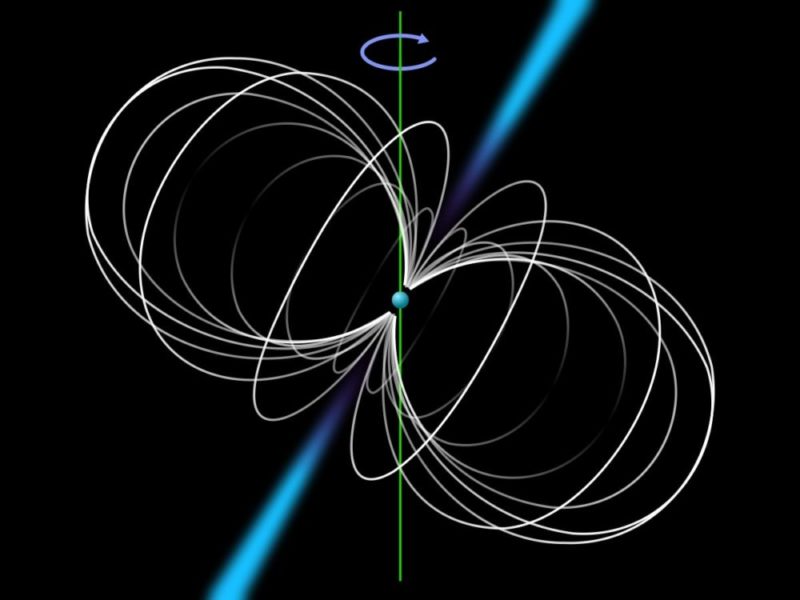
A pulsar is probably the deadliest object in the Universe. Despite their beauty, you wouldn’t want to get close to one of them! They are a type of neutron star that emits a highly focused beam of electromagnetic radiation from both magnetic poles. Mostly, this comes in the form of radio waves. In some cases, this includes higher-energy radiation such as X-rays or gamma rays.
This radiation, extremely hazardous due to intense ionizing energy and particle flux, can only be visible when one of the two beams is turned to face towards the observer. Hopefully, this is not anywhere close. The radiation is so strong that it could severely damage or destroy biological molecules such as DNA through ionization. As a result, survival is extremely unlikely.
Pulsars rotate in a highly stable rate in many cases, especially millisecond pulsars, although some pulsars experience small irregularities known as glitches. It’s this rotation that makes them pulse, hence their name. Their rate of pulsations is extremely regular in the most stable cases. In fact, it rivals atomic clocks in precision for millisecond pulsars.
It is also worth noting that pulsars are not all identical—some are young and erratic, while others are old, rapidly spinning millisecond pulsars. The latter are among the most precise natural clocks in the Universe.
Pulsar Planets: An Unlikely Discovery
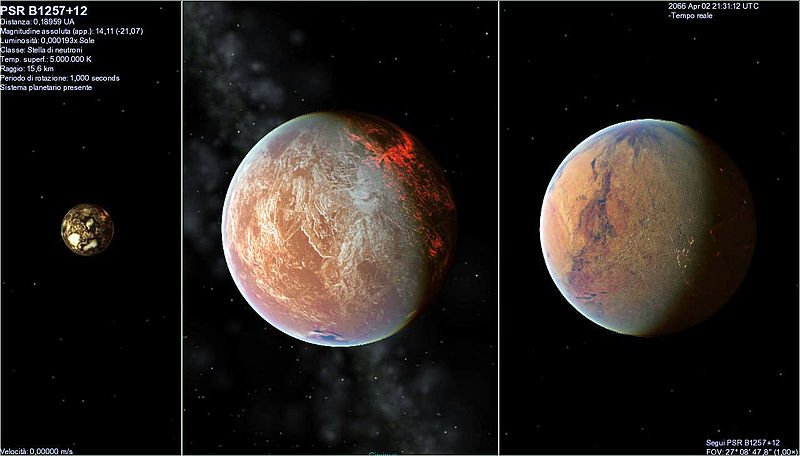
Despite its deadly nature, a pulsar known as PSR B1257+12 (nicknamed Lich), has at least three known planets (Draugr, Poltergeist and Phobetor) orbiting in a close orbit around it.
The pulsar was discovered by the Polish astronomer Aleksander Wolszczan in 1990 using the Arecibo radio telescope. In 1992, he and Dale Frail discovered two extra-solar planets (also known as exoplanets) in orbit around the pulsar—the first confirmed exoplanets ever detected. This discovery was made through precise timing variations in the pulsar’s radio pulses, rather than direct imaging. Two years later a third planet was discovered. (Note: the Arecibo radio telescope is no longer operational, having collapsed in 2020.)
Today, PSR B1257+12 remains historically significant as the first confirmed exoplanet system ever discovered, though it is now understood to be highly unusual compared to the thousands of exoplanets found around normal stars.
Life on a Pulsar Planet? Not Likely
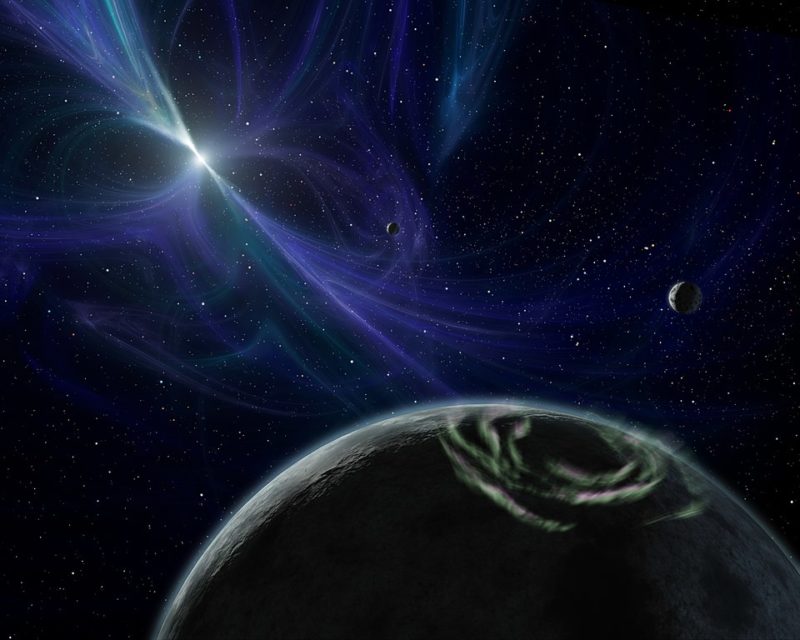
Anyone standing on one of those planets would die a very quick death as their biological molecules would be rapidly damaged by intense ionizing radiation and particle bombardment. However, at least they would enjoy a spectacular view as the pulsar beams swirl through the dark sky.
Those beams might appear visually striking in theory, but they would not resemble Earth’s aurorae in a direct way. Auroras require a substantial atmosphere, and these worlds are likely airless or extremely thin-atmosphere rocky bodies exposed to constant radiation.
In reality, conditions on these planets are expected to be sterile and highly hostile to life as we know it, with survival on the surface being essentially impossible.
How Did These Planets Get There?
Those planets remain a mystery. Their presence is surprising, given the violent conditions in which pulsars form. A pulsar is formed in the aftermath of a dying star that explodes in a supernova. When that happens, any nearby orbiting material is typically destroyed or heavily disrupted.
If those planets somehow survived the cataclysm, it would challenge current understanding of supernova dynamics. However, there is a more widely accepted explanation: these planets likely formed after the supernova, from a disk of fallback material that settled around the neutron star.
This is known as the fallback disk hypothesis, and it is currently the leading explanation. A secondary possibility is that material was captured and reorganized into planets under rare conditions, although this is considered less likely.
If the fallback model is correct, it suggests that planet formation can occur in environments far more extreme than previously thought, though still rare rather than common.
Conclusion
Since the discovery of PSR B1257+12, astronomers have found thousands of exoplanets, mostly orbiting Sun-like or red dwarf stars. Pulsar planets remain extremely rare, making this system an outlier rather than a typical planetary environment.
Nevertheless, it stands as a landmark discovery that reshaped our understanding of how and where planets can form—even in the aftermath of stellar death.
Would you like to receive similar articles by email?

Paul Tomaszewski
Paul Tomaszewski is a science & tech writer as well as a programmer and entrepreneur. He is the founder and editor-in-chief of CosmoBC. He has a degree in computer science from John Abbott College, a bachelor's degree in technology from the Memorial University of Newfoundland, and completed some business and economics classes at Concordia University in Montreal. While in college he was the vice-president of the Astronomy Club. In his spare time he is an amateur astronomer and enjoys reading or watching science-fiction. You can follow him on LinkedIn and Twitter.


You May Also Like

Puppid-Velid Meteor Shower Guide

Stem Cell Therapy: The Next Frontier in Treating Chronic Conditions