Piscis Austrinus Constellation Guide
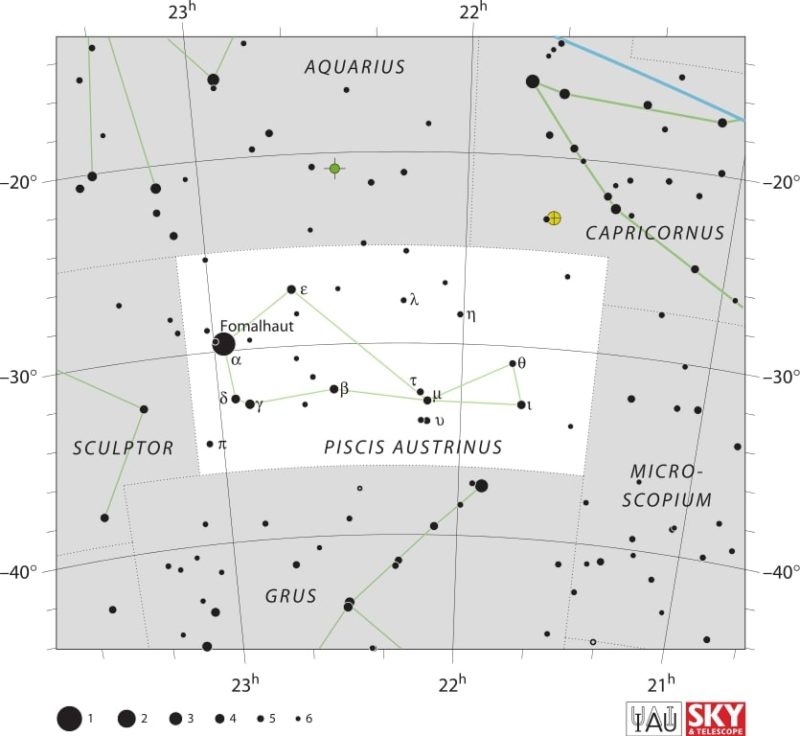
A familiar stargazing frustration: one brilliant star, a handful of faint points, and a fish outline that refuses to look like a fish. That’s Piscis Austrinus, the Southern Fish, a constellation in the southern celestial hemisphere whose reputation rests largely on Fomalhaut. Its shape is hard to trace, but its history reaches back to classical astronomy, and its brightest star has a planetary system surrounded by a striking debris disk.
What Does the Southern Fish Look Like?
Faint Kite Shape
Piscis Austrinus covers about 245 square degrees, making it a modest-sized constellation. Its stars form a loose kite or lasso rather than a convincing animal. Fomalhaut marks the fish’s mouth; the dimmer stars trail away to suggest its body and tail. Without that bright marker, the whole figure can feel like an exercise in generous imagination.
Southern Celestial Hemisphere
The constellation sits south of the celestial equator, in the fourth quadrant of the southern sky. Its official boundaries were standardized in the twentieth century, like those of the other 87 modern constellations. The International Astronomical Union’s constellation reference gives Piscis Austrinus the abbreviation PsA.
Neighboring Constellations
Aquarius lies to the north, with Capricornus nearby; Sculptor, Grus, and Microscopium border other parts of the fish. The water pouring from Aquarius’s urn is traditionally shown flowing toward Piscis Austrinus’s open mouth, a neat piece of celestial staging. The IAU constellation map helps make sense of those borders and the fish’s sparse outline.
When and Where Can You See It?
Best Viewing Season
In the Northern Hemisphere, Piscis Austrinus is easiest to spot on autumn evenings, when Fomalhaut climbs above the southern horizon. From the Southern Hemisphere it appears higher and is visible for more of the year. Local light pollution and latitude matter; near the far north, the constellation stays low, where haze can dim even its brightest star.
Northern and Southern Latitudes
Fomalhaut is a useful guidepost for observers at mid-northern latitudes, though the rest of the fish may be difficult to pick out. Farther south, the constellation’s position is more comfortable to observe. A seasonal viewing guide can help you find the right evening and direction for your location.
Find Fomalhaut
Look low in the southern sky for a bright, solitary-looking star. That is Fomalhaut, also called Alpha Piscis Austrini. Once you have it, use binoculars or a sky chart to search for the faint curve of stars around it. Don’t expect a crisp outline. The fish is more suggestion than portrait.
How Did the Constellation Originate?
Ptolemy’s 48 Constellations
Piscis Austrinus was among the 48 constellations cataloged by the second-century astronomer Ptolemy in the Almagest. That classical list became a foundation for later European star atlases. Its outline and historical names shifted over time, as cartographers argued over which stars belonged to which celestial figures.
Greek Name
The Latin name means “Southern Fish.” Its Greek equivalent, Ichthys Notios, carries the same basic meaning; older sources also use names such as Piscis Notius. This is Piscis Austrinus, singular, and distinct from Pisces, the zodiacal pair of fishes nearby.
Grus and the Lost Tail
The constellation’s historic figure once extended farther, but some stars associated with its tail were later used to form Grus, the Crane. The reshuffling is a reminder that constellations are mapped patterns, not physical neighborhoods in space. Their stars may sit at very different distances from Earth.
What Does the Fish Mean in Mythology?
Syrian and Babylonian Lore
Several traditions attach sacred meaning to fish. In Syrian lore, the fish was associated with Atargatis, a fertility goddess sometimes linked to the figure of Derceto. In one version, a fish rescued her from drowning.
Egyptian Traditions
Some accounts connect a sacred fish with the myth of Osiris, saying it swallowed a part of his body. Such stories appear in differing forms across later retellings, so they shouldn’t be treated as one settled origin for the constellation.
Greek and Roman Accounts
Greek and Roman writers sometimes described the Southern Fish as the parent of Pisces, whose two fish are tied together in the zodiacal sky. Another familiar image shows the fish drinking the stream from Aquarius. Myth gave the stars a story; it did not give them a single, universally agreed one.
Why Is Fomalhaut Its Defining Star?
Brightness and Distance
Fomalhaut has an apparent magnitude of about 1.2 and lies roughly 25 light-years away. It is a white main-sequence star, hotter and more massive than the Sun, and it outshines the constellation’s other naked-eye stars by a wide margin. The star’s name is commonly traced to an Arabic phrase meaning “mouth of the fish.”
Debris Disk
Fomalhaut is surrounded by a broad belt of dust and rocky debris, evidence of ongoing collisions among smaller bodies. Hubble observations helped reveal the disk’s structure and drew attention to a candidate object once described as an exoplanet. That object is now understood as a short-lived cloud of dust from a collision, not a confirmed planet. Recent Hubble observations of the system show how active this apparently quiet neighborhood can be.
The Lonely Star
Fomalhaut can look isolated because few nearby stars rival its brightness. That visual solitude has earned it a “lonely star” reputation, although the star itself is far from alone in its system. Its conspicuousness makes it a handy marker; the rest of Piscis Austrinus asks for patience.
Which Other Stars and Deep-Sky Objects Matter?
Beta, Epsilon, Delta, and Iota Piscis Austrini help sketch the fish, but none competes with Fomalhaut in brightness. The constellation has relatively few showpiece objects for small telescopes. NGC 7314, a spiral galaxy, is a more challenging target, best viewed under dark skies with a telescope.
Is It Worth Tracing the Full Fish?
Honestly, Piscis Austrinus is easy to overrate as a shape. Fomalhaut does most of the work, and calling the rest a fish takes a certain amount of goodwill. Still, it’s worth learning as a seasonal landmark: one bright star, a faint pattern, and a long human history behind both. Find Fomalhaut, take a look around, and move on if the outline won’t resolve. That’s a perfectly sound observing strategy.
FAQ
Is Fomalhaut part of Pisces?
No. Fomalhaut belongs to Piscis Austrinus, the Southern Fish, not the zodiacal constellation Pisces.
Can you see Piscis Austrinus without a telescope?
Yes. Fomalhaut is easy to see with the naked eye, while the fainter stars that outline the fish are best viewed from a dark location.
Does Fomalhaut have a confirmed planet?
No planet has been confirmed in the system. A widely discussed candidate was identified as a transient dust cloud, likely produced by an asteroid collision.
Conclusion
Piscis Austrinus is a constellation of contrasts: an old celestial figure with a famously elusive outline, anchored by one bright star and a debris disk that keeps astronomers curious. You don’t need to force the fish into view. Spot Fomalhaut, explore the surrounding sky, and let the rest remain a little offbeat.
Would you like to receive similar articles by email?

Paul Tomaszewski
Paul Tomaszewski is a science & tech writer as well as a programmer and entrepreneur. He is the founder and editor-in-chief of CosmoBC. He has a degree in computer science from John Abbott College, a bachelor's degree in technology from the Memorial University of Newfoundland, and completed some business and economics classes at Concordia University in Montreal. While in college he was the vice-president of the Astronomy Club. In his spare time he is an amateur astronomer and enjoys reading or watching science-fiction. You can follow him on LinkedIn and Twitter.

You May Also Like

Why Were Ancient Peoples Unable to Detect Stellar Parallax?
How Did Dwarf Planet Salacia Get Its Name