Pisces Constellation Guide
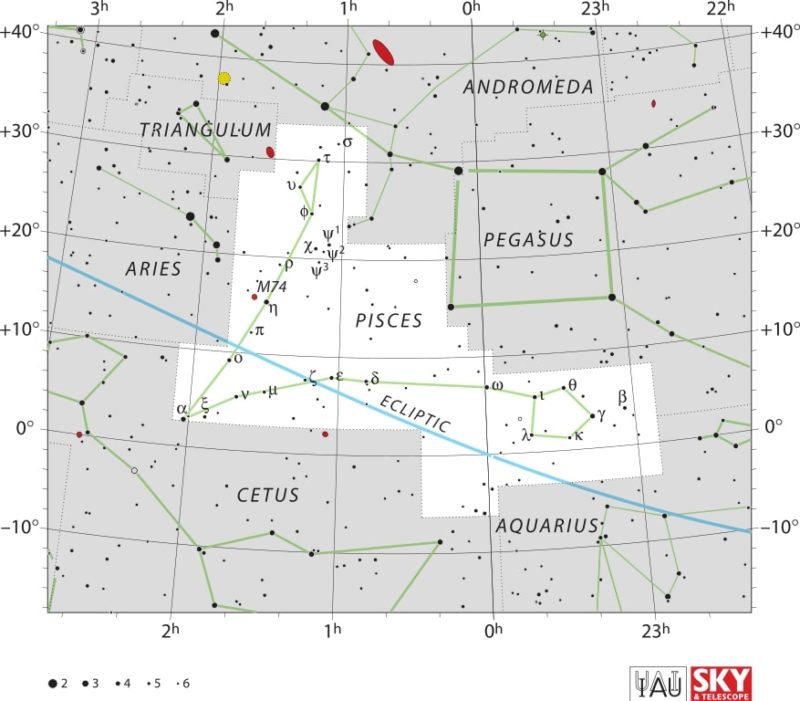
Pisces is a large, faint constellation of the zodiac, best seen on autumn evenings in the Northern Hemisphere. Its outline can be tricky to pick out: a pair of fish joined by a cord, drawn mostly in dim stars rather than bright landmarks. The reward is a useful patch of sky to explore, with galaxies such as NGC 488 tucked among its stars, and a mythology that is more colorful than the constellation itself.
What Is the Pisces Constellation?
Pisces is one of the 88 constellations formally mapped by the International Astronomical Union (IAU). It sits between Aquarius and Aries, with Pegasus, Andromeda, and Cetus among its neighboring constellations. The name comes from the Latin word for “fishes,” plural, though the sky’s two fish are easy to miss if you expect a crisp, obvious drawing.
Pisces lies along the ecliptic, the apparent path the Sun takes across the sky during the year. That places it among the zodiac constellations. For its coordinates and historical place in the zodiac, Chandra’s Pisces guide offers a helpful overview.
Where and When Can You See Pisces?
For observers in the Northern Hemisphere, Pisces is best placed for evening viewing in autumn, especially around October and November. It rises in the east and moves across the southern sky; by winter, it is lower in the west after sunset. The constellation can also be seen from much of the Southern Hemisphere, where its position and season appear different.
Find a dark location, give your eyes about 20 minutes to adjust, and start with the brighter stars of nearby Pegasus. A star chart or planetarium app can help trace Pisces from there. The constellation is broad and faint, so city lights tend to wash out its lesser stars. Around the March equinox, the Sun crosses the celestial equator near the part of the sky associated with Pisces; EarthSky explains the equinox connection.
Which Stars Define Pisces?
Alrescha
Alrescha, also called Alpha Piscium, marks the knot where the two fish’s cords meet. It is a close pair of stars, not the brightest star in the constellation. That distinction belongs to Eta Piscium, whose traditional name is often given as Alpherg. Even this brightest star is modest, so binoculars and patience help when the sky is less than perfectly dark.
The Circlet
The Circlet is a small loop of stars marking the head of the western fish. It is an asterism, a recognizable pattern that forms part of a constellation rather than a separate official constellation.
The two fish
The western fish is associated with the Circlet; the eastern fish lies nearer Pegasus. A long, faint line of stars joins them to Alrescha. The “cord” is the feature that makes the traditional figure readable, though in practice you may need to connect the dots in your imagination.
What Deep-Sky Objects Can You Find in Pisces?
NGC 488
NGC 488 is a face-on spiral galaxy about 62 million light-years away. Its sweeping arms make it a rewarding target in a telescope, but its apparent magnitude is around 10, meaning it is far too faint for unaided viewing and challenging in binoculars. To me, this is a better reason to linger over Pisces than any claim of hidden cosmic wisdom. The galaxy is real, distant, and doing its own spectacular thing.
Other galaxies
Messier 74, also known as M74 or NGC 628, is another face-on spiral galaxy in Pisces. Its broad, delicate arms can be difficult to see because its light is spread across a large area; a dark sky matters more than brute magnification. The SEDS Messier entry for M74 covers its discovery and observing details.
Pisces also contains the dwarf galaxies Pisces A and Pisces B. Hubble observations found evidence of young stars and recent star formation in these faint systems; NASA’s overview and the ESA image release show why a seemingly quiet region of sky can hold a lively history.
What Does Pisces’ Mythology Say?
In one Greek myth, Aphrodite and her son Eros flee the monster Typhon by transforming into fish. They tie themselves together with a cord so they will not lose one another in the water. The story explains the linked-fish symbol, though versions differ across ancient sources and cultures. In Roman mythology, Aphrodite is Venus and Eros is Cupid.
How Does the Constellation Differ From the Zodiac Sign?
The constellation Pisces is a defined region of the sky, with boundaries set by the IAU. The astrological sign Pisces is one of twelve equal 30-degree divisions of the tropical zodiac, traditionally associated with birthdays from about February 19 to March 20. Because Earth’s axis slowly shifts direction, the Sun’s present position against the constellations no longer lines up neatly with those traditional sign dates.
So the astronomy and astrology use related names, but they are not interchangeable. A constellation is mapped among the stars; a horoscope is an astrological interpretation.
Is Pisces Worth Observing?
Absolutely. Pisces offers a chance to practice finding faint patterns, then move from naked-eye stargazing to galaxies that require optical help. The details take effort, which is part of the pleasure. I’d spend my attention on NGC 488 and M74. There’s enough offbeat wonder in the actual science, and exploring the sky is free.
FAQ
Is Pisces visible to the naked eye?
Its brighter stars are visible under dark skies, though the full outline is faint and can be hard to trace.
What is the brightest star in Pisces?
Eta Piscium is generally identified as the constellation’s brightest star.
Can you see NGC 488 without a telescope?
No. NGC 488 is a faint galaxy and requires a telescope, along with a dark observing site, to see well.
Conclusion
Pisces may lack the showy stars of its neighbors, but its linked pattern, old stories, and distant galaxies give it plenty to offer. Learn the Circlet, follow the cord to Alrescha, then let a telescope carry you beyond the zodiac lore and into the deeper sky.
Would you like to receive similar articles by email?

Paul Tomaszewski
Paul Tomaszewski is a science & tech writer as well as a programmer and entrepreneur. He is the founder and editor-in-chief of CosmoBC. He has a degree in computer science from John Abbott College, a bachelor's degree in technology from the Memorial University of Newfoundland, and completed some business and economics classes at Concordia University in Montreal. While in college he was the vice-president of the Astronomy Club. In his spare time he is an amateur astronomer and enjoys reading or watching science-fiction. You can follow him on LinkedIn and Twitter.

You May Also Like
Gemini Constellation Guide

Parallel Universes: Could We Be Living in an Alternate Reality?