Pictor Constellation Guide
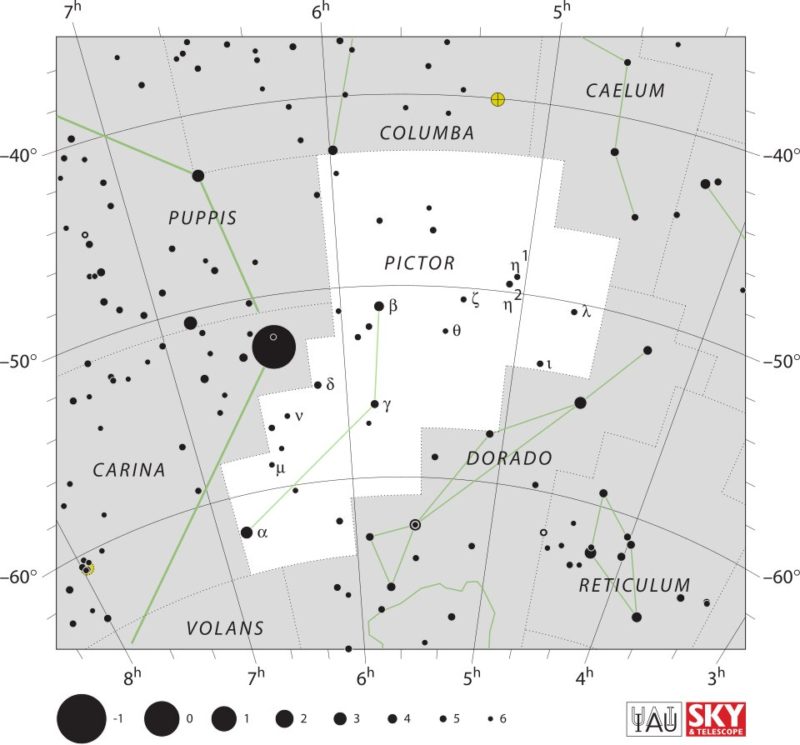
Pictor is a faint southern constellation best known not for a striking pattern of stars, but for the remarkable planetary system around Beta Pictoris. It lies below Canopus and is difficult to pick out from a bright city, yet it has become a serious research target: its young star, dusty debris disk, directly imaged planets, and the distant radio galaxy Pictor A give astronomers plenty to investigate.
Where Is the Pictor Constellation in the Night Sky?
Southern Sky
Pictor sits in the southern celestial hemisphere, below the bright star Canopus in Carina. It’s a small constellation, and its faint stars don’t form an obvious figure. For observers in the Southern Hemisphere, it’s a familiar patch of sky; farther north, the constellation stays low or never rises.
Celestial Coordinates
The Pictor constellation spans roughly right ascension 4 hours 32 minutes to 6 hours 52 minutes and declination −43 to −64 degrees. Those coordinates place it well south of the celestial equator. The International Astronomical Union’s constellation guide explains that modern constellations are defined as official regions of the sky, not just the patterns made by their brightest stars.
Neighboring Constellations
Pictor borders Carina, Puppis, Columba, Caelum, Dorado, Reticulum, and Volans. Dorado points the way toward the Large Magellanic Cloud, a nearby satellite galaxy visible from southern latitudes. Canopus is a useful landmark: look south of it, though don’t expect the stars of Pictor to leap out at you.
When Can You See Pictor?
Best Viewing Season
Pictor is best placed for evening viewing from about December through February. In January, it stands reasonably high in the southern sky for observers below the equator. A planisphere or a stargazing app can help, particularly because the constellation’s outline is easy to lose among the surrounding stars.
Visibility by Hemisphere
Pictor is easiest to see in the Southern Hemisphere. It can be spotted from parts of the Northern Hemisphere, too, but only low in the south; observers at high northern latitudes won’t see it at all. The IAU’s navigation lesson offers useful context on how southern constellations have helped people orient themselves under different skies.
Viewing Conditions
Choose a dark location with an unobstructed southern horizon. Binoculars may help you trace the fainter stars, but they won’t turn Pictor into a bold, tidy pattern. The Pictor star map can help distinguish its boundary from neighboring constellations.
How Can You Find and Recognize Pictor?
Faint Star Pattern
Start with Canopus, the second-brightest star in the night sky, then scan below it for a loose, angled line of modest stars. Alpha Pictoris is the constellation’s brightest star, at about magnitude 3.3, but even it looks subdued beside Canopus. Under darker skies, the rest of the pattern emerges gradually.
Brightness and Shape
Pictor has no showpiece asterism. Its stars suggest a narrow, irregular shape rather than a recognizable object, and the painter’s-easel association takes a little imagination. A constellation is a mapped region, so its official boundaries cover far more sky than the few stars that make a visible pattern.
Nearby Sky Markers
The Large Magellanic Cloud lies in neighboring Dorado, not in Pictor, but it can serve as a useful southern-sky reference. Pictor itself contains distant galaxies and other telescopic targets, though most are not easy visual objects for casual observers.
What Is the Origin of Pictor’s Name?
Lacaille’s Design
French astronomer Nicolas-Louis de Lacaille introduced Pictor in the 18th century while mapping the southern sky. He named several constellations after scientific instruments and tools, a practical Enlightenment-era choice that set them apart from the mythological figures of many ancient star maps.
The Painter’s Easel
The original Latin name was Equuleus Pictoris, meaning “the painter’s easel” or “painter’s small horse.” The name was later shortened to Pictor. It refers to an artist’s equipment, not a horse-shaped constellation.
No Ancient Myth
Pictor has no ancient Greek legend attached to it. That absence is part of its history: it belongs to the era of telescopic southern-sky mapping, not the inherited mythology of classical constellations. Frankly, the name is less compelling than what astronomers have found there.
Which Stars and Objects Stand Out?
Alpha and Beta Pictoris
Alpha Pictoris, a white star about 97 light-years away, is the constellation’s brightest. Beta Pictoris is slightly dimmer to the eye, but far more famous in astronomy. This young star lies roughly 63 light-years from Earth and is surrounded by a large debris disk of dust and rocky material.
Beta Pictoris’s Planetary System
The disk gives astronomers a close look at the leftovers of planet formation. Observations have revealed planets Beta Pictoris b and c orbiting the star, with Beta Pictoris b among the first exoplanets directly imaged. Early ultraviolet observations helped establish the presence of gas around the star.
Beta Pictoris isn’t a finished miniature solar system; its disk is still changing, and astronomers study it to understand how young planetary systems evolve. That’s a much better reason to explore this faint constellation than the outline of an easel.
Pictor A and Nebulae
Pictor A is a radio galaxy, not a nebula. Its central supermassive black hole launches a vast jet of energetic particles, extending about 800,000 light-years into space. The Chandra X-ray Observatory’s observations show the jet in X-rays, revealing an energetic structure far beyond anything visible to the naked eye. Pictor also contains distant galaxy clusters, including the background cluster SPT0615. There is no famous bright nebula here comparable to Orion; the region’s rewards are mostly astrophysical.
Why Do Astronomers Study Pictor?
The constellation’s importance comes from its contents, not its appearance. Beta Pictoris lets researchers examine debris disks and young planets, while Pictor A offers a view of a powerful black-hole-driven jet. These targets connect planetary science with high-energy astronomy, all inside one modest patch of southern sky.
FAQ
Is Pictor visible from the United States?
Only from the far southern part of the country, and then low on the southern horizon. The farther north you are, the less of the constellation rises above the horizon.
What is the brightest star in Pictor?
Alpha Pictoris is the brightest, with an apparent magnitude of about 3.3. Beta Pictoris draws more scientific attention because of its debris disk and planets.
Does Pictor contain a nebula?
It has no prominent, bright nebula known as a casual observing target. Its best-known objects are the Beta Pictoris planetary system and the radio galaxy Pictor A.
Conclusion
Pictor constellation won’t compete with Orion for visual drama, and that’s fine. Its faint stars mark a useful place to look deeper: at worlds still forming around Beta Pictoris, and at a galaxy launching a colossal jet across space. The constellation is a quiet one. The science is not.
Would you like to receive similar articles by email?

Paul Tomaszewski
Paul Tomaszewski is a science & tech writer as well as a programmer and entrepreneur. He is the founder and editor-in-chief of CosmoBC. He has a degree in computer science from John Abbott College, a bachelor's degree in technology from the Memorial University of Newfoundland, and completed some business and economics classes at Concordia University in Montreal. While in college he was the vice-president of the Astronomy Club. In his spare time he is an amateur astronomer and enjoys reading or watching science-fiction. You can follow him on LinkedIn and Twitter.

You May Also Like
How Is a Fireball (Or Bolide) Different From a Meteor?

Discovering the Wonders of Asteroid 3 Juno