Phoenix Constellation Guide
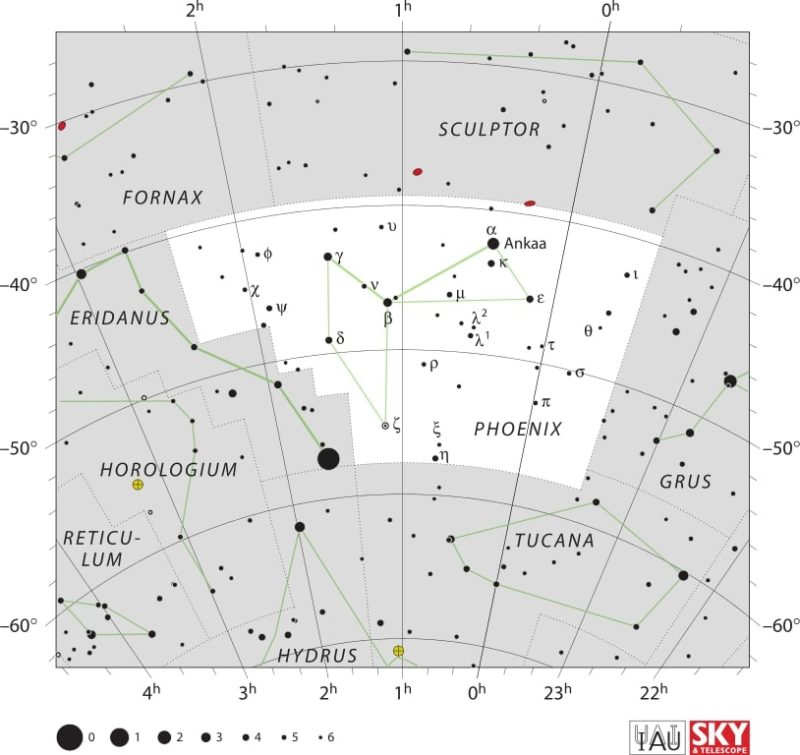
Phoenix is a faint southern constellation, best seen from the Southern Hemisphere during spring, with November bringing it high in the evening sky. Its brightest star, Ankaa, is easy enough to find under dark skies, but the constellation itself is no blazing firebird. The more compelling reason to explore Phoenix lies beyond its modest naked-eye pattern: its galaxies include the remarkable Phoenix Cluster, where stars are forming at a rate that challenges familiar ideas about how galaxy clusters evolve.
Where Is Phoenix in the Night Sky?
Southern celestial hemisphere
Phoenix sits south of the celestial equator, among the constellations of the southern sky. It covers about 469 square degrees, making it reasonably broad but not especially prominent. Its shape is drawn from a handful of stars, and Ankaa is the only one brighter than magnitude 2.5.
Nearby constellations
Phoenix borders Sculptor, Fornax, Grus, Tucana, and Eridanus. The exact boundaries are set by the International Astronomical Union (IAU), whose constellation map divides the entire sky into 88 official regions. A star chart helps here; Phoenix’s brighter stars don’t form a bold, instantly recognizable outline.
Best months to view it
Phoenix is best placed for evening viewing around November, when it reaches its highest point in the sky. The season shifts somewhat with location, and a free star-chart app or planisphere can help you find the right patch of sky for your date and latitude. EarthSky’s guide to the southern birds gives useful seasonal context.
Where Can You See Phoenix?
Visibility by latitude
Phoenix is most comfortably observed from the Southern Hemisphere. Observers in temperate southern regions can see the whole constellation rise well above the horizon. From the Northern Hemisphere, it is a low southern target: Phoenix may be visible from some temperate latitudes, but atmospheric haze and buildings can swallow its fainter stars. Your viewing latitude sets the maximum altitude; Ankaa’s declination is about 42 degrees south, so it barely climbs above the horizon from far north.
Dark-sky conditions
A dark site makes a real difference. Phoenix’s sparse pattern is easy to lose in city glow, and the low altitude for northern observers adds more atmosphere to look through. Give your eyes 20 minutes or so to adjust, then begin with Ankaa and work outward. Universe Today’s Phoenix overview offers a useful orientation to its position and seasonal visibility.
Naked-eye limits
The constellation is a modest naked-eye sight, not a sky show. Ankaa, also known as Alpha Phoenicis, shines at about magnitude 2.4; Beta and Gamma Phoenicis are fainter, around the third magnitude. Under light-polluted skies, those lesser stars may disappear, leaving Ankaa as the obvious marker. That’s the honest bargain: Phoenix rewards patient locating more than casual glancing.
Which Stars Define Phoenix?
Ankaa
Ankaa means “the phoenix” in Arabic, though the name’s later association with the constellation shouldn’t be mistaken for proof that ancient observers saw this exact star pattern as the mythical bird. The star is an orange giant, roughly 80 light-years away, and serves as the constellation’s anchor.
Beta and Gamma Phoenicis
Beta and Gamma Phoenicis help sketch the uneven lines of the figure. They are fainter than Ankaa, and their apparent brightness can vary slightly with observing conditions. Phoenix has no compact, famous asterism to rival the Summer Triangle or Southern Cross; a chart is more useful than a heroic imagination.
HE 0107−5240
This extremely metal-poor star, also cataloged as HE 0107−5240, preserves clues about the early universe. “Metal” in astronomy means elements heavier than hydrogen and helium, not merely iron. Its unusual chemical composition offers researchers a way to study the first generations of stars, whose short lives seeded later galaxies with heavier elements.
What Deep-Sky Objects Are in Phoenix?
Phoenix Cluster
The Phoenix Cluster is the constellation’s standout scientific object, though it is a distant galaxy cluster, not a nebula or something visible through backyard binoculars. Its central galaxy is forming stars at an extraordinary rate, while a supermassive black hole pumps energy into surrounding gas. That feedback should help suppress star formation, yet the system is still producing stars vigorously. NASA’s Hubble overview describes the observations, and Chandra’s X-ray imagery reveals cavities shaped by energetic jets.
Robert’s Quartet
Robert’s Quartet is a compact group of four interacting galaxies: NGC 87, NGC 88, NGC 89, and NGC 92. Their gravitational encounters distort gas and structure, making the group a rewarding target for larger telescopes and long-exposure astrophotography. The “quartet” is a deep-sky prize, not a naked-eye feature.
Other galaxies
Phoenix also contains the Phoenix Dwarf Galaxy, a nearby dwarf system whose gas and star-forming regions make it an intriguing object in its own right. The European Southern Observatory’s image and notes show why this faint galaxy draws professional attention. There are galaxies to discover here, but observers are right to call Phoenix a sparse field compared with richer regions near the Milky Way.
How Did Phoenix Become a Constellation?
Keyser and de Houtman
Dutch navigators Pieter Dirkszoon Keyser and Frederick de Houtman mapped many southern stars during late-16th-century voyages. Phoenix was among the new constellations that emerged from this era of European southern-sky charting. Historian Ian Ridpath’s account of Phoenix’s origins separates the old myth from the newer star-map designation.
Bayer’s star atlas
Johann Bayer included Phoenix in Uranometria, his 1603 star atlas, helping establish it in European celestial charts. Its formal status today comes from the IAU’s modern boundary system, not from an ancient tradition assigning these particular stars to a firebird.
Earlier Arabic star patterns
Earlier Arabic traditions described stars in this region differently, including as a boat or as ostriches. The phoenix myth itself is ancient, with versions in Egyptian and Greek traditions, but attaching it to these specific southern stars was a later act of celestial cartography.
What Does Phoenix’s Mythology Have to Do With Its Stars?
The connection is mostly a name and an image. The legendary bird that dies and rises again has long carried ideas of renewal, but Phoenix’s stellar pattern was mapped centuries later, and other cultures saw different figures in the same region. The mythology adds a memorable label; it doesn’t make the constellation a particularly bright or dramatic sight.
FAQ
Is Phoenix visible from the Northern Hemisphere?
Parts of Phoenix can be seen from some southern locations in the Northern Hemisphere, but it stays low. Observers farther north may find the view poor or impossible.
Is the Phoenix Cluster inside the Milky Way?
No. It is a distant galaxy cluster far beyond the Milky Way. Its name refers to the constellation region where it appears in our sky.
Is there a Phoenix Nebula?
There is no prominent object commonly known as the Phoenix Nebula. The Phoenix Cluster, Phoenix Dwarf Galaxy, and constellation are distinct concepts.
Conclusion
Phoenix is an offbeat constellation: useful to learn, modest to look at, and far more interesting once you move from its stars to its galaxies. If you’re in the south, find Ankaa on a clear November evening, then explore the cluster’s unexpected science. The firebird is old; its place among these stars is not.
Would you like to receive similar articles by email?

Paul Tomaszewski
Paul Tomaszewski is a science & tech writer as well as a programmer and entrepreneur. He is the founder and editor-in-chief of CosmoBC. He has a degree in computer science from John Abbott College, a bachelor's degree in technology from the Memorial University of Newfoundland, and completed some business and economics classes at Concordia University in Montreal. While in college he was the vice-president of the Astronomy Club. In his spare time he is an amateur astronomer and enjoys reading or watching science-fiction. You can follow him on LinkedIn and Twitter.

You May Also Like
How Did the Planets Get Their Names

Things To Consider for Landscaping That Fits the Climate