Perseus Constellation Guide
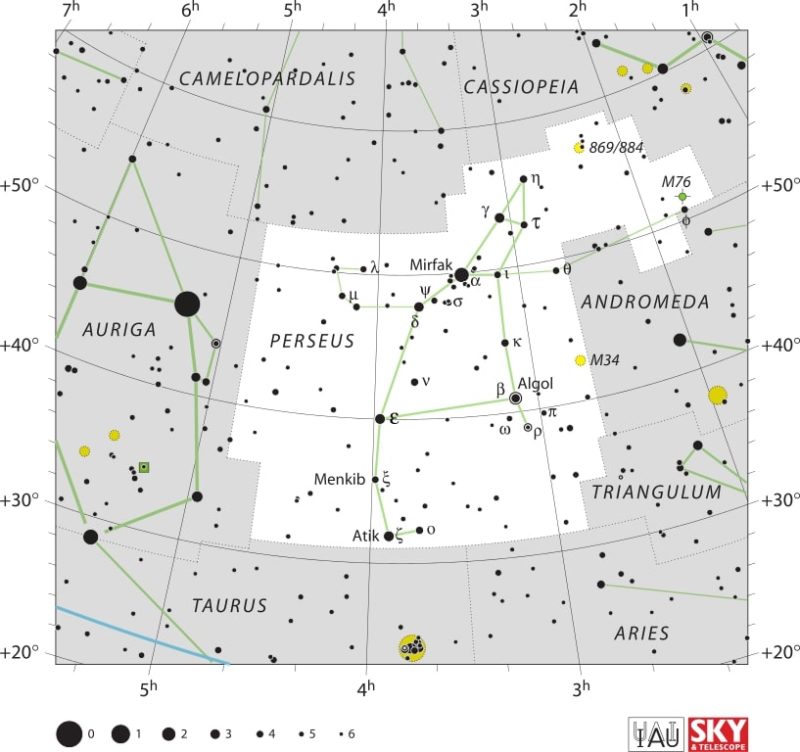
Perseus is a northern-sky constellation best known for the eclipsing star Algol, the Double Cluster, and its place in the Perseid meteor shower. It’s easiest to spot on autumn and winter evenings in the Northern Hemisphere, especially by using the familiar W shape of Cassiopeia as a guide. The ancient hero gives the star pattern a memorable story, but the view through binoculars is the real reward.
Where Is Perseus in the Night Sky?
Northern celestial hemisphere
Perseus sits in the northern celestial hemisphere. Its stars spread roughly from right ascension 1 to 4 hours and declination +31 to +59 degrees. Its position makes it accessible to observers across much of the Northern Hemisphere. However, it appears lower in the sky for viewers at more southerly latitudes.
Neighboring constellations
Perseus lies between Cassiopeia and Auriga. Andromeda, Triangulum, Aries, Taurus, and Camelopardalis are nearby. In the sky’s mythological neighborhood, it belongs to the familiar grouping of Perseus, Andromeda, Cassiopeia, Cepheus, and Pegasus. That’s a story-map, though, not a physical arrangement of stars.
No single line pattern
The International Astronomical Union defines Perseus as one of the 88 modern constellations by its official boundaries. The lines used to connect its stars are a matter of convention, and diagrams don’t all draw them the same way. I find it more useful to recognize the broad patch of sky. Instead of a perfect stick figure, amateurs often treat the area as a rewarding wide-field target. For example, see this observer’s account of Perseus.
When Is Perseus Visible?
Best viewing months
Perseus is prominent on evening skies from autumn into winter, with November a particularly good time to look. It rises earlier as the season advances, then becomes harder to see in the evening during spring. The exact timing shifts with latitude and local horizon.
Seasonal visibility
In the Northern Hemisphere, the constellation climbs high on autumn and winter nights. Cassiopeia stays nearby and circles close to the north celestial pole, making it a useful reference as the sky turns. In summer, Perseus is still present in the daytime sky, but its stars are washed out by sunlight.
Dark-sky conditions
You can pick out the brighter stars from a city, but dark skies reveal more of the Milky Way that runs through Perseus. Give your eyes about 20 minutes to adjust, and avoid checking a bright phone screen. A star chart or astronomy app can help, though a planisphere works nicely when you’d rather not bring another screen outside.
How Do You Find Perseus?
Start with Cassiopeia
Find Cassiopeia’s five bright stars, which form a W or a crooked M depending on the season and their position overhead. From there, look toward the broad arc of stars in Perseus. A sky guide to Perseus and Cassiopeia can help confirm the pattern.
Locate the star Mirfak
Mirfak, also called Alpha Persei, is the constellation’s brightest star. It has an apparent magnitude near 1.8, so it’s visible to the unaided eye under ordinary conditions. Once you’ve found it, look nearby for the loose gathering of stars known as the Alpha Persei Cluster.
Use a star chart
A chart makes it easier to distinguish Perseus from neighboring patterns, especially when light pollution erases fainter stars. Start with Mirfak and Algol, then use the surrounding stars to fill in the wider shape. Don’t worry if your chart’s connecting lines differ from another one; the boundaries matter astronomically, while the stick figure is just a guide.
Which Stars Stand Out in Perseus?
Algol’s eclipsing cycle
Algol, or Beta Persei, is a variable star whose apparent brightness drops noticeably every 2 days, 20 hours, and 49 minutes. That dimming happens because a cooler star passes in front of a hotter, brighter companion from our viewpoint. The system has a third star as well. This guide to Algol’s changing brightness explains why it earned the nickname “Demon Star” in Arabic-influenced star lore.
Mirfak and its star group
Mirfak is a yellow-white supergiant, and the nearby Alpha Persei Cluster gives the region a particularly rich look in binoculars. Several stars appear gathered around it, though they occupy a wide area rather than a tight ball. The apparent grouping is a fine example of how a constellation can offer both a recognizable landmark and a deeper observing target.
What Can You Observe in Perseus?
The Double Cluster
The Double Cluster, NGC 869 and NGC 884, consists of two open clusters visible close together in Perseus. Under dark skies, they can appear as a hazy patch to the naked eye. Binoculars resolve the haze into a spray of stars. They lie about 7,500 light-years from Earth, and each contains hot, young stars. It’s one of the sky’s most satisfying targets for a wide field of view.
Little Dumbbell Nebula
M76, also called the Little Dumbbell Nebula, is a planetary nebula. It is a glowing shell of gas cast off by a dying star. Its small size and faintness make it a tougher target than the Double Cluster. Usually it calls for a telescope and a dark sky. The name can mislead newcomers; it’s not the brighter Dumbbell Nebula in Vulpecula.
NGC 1333 and NGC 1260
NGC 1333 is a star-forming region wrapped in dust, a complex target photographed in far greater detail by large observatories than most backyard telescopes can manage. Meanwhile, NGC 1260 is a galaxy, famous as the host of the unusually bright supernova SN 2006gy. Don’t mix either with the Perseus Cluster, a vast cluster of galaxies hundreds of millions of light-years away.
How Is Perseus Linked to the Perseid Meteor Shower?
The Perseids appear to stream from a radiant in Perseus, which is why the annual meteor shower bears the constellation’s name. The meteors themselves can streak across any part of the sky. For the best view, keep your gaze wide rather than staring directly at the radiant. The shower occurs when Earth crosses debris left by comet 109P/Swift-Tuttle, and it peaks in August.
How Have Cultures Interpreted Perseus?
In Greek mythology, Perseus is the hero who beheads Medusa, the Gorgon whose gaze could turn people to stone. The constellation is often shown holding Medusa’s head, with Algol marking the unsettling face. The story also connects Perseus with Andromeda, whom he rescues from a sea monster. Ancient Greek legends gave the stars a narrative shape; other cultures developed their own sky traditions, and not every tradition maps these stars onto the same hero.
What Should You Know Before Observing?
A pair of binoculars is enough to reveal the Double Cluster, while a small telescope brings Algol’s brightness cycle and fainter objects into reach. Check the Moon phase, give your eyes time to adapt, and dress for a long spell outdoors. Standing still gets cold faster than people expect. Perseus is a free, easy-to-return-to target, with plenty to explore as your equipment and experience grow.
Which Objects Are Easy to Confuse?
The Perseus Cluster is a galaxy cluster, not a star cluster. It’s far too distant for its individual galaxies to show as a bright naked-eye feature. The Double Cluster is the visible pair of open clusters in the constellation. And while the Perseids seem to originate in Perseus, the radiant is a perspective effect, not a point in space where meteors begin.
FAQ
What is the Perseus constellation?
Perseus is a northern constellation named after the Greek hero. It is one of Ptolemy’s 48 ancient constellations. At 615 square degrees, it is the 24th largest.
How do you find the Perseus constellation?
Locate Cassiopeia’s W shape. Then draw a line from its center star through Ruchbah (the bottom right of the W) to reach Mirfak, Perseus’s brightest star.
What is the brightest star in Perseus?
Mirfak (Alpha Persei) is the brightest star at magnitude 1.79. It is a yellow-white supergiant 590 light-years away and the anchor of the Alpha Persei Cluster.
What is the myth behind the Perseus constellation?
Perseus slew the Gorgon Medusa, rescued Princess Andromeda from the sea monster Cetus, and married her. The constellation depicts him holding Medusa’s head marked by Algol.
Conclusion
Perseus rewards a relaxed search: locate Cassiopeia, find Mirfak, then linger over Algol and the Double Cluster. The legend is part of the appeal, but the science is just as good. A star that dims on schedule, young suns grouped in the Milky Way, and meteors linked to a comet all share this patch of sky. So, explore it on a clear night, and the old pattern starts to feel newly alive.
Would you like to receive similar articles by email?

Paul Tomaszewski
Paul Tomaszewski is a science & tech writer as well as a programmer and entrepreneur. He is the founder and editor-in-chief of CosmoBC. He has a degree in computer science from John Abbott College, a bachelor's degree in technology from the Memorial University of Newfoundland, and completed some business and economics classes at Concordia University in Montreal. While in college he was the vice-president of the Astronomy Club. In his spare time he is an amateur astronomer and enjoys reading or watching science-fiction. You can follow him on LinkedIn and Twitter.

You May Also Like
What Is LightSail and How Does It Work?
Delphinus Constellation Guide