Pegasus Constellation Guide
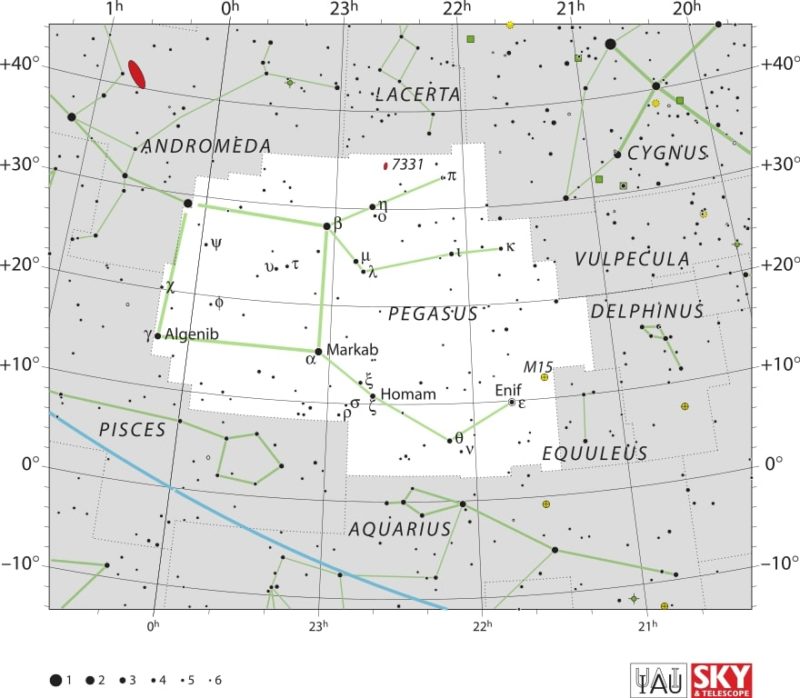
Pegasus is a large northern constellation best known for the Great Square, an easy autumn signpost and a useful route toward Andromeda. The winged horse of Greek mythology also leaves a surprisingly practical mark on astronomy: Pegasus contains the globular cluster Messier 15, the interacting galaxies of Stephan’s Quintet, and 51 Pegasi, the first Sun-like star confirmed to host an exoplanet.
What Is the Pegasus Constellation?
IAU constellation
Pegasus is one of the 88 constellations officially recognized by the International Astronomical Union (IAU). Its boundaries are fixed on the celestial sphere, though the familiar horse-shaped pattern is only a loose arrangement of stars at very different distances from Earth. The IAU’s constellation reference gives the standard name, abbreviation Peg, and genitive form Pegasi.
Great Square
The Great Square is Pegasus’s unmistakable calling card: four stars forming a broad, nearly square shape. Three belong to Pegasus: Markab, Scheat, and Algenib. The fourth, Alpheratz, officially belongs to Andromeda, a small wrinkle that rarely troubles anyone trying to find the pattern.
Seasonal visibility
For observers in the Northern Hemisphere, Pegasus is most prominent on autumn evenings. It can be seen from many locations in the Southern Hemisphere too, though it appears lower in the sky. A planisphere or astronomy app can help account for your latitude and the time of night.
What Is Pegasus in Greek Mythology?
Origin story
In Greek mythology, Pegasus was a winged horse born from Medusa’s blood after the hero Perseus killed her. He was the son of Poseidon, god of the sea, and Medusa. Some versions place his birth near Mount Helicon, where a strike from his hoof brought forth a spring.
Bellerophon’s steed
The hero Bellerophon tamed Pegasus with a golden bridle given to him by Athena. Together they faced the Chimera, a fire-breathing monster, and completed other tasks for King Iobates. Later, Bellerophon tried to ride Pegasus to Olympus. Zeus sent a gadfly to unsettle the horse; Bellerophon fell, while Pegasus continued upward and entered the service of Zeus, carrying the god’s thunderbolts.
Constellation symbolism
The constellation preserves the winged horse’s image, but it does not map neatly onto a complete animal. The Great Square suggests the body, while Enif marks the nose at the end of the neck. Myth supplies the story; the stars supply only a partial sketch.
Which Stars Define Pegasus?
Enif is the brightest star in Pegasus, although its name is less familiar than the Square’s. It is an orange supergiant at the horse’s nose. Markab and Scheat anchor two corners of the Great Square; Algenib marks another. Scheat is a red giant whose brightness varies, so its apparent magnitude can shift.
| Star | Role in Pegasus | What to know |
|---|---|---|
| Enif (Epsilon Pegasi) | Nose | Bright orange supergiant; brightest star in the constellation |
| Markab (Alpha Pegasi) | Square corner | Blue-white star near the horse’s shoulder |
| Scheat (Beta Pegasi) | Square corner | Variable red giant |
| Algenib (Gamma Pegasi) | Square corner | Blue-white star |
Then there is 51 Pegasi, a fainter star outside the main Square. In 1995, astronomers announced a planet orbiting it: 51 Pegasi b, the first exoplanet found around a Sun-like star. The discovery reshaped the search for planets beyond our solar system; NASA’s exoplanet catalog tracks the system.
How Do You Find Pegasus in the Night Sky?
Look high in the east on autumn evenings and search for the Great Square, which is large enough to stand out even when the surrounding star patterns feel unfamiliar. Its western side points toward the wider sweep of Andromeda; follow that region to find the Andromeda Galaxy under dark skies. The Big Dipper can help with general orientation, but it sits far from Pegasus, so it is not the quickest route.
The Square can also act as a rough gauge of sky darkness. If several faint stars are visible inside it, conditions are likely better than they are in a bright city center. Light pollution changes the view dramatically.
Which Deep-Sky Objects Are Worth Observing?
Messier 15, usually called M15, is the most rewarding target for many small-telescope observers. This dense globular cluster lies roughly 35,000 light-years away and is about 12 billion years old, according to Hubble’s M15 overview. Binoculars may reveal it as a small hazy patch; a telescope begins to resolve the cluster’s crowded outer stars.
NGC 7331, a spiral galaxy, is another worthwhile target under a dark sky, though it generally appears as a faint smudge rather than a dramatic whirlpool. More demanding still is Stephan’s Quintet, a compact group of galaxies famous for gravitational encounters and shock waves in hot gas.
Pegasus also contains galaxy clusters, including the distant Pegasus I cluster. These are scientifically rich but not easy visual targets: many galaxies in the region are faint, often beyond what a small telescope can show clearly. The NASA Pegasus image archive gives a wider sense of how much lies beyond the familiar star pattern.
What Can You See Through a Small Telescope?
Pegasus is a little overrated as a telescope constellation. The Great Square is a superb wayfinder, but many of its deep-sky objects are faint, and a modest instrument can leave you searching a dark field for a barely perceptible blur. M15 is the exception worth planning around. Under good conditions, it gives small scopes a clear, satisfying target.
Why Is Pegasus Important to Astronomy?
The science is more compelling than the backyard spectacle. 51 Pegasi b helped establish that planets orbiting other Sun-like stars were real objects of study, not speculation. Stephan’s Quintet, meanwhile, lets researchers examine how galaxies interact and how collisions heat gas between them. Pegasus offers a useful reminder that the night sky is both a visual landscape and a laboratory for innovation in astronomy and technology.
What Should You Know Before Observing?
Choose a moonless night, give your eyes time to adjust, and begin with the naked-eye Square before moving to binoculars or a telescope. A free star chart or app can help identify Enif and M15, but a printed chart works perfectly well too. Explore the region patiently; its best insights often arrive after the obvious pattern has stopped doing all the work.
FAQ
Is Pegasus a real creature?
No, Pegasus is a mythological winged horse from Greek mythology, later placed among the stars as a constellation.
What is the Great Square of Pegasus?
An asterism formed by Markab, Scheat, Algenib in Pegasus and Alpheratz in Andromeda, marking the horse’s body.
When is the best time to see the Pegasus constellation?
Best visible in October at 9 p.m. local time from latitudes between +90° and -60°.
What is the brightest star in Pegasus?
Enif (Epsilon Pegasi), an orange supergiant at magnitude 2.38 marking the horse’s muzzle.
What is 51 Pegasi famous for?
First Sun-like star discovered to host an exoplanet (51 Pegasi b, a hot Jupiter) in 1995.
Conclusion
Pegasus is easy to recognize, rich in myth, and more consequential to science than its modest telescope views suggest. Find the Square, use it to navigate, and save your observing time for M15. The rest of the constellation rewards curiosity more than spectacle.
Would you like to receive similar articles by email?

Paul Tomaszewski
Paul Tomaszewski is a science & tech writer as well as a programmer and entrepreneur. He is the founder and editor-in-chief of CosmoBC. He has a degree in computer science from John Abbott College, a bachelor's degree in technology from the Memorial University of Newfoundland, and completed some business and economics classes at Concordia University in Montreal. While in college he was the vice-president of the Astronomy Club. In his spare time he is an amateur astronomer and enjoys reading or watching science-fiction. You can follow him on LinkedIn and Twitter.


You May Also Like
Space Elevator (Non-Rocket Spacelaunch)

Choosing the Right Material for Medical Device Enclosures