Pavo Constellation Guide
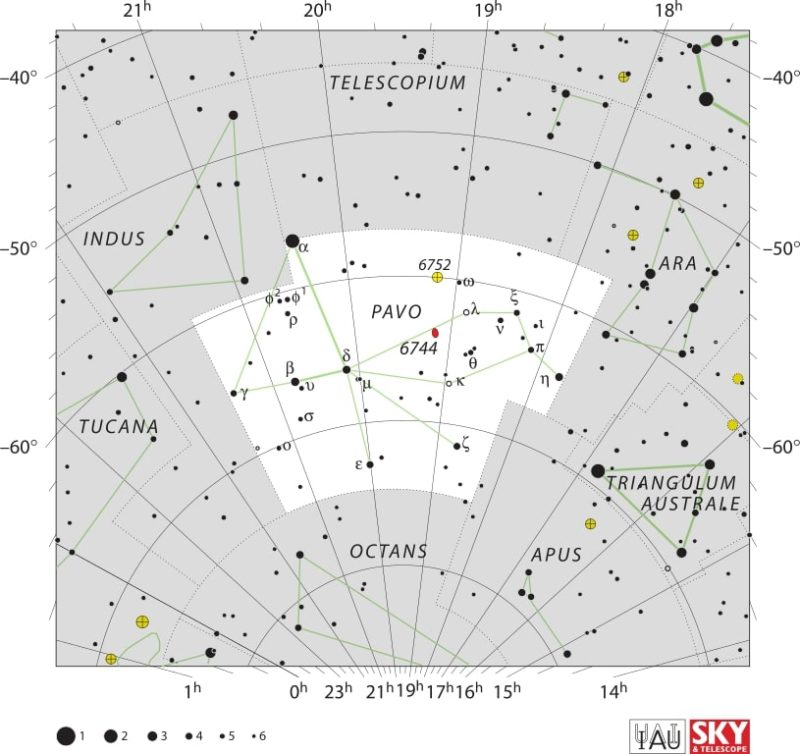
Pavo is a southern constellation named for the peacock, best known for its globular cluster NGC 6752 and the distant spiral galaxy NGC 6744. Its main star, Alpha Pavonis, is easy to spot from much of the Southern Hemisphere, but the rest of the bird’s outline can be tricky to trace. That’s the useful distinction: Pavo is more rewarding as a deep-sky address than as a crisp star picture.
Where Is Pavo in the Sky?
Pavo lies in the southern celestial hemisphere, near Indus, Telescopium, Ara, Apus, and Octans. The International Astronomical Union (IAU) assigns the constellation an area of 378 square degrees, making it the 44th largest of the 88 modern constellations. Those official constellation boundaries describe mapped regions of the sky, not the apparent shape of the stars.
The constellation’s modern history begins with late-16th-century observations by Dutch navigators Pieter Dirkszoon Keyser and Frederick de Houtman. Their southern star measurements helped cartographer Petrus Plancius place Pavo on a celestial globe in 1598. It belongs to a group sometimes called the “Southern Birds,” alongside Phoenix, Grus, and Tucana. Unlike many familiar constellations, Pavo has no ancient Greek origin.
Later storytellers connected the peacock to Hera, the Greek goddess associated with the bird. In that version, the eyes on the peacock’s tail recall Argus Panoptes, the hundred-eyed giant who served as a watchman. It’s a later mythological association, not the source of the constellation’s original name or design.
When and Where Can You See It?
Pavo is most easily observed from the Southern Hemisphere, where it climbs high enough for a comfortable view during the southern winter and early spring. It is visible at least in part from latitudes south of about 15 degrees north; from far northern locations, it never rises above the horizon. The best viewing period is generally July through September, though the exact hours depend on location.
Choose a dark site if you can. Alpha Pavonis stands out, but the constellation’s fainter stars can disappear under city glow. Binoculars help with star fields and clusters; a telescope reveals more detail in deep-sky objects.
How Can You Find Its Faint Star Pattern?
Start with Alpha Pavonis, also called Peacock, then look for a loose arrangement of stars extending around it. In Australia, some observers call the pattern the “Saucepan,” a practical nickname for a shape that may not immediately resemble a bird. Dark skies make a real difference: outside its brightest star, much of the pattern is magnitude 3.6 or fainter.
A simple way to begin:
- Find Peacock low in the southern sky during the appropriate season.
- Use a star map or astronomy app to identify the nearby stars and neighboring constellations.
- Once the outline is familiar, aim binoculars or a telescope toward NGC 6752.
There’s no shame in using an app. A constellation is a patch of sky as much as a drawing, and Pavo’s pattern is easier to learn with a map beside you.
Which Stars Define the Constellation?
Alpha Pavonis, the brightest star in Pavo, shines at an apparent magnitude of about 1.94. It is a spectroscopic binary, meaning its companion is detected through changes in the combined light rather than easily separated as a second point of light. Its name, Peacock, is a relatively modern one. The star’s measured properties make it the most reliable naked-eye marker in the constellation.
Beta Pavonis is fainter, at roughly magnitude 3.4, while Delta Pavonis is notable for a different reason: it is a Sun-like star about 20 light-years away. Delta Pavonis is a subgiant, a star beginning to evolve beyond its main-sequence stage, and astronomers have studied it as a nearby example of a star with properties similar to the Sun. It has no confirmed planet in the linked catalog, so “Sun-like” should not be mistaken for “known to host an Earth twin.”
What Deep-Sky Objects Make It Worth Exploring?
NGC 6752 is the standout. This globular cluster, a dense, roughly spherical gathering of ancient stars, is among the brightest in the night sky and can be glimpsed without optical aid under dark conditions. Binoculars show a compact glow; a small telescope begins to resolve its crowded edges into individual stars. The Chandra archive also documents X-ray sources in the cluster, including systems involving neutron stars.
Behind NGC 6752, Hubble images revealed Bedin 1, an exceptionally isolated dwarf galaxy estimated to be about 13 billion years old. The discovery is a reminder that a familiar fuzzy patch can conceal more than one object at very different distances. ESA/Hubble’s account of Bedin 1 explains how it turned up in the background of the globular cluster.
NGC 6744, a grand-design spiral galaxy roughly 30 million light-years away, is often compared with the Milky Way because of its broad spiral structure. That comparison is useful, though no galaxy is a perfect twin. Hubble’s image and profile of NGC 6744 offer a striking look at its sprawling arms. Pavo also contains NGC 6872, a particularly large barred spiral galaxy, and the dwarf irregular galaxy IC 4710.
Which Planetary Systems Lie Within Its Boundaries?
Several stars within Pavo’s official boundaries have known exoplanets. HD 181433, for example, hosts multiple planets, including a super-Earth; the system’s planetary record is a good reminder that a constellation is a map region, not a single physical neighborhood. Its stars can be hundreds or thousands of light-years apart.
FAQ
Is Pavo visible from the Northern Hemisphere?
Only from its lower latitudes. Observers near the equator may see it low in the southern sky, while places farther north cannot see the constellation.
What is the best object to observe in Pavo?
NGC 6752 is the easiest deep-sky highlight to recommend. Binoculars show its glow, and a telescope can resolve its dense star field.
Does Pavo come from Greek mythology?
No. The constellation was charted in the late 16th century from southern observations. Its later association with Hera and Argus is a mythological interpretation added after its creation.
Conclusion
Pavo’s outline may take patience, especially under light-polluted skies, but its celestial neighborhood pays off. Find Peacock first, then use the constellation as a guide to NGC 6752, NGC 6744, and the galaxies tucked farther into the field. The peacock is a modest drawing. The view behind it is the reason to stay.
Would you like to receive similar articles by email?

Paul Tomaszewski
Paul Tomaszewski is a science & tech writer as well as a programmer and entrepreneur. He is the founder and editor-in-chief of CosmoBC. He has a degree in computer science from John Abbott College, a bachelor's degree in technology from the Memorial University of Newfoundland, and completed some business and economics classes at Concordia University in Montreal. While in college he was the vice-president of the Astronomy Club. In his spare time he is an amateur astronomer and enjoys reading or watching science-fiction. You can follow him on LinkedIn and Twitter.

You May Also Like
Gamma Ursae Minorid Meteor Shower Guide
What Is the Hubble Volume?