Parallel Universes: Could We Be Living in an Alternate Reality?
With recent decades our understanding of science and the universe has expanded exponentially giving us a completely new outlook and opening up a highly debated yet intriguing concept: do parallel universes exist? Could we actually be living in an alternate reality without realizing it?
People might say that the idea is purely philosophical and lacks solid evidence, but as science and our understanding of the universe are advancing we have started taking this idea critically. While there is no confirmed proof, some physicists consider certain multiverse theories plausible. Many popular frameworks such as quantum mechanics and cosmic inflation have led some scientists to explore the possibility that our universe is not alone!
What Is the Universe Made up Of?
Before understanding and exploring the concept of parallel universes let’s first understand how everything we know of came into existence.
About 13.8 billion years ago, the universe began expanding from an extremely hot and dense state in an event known as the Big Bang. Importantly, this was not an explosion in space, but an expansion of space itself. The universe is entirely crafted out of atoms linked together, forming matter and anyone with basic knowledge of atoms would be aware of the fact that atoms are further made out of three subatomic particles which are:
- Protons (positive charge)
- Neutrons (no charge)
- Electrons (negative charge)
Structure: Protons and neutrons form the center of the atom (nucleus) with electrons existing in probability clouds called orbitals around the nucleus, as explained by quantum mechanics.
These atomic structures give rise to the diverse properties observed in different forms of matter.
What Is a Parallel Universe?
A parallel universe is known by multiple terms such as alternate universe, alternate reality or a parallel dimension though their meanings can vary slightly depending on context. Broadly, it refers to a hypothetical universe separate from our own. It simply says that there are multiple universes out there where life and “astronomical objects” exist—raising the possibility that we could be living in an alternate reality right now.
Theories Backing the Claim
There are multiple theories out there suggesting why parallel universes exist but we, here at CosmoBC, aim to provide our readers the best and finest information so we have filtered some of the most convincing ideas for our readers to have the finest understanding of this topic.
The Antimatter Theory
We all are taught at schools and universities that electrons and protons have negative and positive charge, respectively but in 1955 two scientists named Emilio Segrè and Owen Chamberlain discovered something called antimatter which is matter but made out of positrons (positively charged electrons) and antiprotons (negatively charged protons).
Since the discovery of antimatter, we have been able to make antimatter in the laboratories and study their properties. Antimatter behaves similarly to matter, but when the two meet, they annihilate and convert into energy.
When the universe formed, scientists believe it should have produced equal amounts of matter and antimatter. However, today the observable universe is dominated by matter. This unresolved issue is known as the matter–antimatter asymmetry problem.
One hypothesis, though speculative, suggests that antimatter may have formed its own universe. What if after the big bang, a force, similar to repulsion, would have prevented matter and antimatter colliding leading to the antimatter forming a completely different and its own universe where humans just like us would be questioning the existence of matter. Where humans just like us would be studying the same physics class but a different chemistry one!
Entangled Spaces
The second compelling argument for why multiverses exist is given by science’s most successful branch, quantum physics. Quantum entanglement is a phenomenon in which two or more particles share linked quantum states. When particles are entangled, actions performed on one can affect the other, even across vast distances. However, it is important to note that entanglement itself does not prove the existence of parallel universes.
Consider the famous thought experiment Schrödinger’s cat, where a cat in a box may be considered both alive and dead until observed. This illustrates quantum superposition. This does not mean we literally observe both outcomes, but rather that quantum systems can exist in multiple possible states until measured.
The idea that all outcomes actually occur in separate realities comes from the Many-Worlds Interpretation, proposed by Hugh Everett III. According to this interpretation, every possible outcome of a quantum event may occur in its own separate universe. However, this remains unproven and highly debated.
Bubble Universes
Quantum mechanics states, there is no such thing as empty space. Even the most perfect vacuum is actually filled by particles and antiparticles, which flare into existence and almost instantaneously fade back into nothingness. The reason why we can’t observe them is that they don’t last enough to be perceived, but we know they do exist because of their effects.
When quantum theory is applied to space itself, some models suggest space-time may fluctuate at extremely small scales. These fluctuations could, in theory, give rise to entire regions of space.
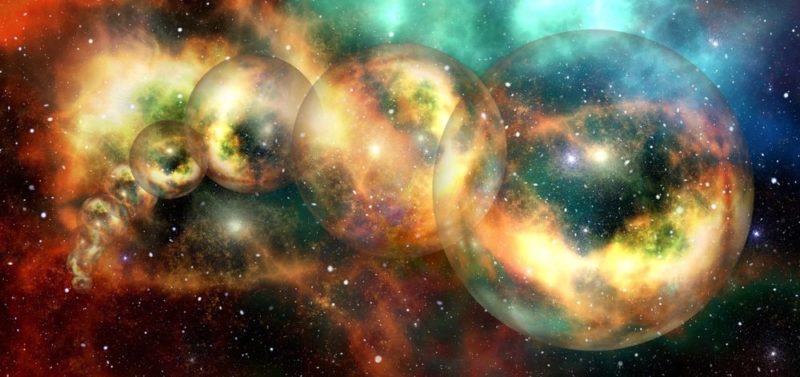
This idea is rooted in inflationary cosmology, particularly the concept of eternal inflation proposed by Alan Guth. It suggests our universe may be one of many expanding “bubbles” in a larger multiverse. While mathematically plausible, this idea has not been directly observed or confirmed.
Other Multiverse Ideas
Another major framework comes from string theory, which suggests the existence of additional dimensions and potentially many different possible universes with varying physical laws. Like other multiverse ideas, this remains theoretical and unconfirmed.
Why We Haven’t Observed Parallel Universes
Despite these theories, there is currently no direct evidence for parallel universes. This is largely because:
- We are limited by the observable universe—light from beyond a certain distance has not had time to reach us.
- Other universes, if they exist, may not interact with ours in detectable ways.
- Many multiverse theories are difficult or impossible to test experimentally.
How Parallel Universes Solve Many Problems
If proven, parallel universes could significantly change our understanding of life—especially if we are already living in an alternate reality—and can provide answers to century-old problems and questions.
The Paradoxes of Time
Time travel leads to multiple time travel paradoxes such as the “grandfather paradox” which says that if a person travels to a time before their grandfather had children and kills him making their own birth impossible. So how was he able to move back in time in the first place? If the theory of entangled spaces held true then they can resolve this mind melting problem by just reasoning that when you go back in time to kill your grandfather, you’re not going back to your own history, but a copy of your history, and everything you do in this version of your history will affect the alternate future of that universe, not your own. It is the universe where your grandfather was dead, and it would not affect the timeline you are living in.
The Ultimate Question of Existence
The ultimate question of existence which is why is there anything instead of nothing can be resolved by the “bubble universes” theory stating that space and time popped out of nothingness creating bubbles of universes which we inhabit. This is one of many philosophical and scientific approaches, not a definitive answer.
Books and Movies on Parallel Universe
If the concept of living in an alternate reality fascinates you, books and films can offer powerful visualizations of what that might look like. For some people, the best way to understand something in depth could be through books and movies so we have compiled a list of parallel universe books and movies which you can read and watch to get to the root of this topic and picture it.
Parallel Universe Movies
- Spider-Man: Into the Spider-Verse IMDB 8.4
- Another Earth IMDB 7.0
- Sliding doors IMDB 6.7
- MR. Nobody IMDB 7.8
Parallel Universe Books
- Parallel Worlds by Michio Kaku.
- The Hidden Reality by Brian Greene
- Parallel Universes: The Search for Other Worlds by Fred Alan Wolf
- The Fabric of Reality by David Deutsch
- A Darker Shade of Magic by V. E. Schwab
Conclusion
Many find the idea of living in an alternate reality fascinating. As science advances, researchers continue to explore whether such realities could exist. Some theoretical frameworks, such as string theory and inflationary cosmology, allow for the possibility of multiple universes. However, no experimental evidence currently confirms their existence.
Even though we are far from definitive proof, the concept continues to push the boundaries of physics and philosophy. Whether or not parallel universes exist, exploring the idea helps deepen our understanding of the universe we inhabit.
FAQ
Is there proof of parallel universes?
No, there is currently no direct experimental evidence of parallel universes.
Do scientists believe in parallel universes?
Some scientists consider certain models of parallel universes plausible, but it is not a confirmed theory.
Can we travel to another universe?
There is no known scientific method to travel to another universe.
Would you like to receive similar articles by email?

Yahya Ashraf
Yahya Ashraf is just a normal person trying to understand the complexities of the cosmos and show the world how outlandish the universe is. He has his own blog BeforeTheBang where he write about strange and intriguing theories of physics.


You May Also Like
How Did Jupiter’s Moon Callisto Get Its Name
Exciting Future Uses of Textiles in Space