How to Run A Memory Test
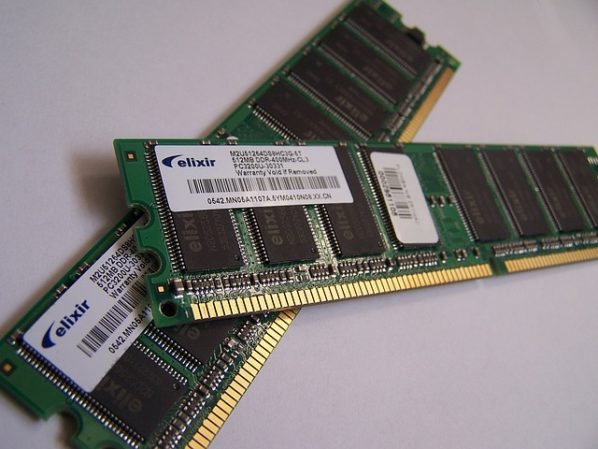
There are a number of sites on the web which were created to assist computer users in running memory tests and debugging memory problems with their personal computers. They will help you to automatically complete these tests, but if you must do them manually, here are some tips.
Monthly Stargazing Calendar for June 2012
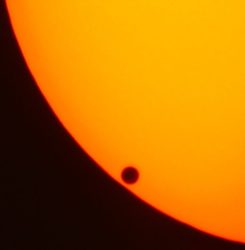
Today on June 5 we will have the chance to witness the transit of Venus across the Sun. This extremely rare event will be entirely visible throughout most of eastern Asia, eastern Australia, and Alaska.
Monthly Stargazing Calendar for May 2012
On May 5, 6 we witnessed the Eta Aquarids Meteor Shower. It is a a light shower, usually producing about 10 meteors per hour at the peak. The full moon ruined the show this year, washing out all but the brightest meteors with its glare.
Earth’s First Trojan Asteroid discovered by NASA’s WISE
NASA's WISE mission discovered asteroid 2010 TK7, an Earth Trojan, in a stable orbit around a Lagrangian point, possibly a future space destination.
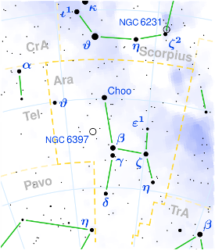
Ara Constellation
Explore the Ara constellation with its mythological roots, notable stars like Beta Arae, a star with planets, and fascinating deep-sky objects.
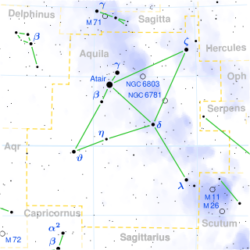
Aquila Constellation
Discover Aquila, the eagle, in Greek mythology. Explore its notable stars like Altair and Alshain, as well as intriguing deep-sky objects.
Aquarius Constellation
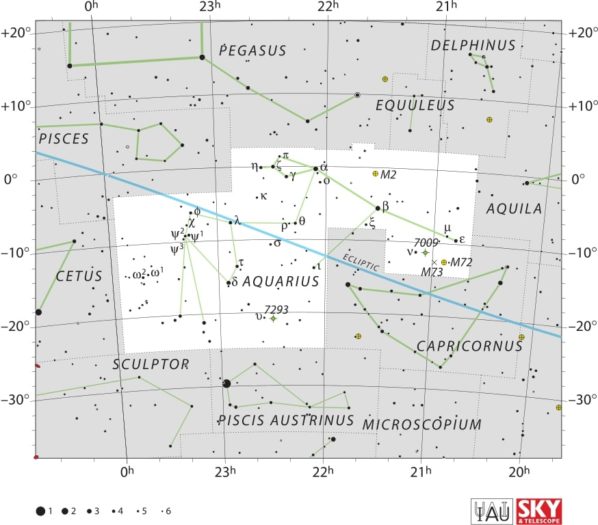
Explore the constellation Aquarius, the water-bearer. Discover its mythology, notable stars like Gliese 876, and captivating deep-sky objects like Messier 2.
Non-Rocket Spacelaunch – Advantages and Difficulties of a Launch Loop
Unlike conventional rockets, launch loops can have many launches per hour, independent of weather, and are not inherently polluting. Rockets create pollution such as nitrates in their exhausts due to high exhaust temperature, and can also create greenhouse gases depending on propellant choices. Launch loops require power in the form of electricity and as such it can be clean.
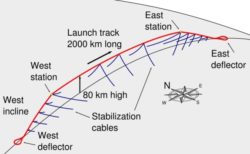
Non-Rocket Spacelaunch – Launch Loop
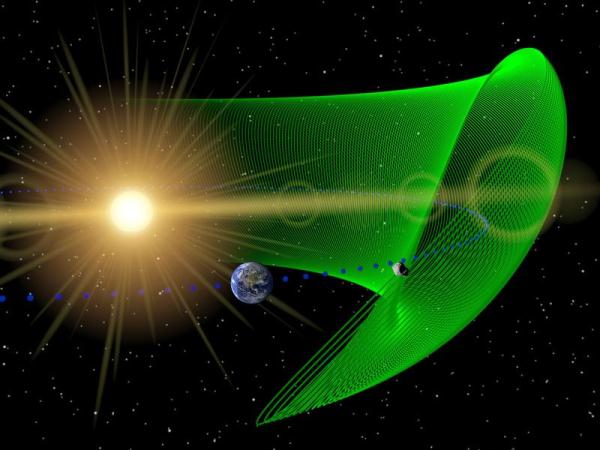
A launch loop (also known as a Lofstrom loop) is a proposed design for a very efficient non-rocket spacelaunch method. It is a much simpler concept than the space elevator, but still more complex than tether propulsion systems such as the rotovator.
Non-Rocket Spacelaunch – Tether propulsion in fiction
This is the fourth and final part of the tether propulsion article of the non-rocket spacelaunch methods article series. This post will focus on references to the tether propulsion concept in fiction. The most prominent science fiction novels on the subject include the following.
Non-Rocket Spacelaunch – Tether propulsion safety issues
The use of tethers in space poses many challenges and safety issues. This third part to the tether propulsion article will focus on those issues. A lot of the challenges and safety issues of a space tether system are similar to those of a space elevator described in a previous article, but some are unique to the space tether concept.
Non-Rocket Spacelaunch – Tether satellite missions
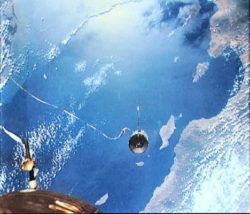
This is the second part to the article about tether propulsion. It will focus on space missions that tested tethers in space. The first such mission took place in 1966. Gemini 11 deployed a 30m tether connecting it to the Agena target vehicle. It created a small amount of artificial gravity (0.00015 g) by spinning the two spacecraft.
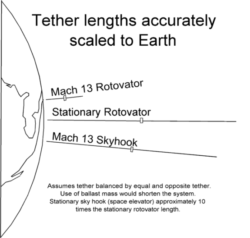
Non-Rocket Spacelaunch – Tether propulsion
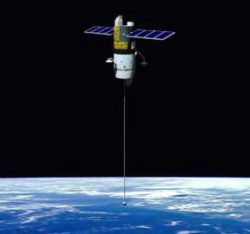
Tether propulsion consists in using long, very strong cables (known as tethers) to change the velocity of spacecraft and payloads. The tethers may be used to initiate launch, complete launch, or alter the orbit of a spacecraft. This form of propulsion would be significantly less expensive than spaceflight using modern rocket engines.
Non-Rocket Spacelaunch – Space Elevators in Fiction
This is the fourth and final part of the space elevator article of the non-rocket spacelaunch methods article series. This post will focus on references to the space elevator concept in fiction. The first mention of anything remotely similar to a space elevator was the beanstalk in the children's fairy tale called Jack and the Beanstalk, published in 1807.
Non-Rocket Spacelaunch – Extraterrestrial Space Elevator Concepts
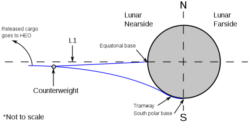
Space elevators, a futuristic concept, could be adapted for various celestial bodies: Mars, the Moon, and even asteroids, they promise a revolution in space access.
Non-Rocket Spacelaunch – Space Elevator Safety Issues
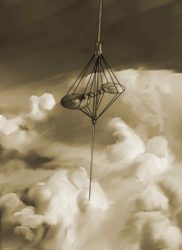
The space elevator is a gigantic concept and as such it has many safety issues that would have to be resolved before construction begins. A space elevator would present a navigational hazard, both to aircraft and spacecraft.
Non-Rocket Spacelaunch – Space Elevator
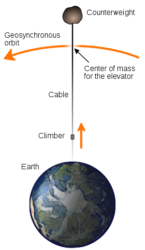
Why non-rocket spacelaunch? Because the current chemical rockets are really expensive. In order to further explore outer space and establish a permanent human presence in space we need more cost efficient spacelaunch methods.
Apus Constellation
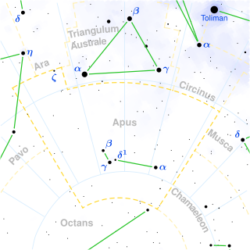
Apus is a faint constellation in the southern sky. Its name means “no feet” in Greek and it represents a bird-of-paradise, which were once believed to have no feet. It was one of the twelve constellations created by Petrus Plancius in the late 16th century. The first known depiction of the constellation in a celestial atlas was in Johann Bayer’s Uranometria of 1603. Bird-of-Paradise after which the Apus constellation was named. Credit & Copyright: Roderick Eime. For more constellations see the Constellations Guide.
Introduction to Astronomy – Apparent magnitude
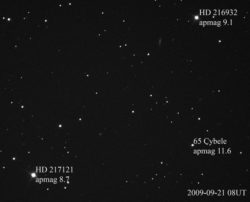
Yesterday I have used the term “apparent magnitude” in my article about the Antlia Constellation. Since some of you may be new to astronomy, I decided to start a new series of articles to introduce you to the topic. Each article of the series will focus on one scientific term used in astronomy. The series will not be a regular one: I will only write an article after using a complicated astronomy term that some of you would need me to explain. Definition The apparent magnitude (noted as m) of a celestial body is a measure of its brightness as seen by an observer on Earth. Since the apparent brightness…
Antlia Constellation
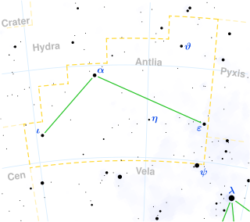
Antlia is a constellation in the southern sky and therefore has been unknown to the ancient Greeks and Romans. Its name means “pump” and it specifically represents an air pump. It was created by the French astronomer Abbé Nicolas Louis de Lacaille, who created fourteen constellations for the southern sky to fill some of the faint regions. He originally named it Antlia pneumatica to commemorate the air pump invented by the French physicist Denis Papin. It was later adopted by the International Astronomical Union as one of the 88 modern constellations under the shortened name of Antlia. Main Stars and Deep Sky Objects The Antlia constellation has no bright stars.…