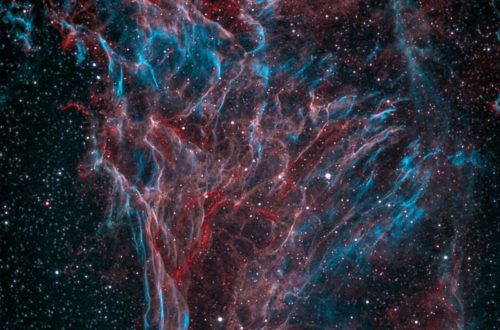
Orion Constellation Guide
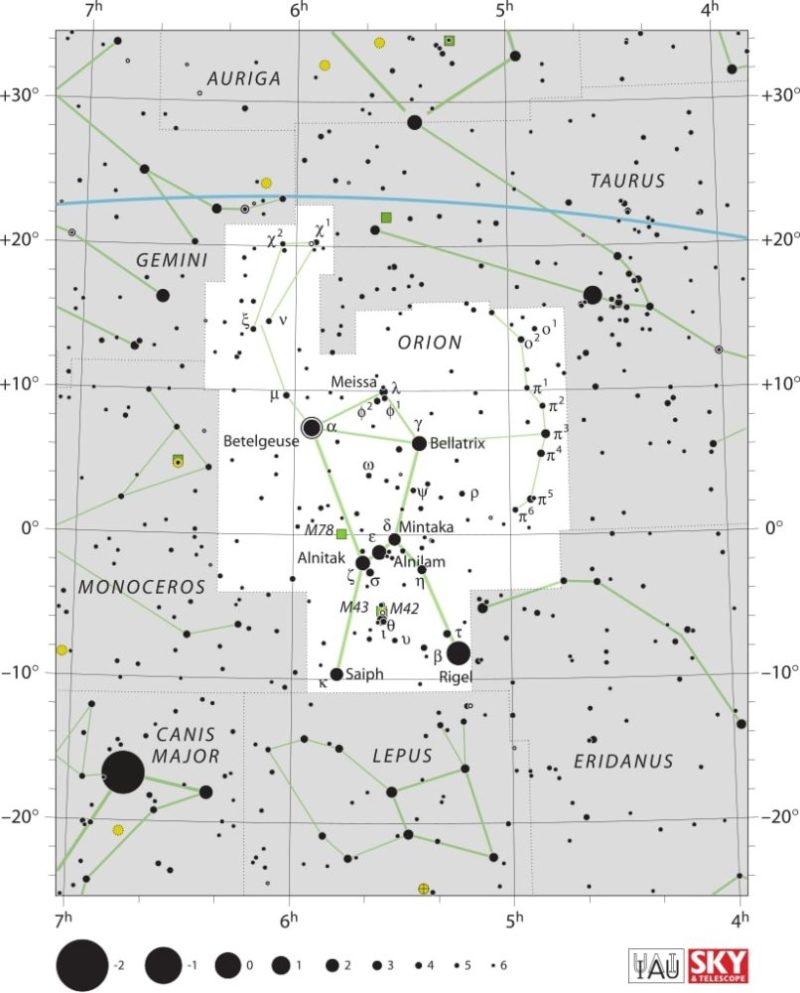
Orion is one of the easiest constellations to spot: find three bright stars in a short, nearly straight row, then look for four brighter stars making a broad hourglass around them. That familiar pattern is a handy starting point for exploring the winter sky, but it’s only the foreground of a much larger story. Orion also contains hot, young stars, glowing gas, and a nearby stellar nursery where new stars are forming.
Where Can You See Orion?
Best Viewing Season
For observers in the Northern Hemisphere, Orion is most prominent on evenings from late fall through winter, especially around January. It rises in the east and moves across the southern sky before setting in the west. In the Southern Hemisphere, the same pattern is visible during the warmer months, but appears higher in the northern sky and upside down compared with the view from much of North America and Europe.
Orion lies across the celestial equator, so people in both hemispheres can see it. Its visibility still depends on your latitude, local horizon, and light pollution. A clear view helps; binoculars are a bonus, not a requirement.
Northern and Southern Skies
The constellation is one of the 88 modern constellations recognized by the International Astronomical Union (IAU). Those official regions divide the entire sky, while the familiar stick-figure arrangement is an asterism: a recognizable pattern, not a physical grouping of nearby stars. The IAU’s constellation boundaries make that distinction clear.
Find Orion’s Belt
Start with the Belt: Alnitak, Alnilam, and Mintaka, three bright stars in a row. From there, the four stars around them create the outline of Orion’s body. Below the Belt, a smaller line of stars forms the Sword. Give your eyes a few minutes to adjust, and the pattern becomes hard to mistake.
How Do You Recognize Orion?
The Hourglass Pattern
The four main stars around the Belt make a roughly rectangular shape, often described as an hourglass. Betelgeuse marks one shoulder, Bellatrix the other; Rigel and Saiph mark the feet. Orion’s head is represented by the fainter star Meissa, sometimes counted as an additional eighth star in the basic outline.
The Belt and Sword
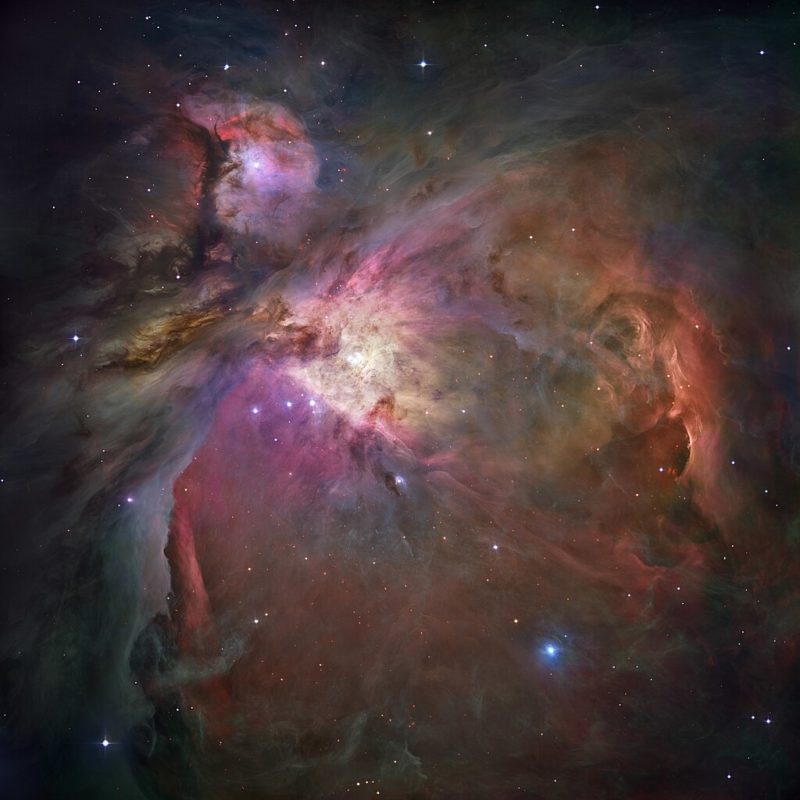
The Sword hangs below Orion’s Belt. Its middle “star” looks fuzzy to the naked eye under dark conditions. That blur is the Orion Nebula, a vast cloud of gas and dust rather than a single star. A small telescope reveals more detail, but even binoculars can show the difference between a pinprick of light and a hazy patch.
Nearby Constellations
Orion sits near Taurus, the Bull, and Canis Major, home to Sirius, the brightest star in the night sky. The line of the Belt points toward Sirius in one direction and toward Aldebaran in Taurus in the other. These neighboring patterns are useful landmarks when the sky is crowded with stars.
Which Stars Make Up Orion?
Betelgeuse and Bellatrix
Betelgeuse, pronounced in several accepted ways, is a red supergiant and a variable star: its brightness changes over time. Its striking color contrasts with Bellatrix, a hot blue-white star. Betelgeuse’s unusual “Great Dimming” in 2019–2020 drew attention to how dust and activity in a giant star’s atmosphere can alter the light reaching Earth. The research on Betelgeuse’s dimming traces changes in its atmosphere during that period.
Rigel and Saiph
Rigel is a luminous blue supergiant and usually appears brighter than Betelgeuse, though their apparent brightness varies for different reasons. Saiph, another hot blue star, completes the lower side of Orion’s outline. The stars seem arranged together from our viewpoint, but they sit at different distances in space. The NASA overview of Orion offers a useful look at the constellation’s stars and their differing scales.
Alnitak, Alnilam, and Mintaka
The Belt’s three stars are not a matching set at the same distance. Alnitak, Alnilam, and Mintaka are luminous systems with their own complexities; Mintaka, for example, is a multiple-star system. That tidy line is a perspective trick, a reminder that a constellation diagram maps sightlines, not the architecture of a single neighborhood.
What Can You See in Orion’s Nebulae?
Orion Nebula
The Orion Nebula, also called Messier 42 or M42, is visible without a telescope as a faint smudge in the Sword. It is a star-forming region roughly 1,300 to 1,500 light-years away, depending on the measurement cited. Inside it, young stars and radiation shape the surrounding gas. NASA’s Hubble view of Messier 42 shows how much structure hides inside that small-looking patch.
Horsehead Nebula
The Horsehead Nebula is a dark cloud silhouetted against brighter gas near Alnitak. It is not an easy naked-eye target; photographs and larger telescopes reveal its familiar profile far better than a casual glance.
Orion Molecular Cloud Complex
The Orion Molecular Cloud Complex is the more compelling story behind the hunter-shaped pattern. It contains dense gas, dust, and hundreds of young stellar objects, giving astronomers a nearby laboratory for studying how stars form. Infrared observations can peer through dust that blocks visible light, while Webb’s instruments examine chemistry in the region; ESA’s Webb observations even detected methyl cation in a planet-forming disk.
Orion Across Cultures and History
The Greek story presents Orion as a hunter, though the details vary across ancient tellings. In one familiar version, a scorpion sent by Gaia kills him; the two figures occupy opposite parts of the sky, so Orion sets as Scorpius rises. Other peoples have read the same stars differently. Cree traditions, for instance, include the Belt as the Three Chiefs, while Māori sky lore connects stars in this region with Te Waka o Rangi, a celestial canoe. A constellation is a human way of organizing the sky, and its meanings are never universal.
Orion’s fame has also inspired claims that the Giza pyramids were deliberately mapped to match the Belt. The idea is popular, but a precise, large-scale ground plan is not established by mainstream archaeological evidence. The stars are fascinating enough without asking them to prove more than they can.
How Has Orion Shaped Astronomy and Navigation?
Orion is a practical guide for learning the sky: its bright stars help observers locate neighboring constellations, and its seasonal appearance has served as a calendar marker in many cultures. It can help orient a beginner, though it is not a substitute for a compass or a reliable navigation system.
For astronomers, the region offers more than a memorable diagram. The Orion Nebula and its surrounding molecular clouds expose the messy stages of stellar birth, from collapsing gas to young stars carving cavities in dust. Hubble and other observatories have revealed faint objects that ordinary eyesight misses, turning an old sky pattern into a continuing source of scientific insights.
FAQ
Is Orion visible all year?
No. It is best seen in the evening during winter in the Northern Hemisphere and during the corresponding warmer months in the Southern Hemisphere.
What is the bright fuzzy patch below Orion’s Belt?
It is the Orion Nebula, a star-forming region visible to the unaided eye under dark skies.
Are the Belt stars close together?
They appear aligned from Earth, but they are at different distances and are not a compact trio in space.
Conclusion
Orion’s familiar shape makes it easy to find, but the pattern is only the beginning. Follow the Belt to the Sword, pause at the nebula, and remember that those bright points occupy a far larger, less orderly landscape than the hunter suggests. That gap between the simple outline and the crowded reality is exactly what makes Orion worth revisiting.
Would you like to receive similar articles by email?

Paul Tomaszewski
Paul Tomaszewski is a science & tech writer as well as a programmer and entrepreneur. He is the founder and editor-in-chief of CosmoBC. He has a degree in computer science from John Abbott College, a bachelor's degree in technology from the Memorial University of Newfoundland, and completed some business and economics classes at Concordia University in Montreal. While in college he was the vice-president of the Astronomy Club. In his spare time he is an amateur astronomer and enjoys reading or watching science-fiction. You can follow him on LinkedIn and Twitter.

You May Also Like
NGC 7496: A Stunning Example of a Barred Spiral Galaxy
Aquila Constellation Guide