Ophiuchus Constellation Guide
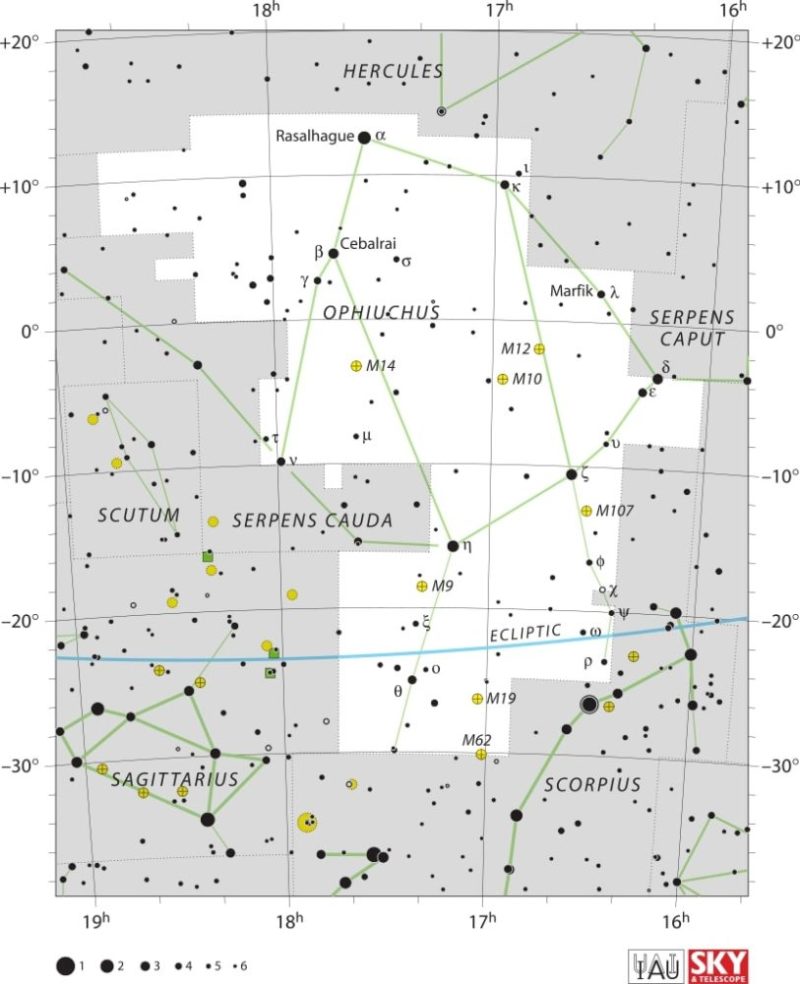
Ophiuchus is a large constellation near the celestial equator, best seen on summer evenings in the Northern Hemisphere. It’s famous as the “13th zodiac constellation” because the Sun crosses its boundaries, but that astronomical fact does not add a sign to traditional Western astrology. The distinction is worth keeping clear: one describes the Sun’s path among mapped stars; the other uses a symbolic twelve-part system.
What Is Ophiuchus?
The Serpent Bearer
The name Ophiuchus comes from Greek and Latin roots meaning “serpent bearer.” Its star pattern is often imagined as a person holding a snake, though the figure takes a little imagination. The snake is represented separately by Serpens, the only constellation divided into two parts: Serpens Caput, the head, and Serpens Cauda, the tail.
The pairing makes the region easier to recognize. Ophiuchus appears to hold the serpent across its body, a pattern reflected in the constellation’s name and ancient mythology.
Constellation Boundaries
Ophiuchus is one of the 88 modern constellations recognized by the International Astronomical Union (IAU). Its official boundaries are defined areas on the celestial sphere, not lines connecting the brighter stars. The IAU’s historical account of Ptolemy’s 48 constellations places Ophiuchus among the ancient patterns that survived into modern astronomy.
Position on the Ecliptic
The ecliptic is the apparent yearly path of the Sun across the sky. Ophiuchus lies across part of it, so the Sun passes through Ophiuchus for roughly three weeks, commonly dated from November 29 to December 17. The exact dates depend on how the constellation boundaries and the Sun’s position are calculated; EarthSky explains the astronomical overlap.
That crossing is why Ophiuchus gets pulled into zodiac debates. It’s a real constellation, not a recent invention.
Where Is Ophiuchus in the Night Sky?
Neighboring Constellations
Look between Scorpius and Hercules. Sagittarius sits nearby, too, while Serpens winds through Ophiuchus. The constellation is broad but not especially compact, so its brightest stars form a loose outline rather than a crisp geometric shape.
Finding the Serpent
Start with Antares, the reddish star in Scorpius, then look north for Rasalhague, Ophiuchus’s brightest star. From there, the surrounding stars suggest the figure’s head and shoulders. A constellation map and observing guide can help distinguish the pattern from neighboring Serpens.
Sky Chart Tips
A printed sky chart or astronomy app can make the first search much easier. Set the chart to your location and date, then check the horizon: Ophiuchus rises in the east and reaches its highest point, or culmination, toward the south for many Northern Hemisphere observers. A clear southern horizon helps. So does getting away from bright streetlights.
When Can You See Ophiuchus?
Best Viewing Months
Ophiuchus is best placed for evening viewing from late spring into early fall, with June through August especially convenient in the Northern Hemisphere. The constellation is technically observable at other times, but it may be low, hidden by daylight, or visible only before dawn.
Northern and Southern Hemispheres
Observers in both hemispheres can see Ophiuchus because it straddles the celestial equator. In the Northern Hemisphere, it appears toward the southern sky; in much of the Southern Hemisphere, it climbs higher overhead. Local season and latitude change the view, so a sky chart set for your location is more useful than a generic calendar.
Dark-Sky Conditions
The brightest stars are visible without special equipment under ordinary dark skies. Binoculars reveal more, while a telescope brings globular clusters into better view. Give your eyes time to adjust, and avoid white phone screens if you’re hoping to pick out faint detail.
What Is Ophiuchus’s History and Mythology?
Ancient Star Catalogs
Ophiuchus was recorded by the Greek astronomer Ptolemy in the second century, though the pattern’s roots may be older. Babylonian sky traditions also included figures in this region. Constellations were used to organize the sky long before modern telescopes; their histories are a mix of observation, inherited star lore, and storytelling.
Asclepius and the Serpent
In Greek mythology, Ophiuchus is often identified with Asclepius, the physician and son of Apollo. A serpent became associated with healing, perhaps because it sheds its skin and appears renewed. Stories differ in their details, but the familiar figure is a healer holding a snake, not a record of a historical physician.
The Healer Tradition
The staff of Asclepius, a single serpent wound around a rod, remains a medical symbol. That enduring image gives Ophiuchus a striking place in the sky’s mythology.
Which Stars and Deep-Sky Objects Stand Out?
Rasalhague and Key Stars
Rasalhague, also called Alpha Ophiuchi, is the constellation’s brightest star, shining at about magnitude 2. The name means “head of the serpent collector.” Sabik and Cebalrai are other useful landmarks. Together, these bright stars sketch the upper body and make Ophiuchus easier to locate.
Barnard’s Star
Barnard’s Star is a nearby red dwarf, just under six light-years from Earth. It’s faint, around magnitude 9.5, so binoculars generally won’t show it; a telescope and a careful chart are needed. Its fame comes from its proximity and rapid motion across the background stars, not its appearance.
Nebulae and Star Clusters
Ophiuchus contains several globular clusters, including Messier 9, M10, M12, and M14. These dense, old collections of stars are rewarding telescope targets, though they won’t look like the sharp, colorful photographs made by space observatories. The constellation also includes planetary nebulae such as NGC 6572, featured in an ESA Hubble image.
On a much larger scale, the Ophiuchus galaxy cluster is known for a colossal eruption from a central black hole, which carved a cavity in the surrounding hot gas. NASA’s account of the event offers a reminder that a constellation is a patch of our viewpoint, not a physical neighborhood.
Does Ophiuchus Count as a Zodiac Sign?
Astronomically, the Sun crosses Ophiuchus. In traditional Western astrology, the zodiac uses twelve equal 30-degree signs tied to a seasonal framework, rather than the uneven boundaries of the 13 constellations the Sun appears to cross. Those are different systems, and one does not automatically rewrite the other. NASA has not changed anyone’s sign; CNN’s fact check addresses the recurring online rumor.
FAQ
Is Ophiuchus visible to the naked eye?
Yes. Its brighter stars are visible under reasonably dark skies, though the full outline can be hard to trace in light-polluted areas.
Is Ophiuchus the same as Serpens?
No. Ophiuchus depicts the serpent bearer; Serpens is the separate constellation representing the snake.
Conclusion
Ophiuchus offers a satisfying mix of practical stargazing, ancient stories, and a little internet mischief. Find Rasalhague, follow the serpent’s curve, then try for a globular cluster with binoculars or a telescope. The zodiac argument can wait; the sky is right there.
Would you like to receive similar articles by email?

Paul Tomaszewski
Paul Tomaszewski is a science & tech writer as well as a programmer and entrepreneur. He is the founder and editor-in-chief of CosmoBC. He has a degree in computer science from John Abbott College, a bachelor's degree in technology from the Memorial University of Newfoundland, and completed some business and economics classes at Concordia University in Montreal. While in college he was the vice-president of the Astronomy Club. In his spare time he is an amateur astronomer and enjoys reading or watching science-fiction. You can follow him on LinkedIn and Twitter.


You May Also Like

Canadian Space Agency and Its Key Missions
NGC 7023: The Iris Nebula