Octans Constellation Guide
A lot of people expect the south celestial pole to have its own brilliant beacon, a southern twin of Polaris. It doesn’t. Octans is the faint constellation surrounding that pole, and its best-known star, Sigma Octantis, is difficult to pick out even under dark skies. The region matters greatly for orientation, though its modest stars and lack of showpiece objects make it a quiet patch of the southern sky.
Where Is Octans in the Southern Sky?
Location and boundaries
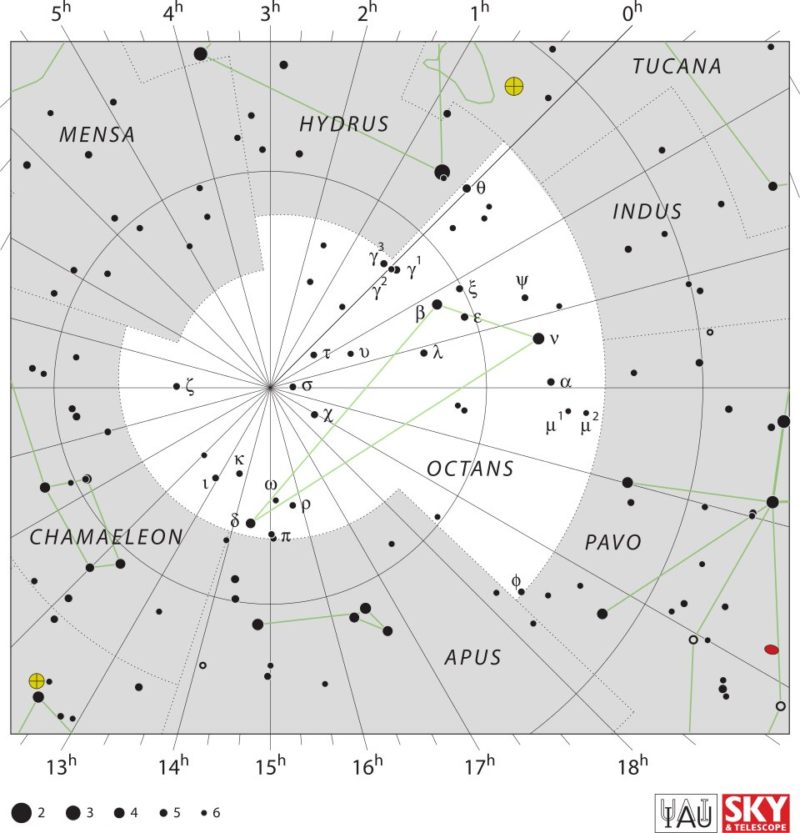
Octans lies around the south celestial pole, the point in the sky directly above Earth’s geographic South Pole. Its official boundaries cover about 291 square degrees, making it a relatively small constellation. On a sky map, it sits among Apus, Chamaeleon, Hydrus, Indus, Mensa, Pavo, and Tucana.
The boundary is a cartographic border, not a visible shape. Octans has no familiar pattern of bright stars to trace, and mapmakers’ connecting lines are only a guide; different charts may draw them differently.
Southern-sky visibility
Octans is best seen from the Southern Hemisphere, where much of it stays above the horizon throughout the year. Near the equator, it appears low in the south; farther north, most or all of the constellation may remain below the horizon. Light pollution and a blocked southern horizon can make an already faint field harder to explore. NOIRLab’s Octans observing guide gives a useful sense of its subdued appearance.
Best viewing season
Octans is circumpolar for many southern observers, meaning it never sets. That doesn’t make every night equally convenient: it reaches its highest evening position around September, so late southern winter and early spring are a practical time to look. In other months, it can still be found, but may sit lower at a comfortable observing hour.
Why Does Octans Mark the South Celestial Pole?
Sigma Octantis
Sigma Octantis, also called Polaris Australis, is the nearest naked-eye star to the south celestial pole. At roughly magnitude 5.5, it is faint: from a dark site with clear skies, a sharp-eyed observer may see it, but it is no easy navigational marker. The IAU recognizes the name Polaris Australis, though the star is often simply called Sigma Octantis.
The pole’s exact position
The south celestial pole is a point, not a star. Sigma Octantis lies about a degree away, and Earth’s axial precession slowly shifts the pole’s position against the background stars over long stretches of time.
Comparison with Polaris
Polaris is bright and easy to locate near the north celestial pole. Sigma Octantis is much dimmer, and the stars around it don’t form a comparably clear pointer pattern. The difference is practical, not merely aesthetic: in the south, observers often find the pole by using surrounding constellations rather than relying on one star.
How Can You Locate Octans?
Use a southern-sky map
Start with a planisphere or a digital sky chart set to your location and date. Make sure the chart shows the southern horizon and the celestial pole; a map centered on the whole sky can make this compact region easy to miss.
Find nearby constellations
The Southern Cross, or Crux, is a useful landmark. Extend its long axis away from the cross to estimate the direction of the south celestial pole; Octans surrounds that point. Then use nearby constellations to orient the map. A guide to finding the southern celestial pole explains the Crux method and its limits.
A few sensible habits help:
- Face south and let your eyes adjust to the dark for about 20 minutes.
- Use a chart that matches your latitude and the date.
- Treat Sigma Octantis as a nearby reference, not the pole itself.
Set realistic expectations
You may not see a tidy outline. Octans is a loose scatter of faint stars, and the brightest star in the constellation is Nu Octantis, around magnitude 3.7, not Sigma Octantis. The Octans star chart helps distinguish the named stars from the map’s drawn connections.
How Did Octans Get Its Name?
Lacaille’s 18th-century map
French astronomer Nicolas-Louis de Lacaille introduced Octans in the 1750s while mapping southern stars that were unfamiliar to European astronomers. His work added several constellations to the southern sky, many named for scientific instruments rather than mythological figures. Ian Ridpath’s account of Lacaille’s Octans traces the constellation’s history.
The octant instrument
An octant was a navigational instrument used to measure the altitude of celestial objects. Its name refers to one-eighth of a circle. Lacaille chose it as a fitting tribute to the tools navigators used to find their way across the oceans. A historical discussion of the name appears in Allen’s star-name archive.
No classical mythology
Unlike Orion or Andromeda, Octans has no ancient Greek myth behind it. It belongs to the era of scientific navigation and Enlightenment-era sky mapping.
Which Stars and Objects Stand Out?
Nu Octantis is the constellation’s brightest star. Sigma Octantis is more famous for its proximity to the pole than for its appearance, while several other stars form a faint, uneven field. Octans has no Messier objects, but it does contain galaxies, including NGC 7098 and NGC 2573. They are faint targets, generally better suited to telescopes and dark skies than casual viewing.
What Should You Know Before Observing?
Bring a southern-sky chart, choose a site with an open view toward the south, and don’t expect the pole star to announce itself. Binoculars can reveal more of the star field, though they won’t turn Octans into a bold pattern. The reward is subtler: learning how the sky is mapped around Earth’s southern axis, and spotting a constellation shaped more by navigation history than by spectacle.
FAQ
Can you see Octans from the Northern Hemisphere?
Only from low northern latitudes, where it appears close to the southern horizon. From most northern locations, it stays below the horizon.
Is Sigma Octantis exactly at the south celestial pole?
No. It lies about a degree away. The pole is an imaginary point in the sky, not a star.
Is Octans worth observing?
For bright, dramatic sights, probably not. For understanding southern-sky navigation, constellation history, and the geography of the celestial pole, it’s well worth a look.
Conclusion
Octans was mapped not for its brilliance but for its utility, a constellation named after the navigational octant that helped sailors measure their way across southern oceans. With no bright pole star to rely on, observers in the south learn to orient themselves through Crux and the faint field around Sigma Octantis, turning a subtle region into a dependable reference. The constellation endures as a quiet lesson in practical astronomy: the most useful markers are often the ones you have to work to find.
Would you like to receive similar articles by email?

Paul Tomaszewski
Paul Tomaszewski is a science & tech writer as well as a programmer and entrepreneur. He is the founder and editor-in-chief of CosmoBC. He has a degree in computer science from John Abbott College, a bachelor's degree in technology from the Memorial University of Newfoundland, and completed some business and economics classes at Concordia University in Montreal. While in college he was the vice-president of the Astronomy Club. In his spare time he is an amateur astronomer and enjoys reading or watching science-fiction. You can follow him on LinkedIn and Twitter.


You May Also Like
How Did Neptune’s Moon Triton Get Its Name
How Did the Moon Get Its Name?