Norma Constellation Guide
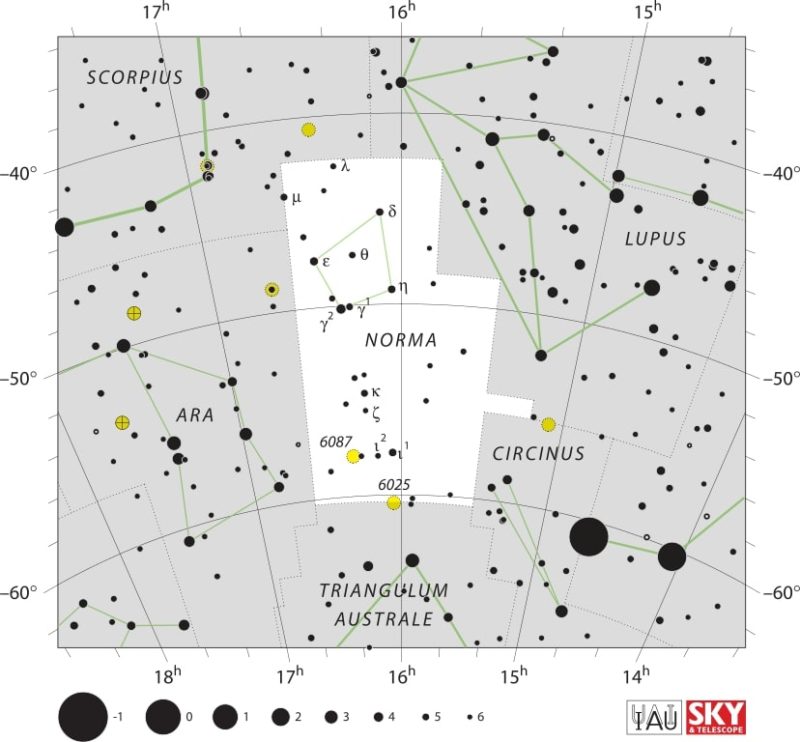
A lot of people expect a constellation to announce itself with a crisp shape. Norma won’t. This small southern constellation is faint, its brightest star is only around magnitude 4, and its real appeal lies in the crowded Milky Way field behind the modest outline: open clusters, nebulae, and the distant Norma Cluster near the region associated with the Great Attractor.
What Is Norma’s Place in the Southern Sky?
Celestial location
Norma lies in the Southern Celestial Hemisphere, between Scorpius, Lupus, Ara, Circinus, and Triangulum Australe. Its stars sit close to the plane of the Milky Way, where the background can look richly stippled under dark skies. For observers, that means the constellation is less a bold figure than a patch of sky worth exploring with binoculars or a telescope.
IAU boundaries
Norma is one of the 88 modern constellations recognized by the International Astronomical Union. Its boundaries define a fixed area of sky, not a physical grouping of stars; the stars that appear near one another can be at very different distances from Earth. The NOIRLab constellation guide gives a helpful overview of Norma’s location and history.
Milky Way position
The galactic plane runs through Norma, which is why the region contains so many stellar fields and deep-sky targets. The same alignment also puts distant objects behind thick foreground dust and stars, making some observations difficult. The view is busy, in other words, and not always tidy.
What Does Norma Represent?
Lacaille’s instrument
French astronomer Nicolas-Louis de Lacaille introduced Norma in the 18th century while mapping the southern sky. He named it Norma et Regula, Latin for the set square and ruler, tools used by carpenters and surveyors. The history of the constellation reflects Lacaille’s interest in depicting scientific instruments rather than figures from classical myth.
No classical myth
Norma has no ancient Greek or Roman story attached to it. It belongs to a group of southern constellations named for instruments, including Circinus and Telescopium. The French name, Équerre et la Règle, likewise refers to a square and ruler; the stars do not form a convincing carpenter’s square unless you’re feeling generous.
Which Stars Form Norma?
Gamma² Normae
Gamma² Normae is the constellation’s brightest star, with an apparent magnitude close to 4.0. That’s visible to the naked eye from a dark site, but it won’t overpower nearby city lights. Gamma¹ Normae lies nearby, and the pair is an optical grouping rather than a single close star system.
Missing Alpha and Beta
Norma has no stars currently designated Alpha or Beta Normae. Stars once associated with those labels ended up within neighboring Scorpius as constellation boundaries and naming conventions changed. It’s a small cartographic oddity, and one reason Norma can feel like a constellation assembled from the leftovers of a celestial map.
Faint star pattern
The brighter stars make an uneven quadrilateral, not a clean geometric figure. Even the brightest star, Gamma² Normae, is faint compared with the leading stars in showier constellations. Don’t spend an evening trying to force a perfect square out of the pattern. A star chart will help you identify the borders, then the surrounding Milky Way becomes the more rewarding view.
What Deep-Sky Objects Lie in Norma?
NGC 6067
NGC 6067 is a rich open cluster, a gathering of stars born from the same molecular cloud. It can be seen with binoculars under dark skies, while a small telescope begins to resolve its members. It sits in a crowded field, so take time to distinguish the cluster from the many unrelated background stars. Observers can also look for NGC 6087, another open cluster in Norma that contains the Cepheid variable S Normae.
Norma Cluster
Far beyond those Milky Way objects lies the Norma Cluster, also called Abell 3627, a massive concentration of galaxies roughly 200 million light-years away. It is associated with the Great Attractor, a broad region of excess mass whose gravitational influence contributes to the motion of our Local Group of galaxies. The Great Attractor is not a single object, nor is it simply another name for the Norma Cluster. The Milky Way’s dust and stars obscure much of this part of the sky, which makes the region harder to study in visible light.
RCW 104
RCW 104 is a nebula in Norma that astrophotographers often capture through long exposures and narrowband filters. Its delicate structure is not a naked-eye target, but images reveal a glowing shell against the crowded galactic background.
When and Where Can You See Norma?
Norma is best placed for evening viewing around June and July. It is most accessible from the Southern Hemisphere, where it climbs higher above the horizon; observers in lower northern latitudes may catch parts of it during summer, though haze and the horizon can get in the way. Farther north, much or all of the constellation remains below the horizon.
Choose a dark location with a clear southern view. City lighting washes out the fainter stars, and Norma doesn’t have a bright beacon to compensate. A free star chart or astronomy app can show when the constellation rises from your location.
How Do You Find Norma in the Night Sky?
Start with Scorpius, whose bright red star Antares is hard to miss, then scan southward toward the less prominent fields of Ara and Triangulum Australe. Norma lies between these neighboring constellations, but its faint outline can be elusive, so use a chart rather than relying on shape alone. Binoculars make the dense Milky Way field easier to explore; a small telescope is a better purchase if clusters and nebulae are the goal. Frankly, buying gear just to “see Norma” is a poor bargain. The constellation is a useful address in the sky, not a spectacle.
FAQ
Is Norma easy to see with the naked eye?
Not especially. Its brightest star is around magnitude 4, and the overall pattern is faint. Dark skies and a chart make a real difference.
Is the Great Attractor inside Norma?
The Norma Cluster, a major galaxy cluster in the Great Attractor region, lies in Norma’s direction. The Great Attractor describes a larger gravitational concentration, not a single object contained neatly within the constellation.
Conclusion
Norma’s outline is forgettable, and that’s a fair criticism. Its value is the territory it marks: a rich Milky Way field, star clusters, nebulae, and a view toward one of the most intriguing large-scale structures in our cosmic neighborhood. Find it with a chart, then look beyond the lines.
Would you like to receive similar articles by email?

Paul Tomaszewski
Paul Tomaszewski is a science & tech writer as well as a programmer and entrepreneur. He is the founder and editor-in-chief of CosmoBC. He has a degree in computer science from John Abbott College, a bachelor's degree in technology from the Memorial University of Newfoundland, and completed some business and economics classes at Concordia University in Montreal. While in college he was the vice-president of the Astronomy Club. In his spare time he is an amateur astronomer and enjoys reading or watching science-fiction. You can follow him on LinkedIn and Twitter.


You May Also Like
What Is the Council of Giants?

Did You Know Polyurethane Foam Made the Space Shuttle Possible?