NGC 891: A Close-Up Look at the Silver Sliver Galaxy
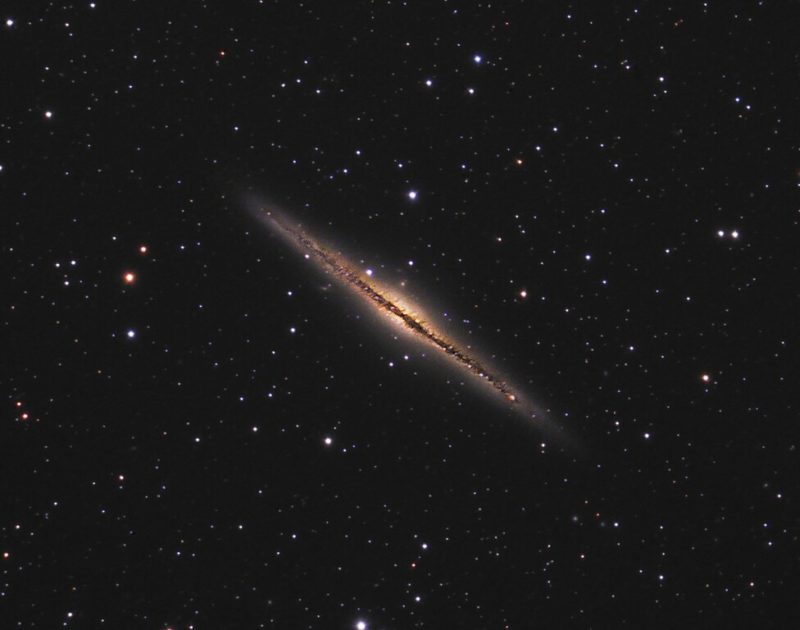
NGC 891, also known as the Silver Sliver Galaxy, has long been a subject of fascination for astronomers. With its edge-on orientation and similarity to our own Milky Way, it presents a wealth of mysteries waiting to be unraveled.
In this article, we’ll take a close-up look at NGC 891. We will also answer some questions you may have about this enigmatic celestial body.
Where is NGC 891 located?
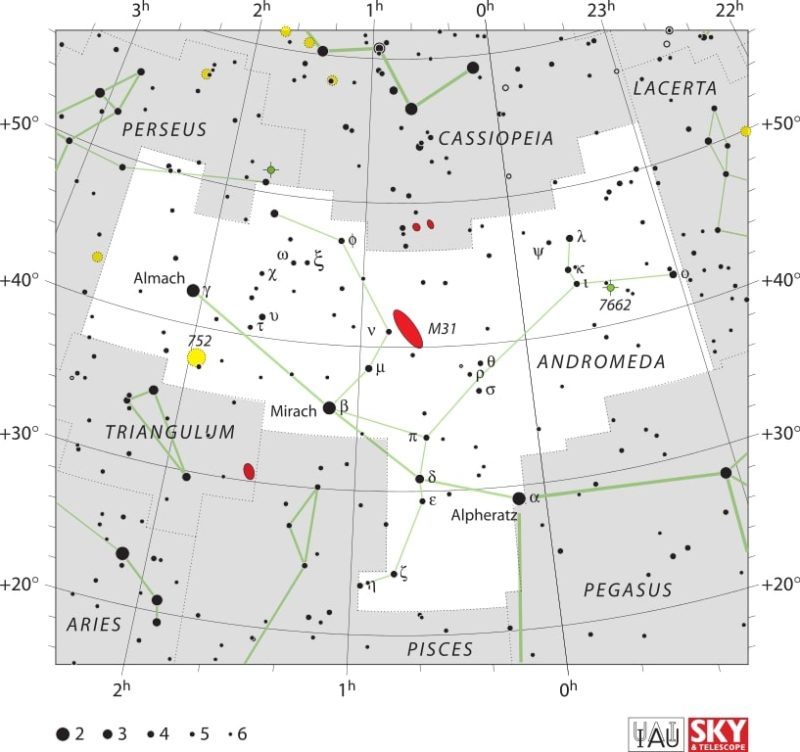
NGC 891 is a galaxy located in the constellation of Andromeda, about 27.3 ± 1.8 million light-years away from Earth. It is a member of the NGC 1023 group of galaxies in the Local Supercluster.
It is considered one of the closest and best analogs to the Milky Way. This makes it a valuable subject for studying galactic structure from an external perspective.
What type of galaxy is NGC 891?
NGC 891 is an edge-on spiral galaxy often classified as an Sb-type system. Because it is viewed edge-on, determining its internal structure is challenging. While it has traditionally been classified as unbarred, some infrared observations suggest the presence of a weak central bar. This would make a barred spiral classification, such as SBb, possible.
How big is NGC 891?
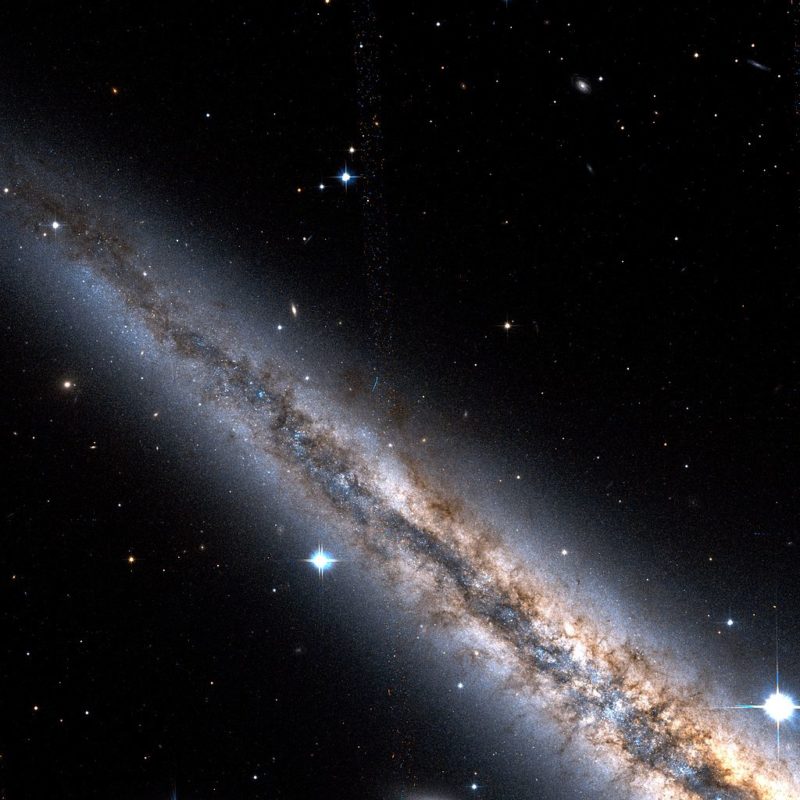
Its disk is approximately 130,000 light-years (~40 kpc) in diameter and contains a prominent dust lane that runs along its midplane. The galaxy also has a prominent central bulge and a halo of stars that extends far beyond its disk.
Deep imaging has revealed a vast halo of gas, dust, and stars extending several thousand light-years above the galactic plane. This halo is likely driven by supernova explosions, which push material into the surrounding space.
Astronomers have also detected extraplanar dust filaments and large reservoirs of neutral hydrogen gas. Furthermore, they observed hot halo gas surrounding the galaxy. These features support the idea of a galactic fountain process. In this process, material cycles between the galactic disk and halo.
NGC 891 also exhibits ongoing star formation at a rate broadly comparable to that of the Milky Way, making it an important laboratory for studying how stellar activity influences galactic evolution.
Why is NGC 891 known as the Silver Sliver Galaxy?
This unique galaxy is often referred to as the Silver Sliver Galaxy due to its thin, elongated shape from our vantage point. Its bright, spindle-like appearance and prominent dark dust lane make it a popular target for astronomers. This is due to its edge-on orientation. The orientation gives us a rare opportunity to study its structure and contents.
For amateur astronomers, NGC 891 appears as a faint, cigar-shaped smudge in medium-sized backyard telescopes under dark skies, offering a rewarding challenge for deep-sky observers. Its relatively low surface brightness means darker skies and larger apertures can significantly improve visibility.
Why is NGC 891 also known as the Outer Limits Galaxy?
NGC 891 is sometimes called the Outer Limits Galaxy because it appeared in the end credits of the famous Outer Limits TV show. Additionally, it appeared alongside the Andromeda Galaxy, M67, the Sombrero Galaxy, the Pinwheel Galaxy, NGC 5128, NGC 1300, and M81. This TV show brought some recognition to this galaxy in popular culture.
Conclusion
Despite its relative proximity, there is still much we don’t know about NGC 891. Astronomers continue to study this fascinating galaxy to unravel its mysteries. The galaxy remains a benchmark for testing computer models of dust distribution, halo formation, and the dynamics of the interstellar medium.
Its striking appearance, active disk-halo environment, and similarity to the Milky Way ensure it will remain a favorite target for astronomers. Both professional and amateur astronomers will observe it for years to come. Moreover, ongoing observations across radio, infrared, optical, and X-ray wavelengths continue to deepen our understanding of this remarkable galaxy.
Would you like to receive similar articles by email?

Paul Tomaszewski
Paul Tomaszewski is a science & tech writer as well as a programmer and entrepreneur. He is the founder and editor-in-chief of CosmoBC. He has a degree in computer science from John Abbott College, a bachelor's degree in technology from the Memorial University of Newfoundland, and completed some business and economics classes at Concordia University in Montreal. While in college he was the vice-president of the Astronomy Club. In his spare time he is an amateur astronomer and enjoys reading or watching science-fiction. You can follow him on LinkedIn and Twitter.


You May Also Like
How Did Jupiter’s Moon Europa Get Its Name

Why Scientists Need Clear Imaging to Solve Medical Mysteries