NGC 2336: A Unique Barred Spiral Galaxy
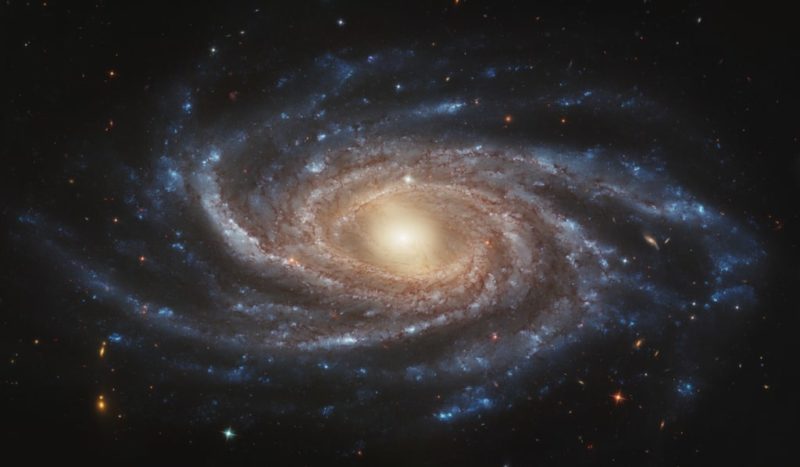
NGC 2336 is a remarkable barred spiral galaxy discovered by astronomer Wilhelm Tempel in 1876. What sets it apart from other galaxies is its prominent central bar, circumnuclear star-forming ring, and complex multi-armed spiral structure. Observations across visible, ultraviolet, and infrared wavelengths have provided insights into its star formation activity and internal structure, making NGC 2336 a fascinating object of study for astronomers worldwide.
NGC 2336 Location
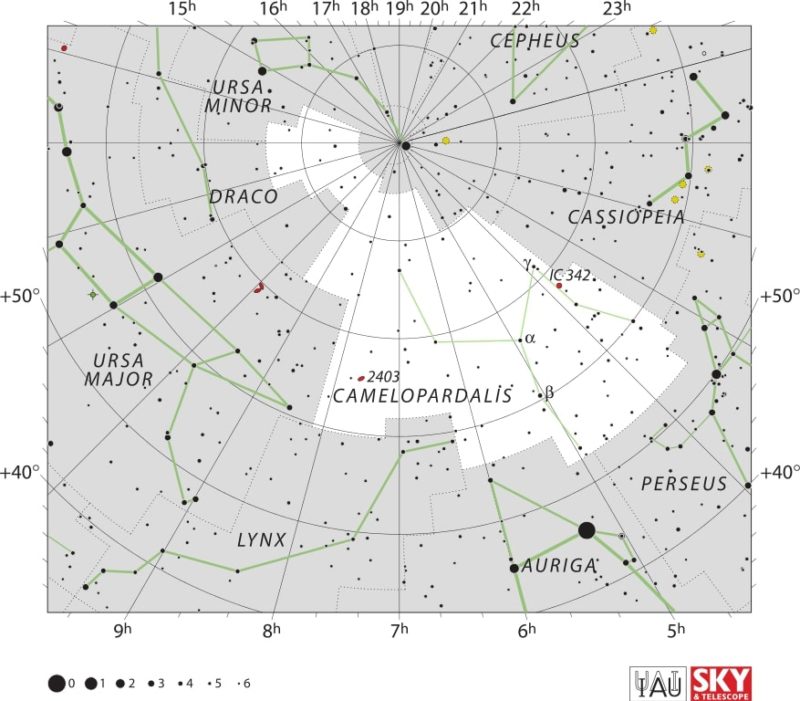
NGC 2336 is a barred spiral galaxy located in the constellation Camelopardalis, about 90 million light-years away from Earth. It is estimated to be about 200,000 light-years across. With a few other galaxies it makes a galaxy group named the NGC 2336 group.
Exploring the Unique Features of NGC 2336
NGC 2336 is a barred spiral galaxy with several distinctive features that set it apart from other galaxies. One of the most notable features of this galaxy is its central bar, which is surrounded by a bright ring of active star formation. Additionally, it has multiple well-defined spiral arms that extend out from the central bar, giving it a distinctive shape.
The galaxy has a high level of star formation activity concentrated in its circumnuclear ring and spiral arms. As many as 28 H II regions, that may host young star clusters, have been observed in the galaxy. The bright blue color of these regions contrasts with the reddish tones of older stars closer to the center.
Another unique feature is evidence suggesting an active galactic nucleus (AGN). It is thought to be powered by a supermassive black hole at the center of the galaxy. This black hole is estimated to have a mass of roughly 30 million solar masses.
Finally, a type Ia supernova (SN 1987L) was discovered in this galaxy in 1987 by James Dana Patchick, an American amateur astronomer. It had an apparent magnitude of 14.2. Like other Type Ia supernovae, the event contributed to the study of stellar explosions. In addition, it aided the calibration of cosmic distance measurements.
Conclusion
In its remote expanse, NGC 2336 stands as a cosmic marvel, captivating astronomers with its distinct bar structure, luminous ring, and spiral arms. Through multiwavelength observations, this barred spiral galaxy has unveiled details about its structure and stellar activity. In doing so, it offers a glimpse into the enigmatic mechanisms shaping its unique features.
From the vibrant bursts of star formation to the possible presence of a central black hole alongside ongoing stellar birth, NGC 2336 continues to beckon scientists. It remains an intriguing celestial canvas for ongoing astronomical exploration and research into barred galaxy evolution and star formation processes.
Would you like to receive similar articles by email?

Paul Tomaszewski
Paul Tomaszewski is a science & tech writer as well as a programmer and entrepreneur. He is the founder and editor-in-chief of CosmoBC. He has a degree in computer science from John Abbott College, a bachelor's degree in technology from the Memorial University of Newfoundland, and completed some business and economics classes at Concordia University in Montreal. While in college he was the vice-president of the Astronomy Club. In his spare time he is an amateur astronomer and enjoys reading or watching science-fiction. You can follow him on LinkedIn and Twitter.


You May Also Like
November Orionid Meteor Shower Guide

The Best Glasses for Working from Home