The Necklace Nebula: A Heavenly Jewel in Our Universe
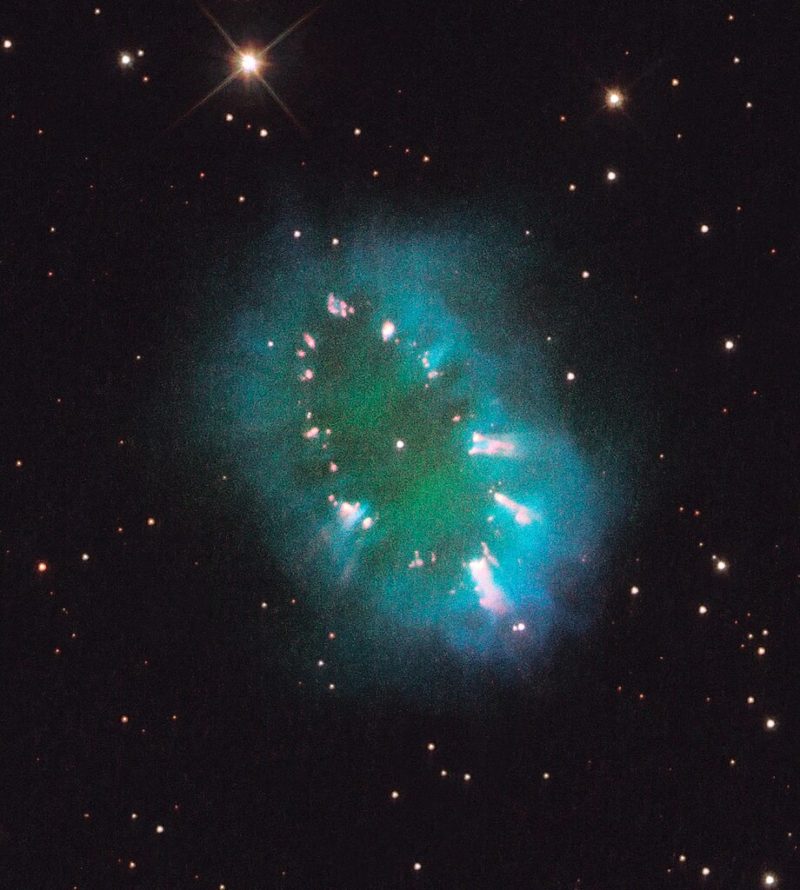
The Necklace Nebula, also known as PN G054.2-03.4, is a breathtakingly beautiful planetary nebula located approximately 15,000 light-years away from us. Its unique and intricate structure has earned it the name ‘necklace’. Moreover, it is truly a heavenly jewel in our universe. In this article, we will explore the fascinating characteristics and mysteries of this stunning celestial object.
What is the Necklace Nebula?
The Necklace Nebula is a planetary nebula. This means that it is the result of a star similar to our Sun that has reached the end of its life. Specifically, the star has shed its outer layers. The name “Necklace” comes from the shape of the nebula, which resembles a string of pearls.
It is also known as PN G054.2-03.4. It was identified in 2005 through observations from the Isaac Newton Telescope Photometric H-alpha Survey (IPHAS).
Necklace Nebula Location
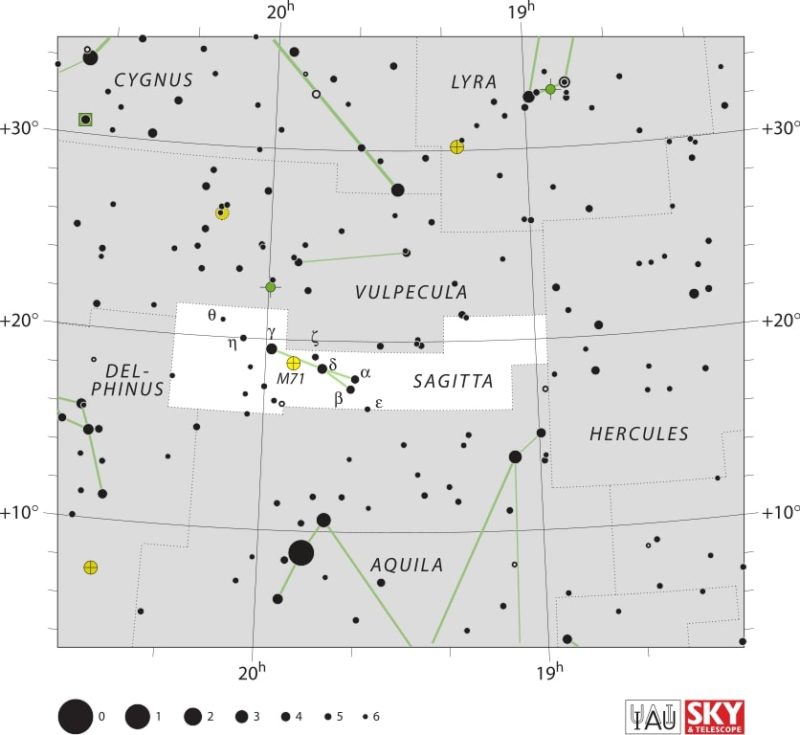
The stunning Necklace Nebula is located in the northern constellation of Sagitta. It is an estimated 15,000 light-years away from Earth.
Sagitta is one of the smallest constellations in the night sky, but it is relatively easy to find because it lies close to the bright Summer Triangle formed by the stars Vega, Altair, and Deneb. Despite its size, Sagitta is rich in deep-sky objects. The Necklace Nebula is one of its most striking hidden gems. Because of its faintness, the nebula cannot be seen with the naked eye. Therefore, it is primarily an astrophotography target. It requires large telescopes or space observatories such as the Hubble Space Telescope to reveal its structure.
Characteristics of the Necklace Nebula
The Necklace Nebula consists of a bright ring, measuring about two light-years (≈19 trillion kilometers) across. It has dense, bright knots of gas spread out in a way that resembles the diamonds in a necklace.
The knots are not stars; they glow because the gas is excited and ionized by intense ultraviolet radiation from the hot central stellar system.
The Necklace Nebula is also an important example of a planetary nebula shaped by a close binary star system, where stellar interaction plays a key role in forming its structure.
History of the Formation of the Nebula
The nebula was created by a pair of stars orbiting very close together. About 10,000 years ago, one of the aging stars swelled into a red giant. Next, it expanded to the point that it engulfed its companion star, creating a common-envelope system.
As the two stars orbited inside this shared envelope, drag forces caused them to spiral closer together. This released energy that helped eject the outer layers of the red giant into space. Thus, this process formed the dense ring-shaped nebula we observe today. The glowing knots are the densest clumps of this expelled material.
Due to this violent event both stars survived albeit with reduced sizes. Now, they are closely orbiting around each other, completing an orbit in a little more than a day. For comparison, Mercury, the closest planet to the Sun, takes 88 days to orbit the Sun. (Facts via NASA: Hubble Offers a Dazzling ‘Necklace’)
Conclusion
In short, the Necklace Nebula is truly an unforgettable celestial beauty that continues to captivate astronomers and stargazers alike. Its unique shape and intricate details make it a stunning jewel in our universe that never fails to impress. Whether viewed through a telescope or admired in stunning images captured by space telescopes, the Necklace Nebula is a true wonder of the cosmos that reminds us of the beauty and majesty of the universe we call home.
Would you like to receive similar articles by email?

Paul Tomaszewski
Paul Tomaszewski is a science & tech writer as well as a programmer and entrepreneur. He is the founder and editor-in-chief of CosmoBC. He has a degree in computer science from John Abbott College, a bachelor's degree in technology from the Memorial University of Newfoundland, and completed some business and economics classes at Concordia University in Montreal. While in college he was the vice-president of the Astronomy Club. In his spare time he is an amateur astronomer and enjoys reading or watching science-fiction. You can follow him on LinkedIn and Twitter.


You May Also Like
December Leonis Minorid Meteor Shower Guide
Indus Constellation Guide