Musca Constellation Guide
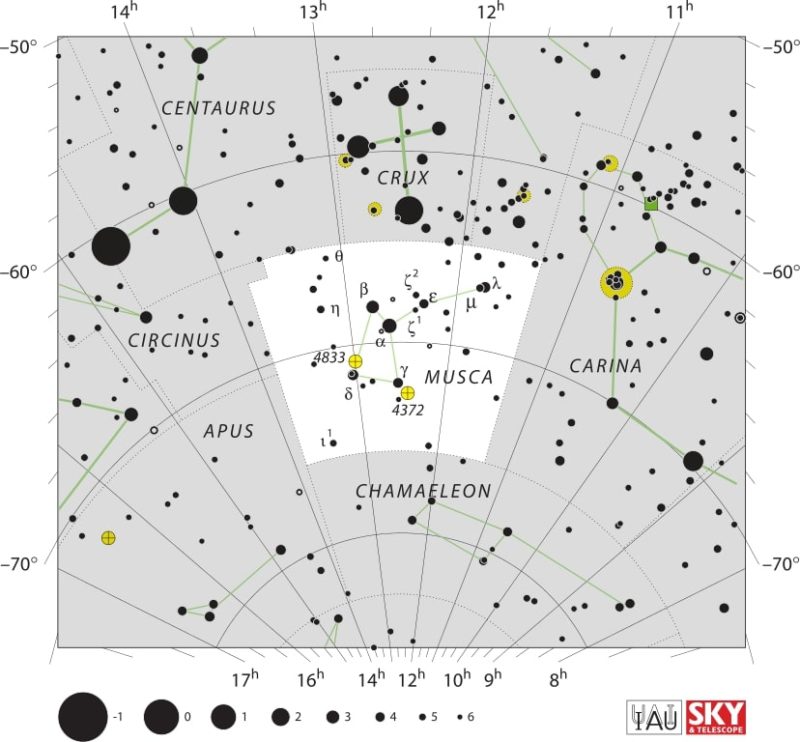
Musca is easy to miss when you’re trying to make out its namesake, a fly. This small constellation in the deep southern sky lies beside the Southern Cross, but its real appeal is in the objects tucked into its Milky Way star field: a striking planetary nebula, globular clusters, and a long, ink-dark cloud. Musca is a southern constellation, so how much of it you can see depends strongly on where you live.
Where Is Musca, and When Can You See It?
Southern Sky
Musca sits well below the celestial equator, in the southern hemisphere. Its area is about 138 square degrees, making it the 77th-largest of the 88 modern constellations. That compact footprint can make it seem modest on a star chart, though the Milky Way runs through it and fills the field with stars.
Nearby Constellations
Look for Musca just south of Crux, the Southern Cross. Centaurus lies to the north, while Carina, Chamaeleon, Apus, and Circinus border the region. The constellation’s outline is small and made from a handful of stars, so the neighboring patterns are useful landmarks. EarthSky’s guide to Musca explains its position in relation to Crux and the southern sky.
Visibility by Season
For observers in the southern hemisphere, Musca is best viewed on autumn evenings, around April and May, when it climbs high above the horizon. It is circumpolar from some southern latitudes, meaning it never sets, though its position in the sky still changes through the night. From much of the northern hemisphere, the constellation stays below the horizon. Observers in tropical northern regions may catch parts of it low in the south.
How Do You Find Musca?
Start with Crux
First locate Crux, which is among the most recognizable patterns in the southern sky. Musca sits immediately beneath it. A clear southern horizon helps; buildings, trees, haze, and light pollution can all swallow the lower stars.
Trace the Star Pattern
The two brightest stars are Alpha Muscae and Beta Muscae. Follow the smaller, fainter stars between and around them to sketch the fly’s compact body. The outline is open to interpretation: some observers see an insect, others see something closer to an axe. A star chart or astronomy app can help confirm the pattern, especially on a night when the Milky Way makes the field busy.
Use Dark Skies
A dark site makes the difference between seeing the constellation’s bright stars and exploring its deeper targets. For current object positions and visibility details, TheSkyLive’s Musca catalog is a useful reference. Binoculars can reveal richer star fields; a telescope brings globular clusters and nebulae into view.
Which Stars and Deep-Sky Objects Matter Most?
Alpha and Beta Muscae
Alpha Muscae is the constellation’s brightest star, with an apparent magnitude of about 2.7. It is a hot, blue-white star, much more luminous than the Sun. Beta Muscae is another blue-white star and a binary system; a telescope can help separate its components. The pair anchors the pattern, but neither is likely to make a casual observer stop in their tracks.
NGC 5189
NGC 5189 is the showpiece: a planetary nebula, formed from gas shed by a dying star. Its twisting filaments give it an unusually tangled appearance, often compared to an hourglass. The label “planetary” is historical; the object has nothing to do with planets. Hubble’s zoom sequence reveals the complex structure hidden inside this small patch of sky.
Dark Doodad Nebula
The Dark Doodad is a long, narrow dark nebula, a dense dust cloud that blocks light from stars behind it. It stretches across the Milky Way near the globular cluster NGC 4372, making for a striking wide-field pairing. NASA’s view of the Dark Doodad shows how the cloud cuts a dark seam through the brighter star field. Musca also contains NGC 4833, another globular cluster, and Nova Muscae 1991, an X-ray binary associated with a black hole.
What Is Musca’s History?
Apis to Musca
Musca constellation has no deep roots in Greek mythology. It emerged from European mapping of the southern sky during the late 16th century, drawing on observations made by Dutch navigators Pieter Dirkszoon Keyser and Frederick de Houtman. The pattern was first associated with Apis, Latin for “bee,” before its identity shifted toward a fly. Universe Today’s history of Musca describes the changing names and the confusion around its early mapping.
Lacaille’s Southern Fly
The name changed again as astronomers tried to distinguish the southern Fly from an obsolete northern counterpart, Musca Borealis. In the 18th century, French astronomer Nicolas-Louis de Lacaille used Musca Australis, or “Southern Fly.” His southern-sky charts added many constellations that remain in use.
IAU Standardization
The International Astronomical Union recognized 88 modern constellations in the 20th century and established official boundaries for them. Musca’s borders are now fixed regions of the sky, not just lines connecting stars. The constellation name was shortened to Musca, leaving the old labels as historical curiosities.
How Should You Choose What to Observe?
If you have binoculars and a wide view, start with the Dark Doodad and NGC 4372. For a telescope, try NGC 5189, though its small apparent size and intricate structure reward steady viewing. Don’t spend the whole session trying to catch the insect. Musca’s star outline is a useful signpost; the deep-sky targets are the reason to linger.
Can You See Musca from the Northern Hemisphere?
Most northern observers cannot see the whole constellation. From locations near the tropics, parts may rise briefly above the southern horizon, but haze and local obstructions can make them difficult to pick out. Farther north, Musca remains below the horizon.
FAQ
Is Musca one of the zodiac constellations?
No. It lies in the far southern sky, well away from the zodiac band.
Can Musca be seen without a telescope?
Its brightest stars are visible to the naked eye from suitable southern locations under dark skies. The nebulae and globular clusters generally need binoculars or a telescope.
What is the brightest star in Musca?
Alpha Muscae, a hot blue-white star of magnitude 2.7, is the constellation’s brightest star.
What deep-sky objects can be found in Musca?
Musca contains the planetary nebula NGC 5189, the Dark Doodad Nebula, and globular clusters NGC 4372 and NGC 4833.
When is the best time to see Musca?
For southern hemisphere observers, Musca is best viewed on autumn evenings around April and May when it climbs high above the horizon.
Can Musca be seen from the Northern Hemisphere?
Most northern observers cannot see the whole constellation; only those near the tropics may catch parts of it low in the south.
Conclusion
Musca may be small, and its name has wandered from bee to fly and back through several chart-makers’ hands. Still, its position near Crux makes it easy to find from the south, while its dark cloud and intricate nebula offer plenty to explore. A modest constellation, perhaps, but a rewarding one.
Would you like to receive similar articles by email?

Paul Tomaszewski
Paul Tomaszewski is a science & tech writer as well as a programmer and entrepreneur. He is the founder and editor-in-chief of CosmoBC. He has a degree in computer science from John Abbott College, a bachelor's degree in technology from the Memorial University of Newfoundland, and completed some business and economics classes at Concordia University in Montreal. While in college he was the vice-president of the Astronomy Club. In his spare time he is an amateur astronomer and enjoys reading or watching science-fiction. You can follow him on LinkedIn and Twitter.


You May Also Like

Dorado Constellation Guide
Tau Herculid Meteor Shower Guide