
Did you know? The Moon has an Atmosphere
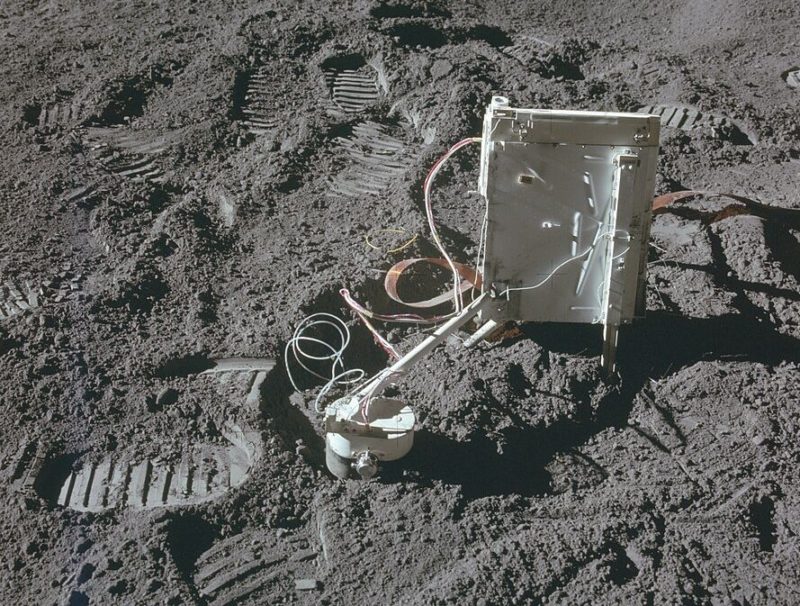
It is a common misconception that the Moon’s surface is a perfect vacuum. It is not! The Moon indeed has an atmosphere, a very tenuous one however. More precisely, it consists of only an exosphere, an extremely thin type of atmosphere where atoms rarely collide. If you could capture the Moon’s entire atmosphere, it would weigh about 10,000 kg. This value can vary depending on solar activity and time of day. In other words, it would weigh less than a large truck.
Sources of the Lunar Atmosphere
There are two main sources of the lunar atmosphere. One of them is outgassing, which is the release of gasses that originate from radioactive decay processes deep inside the crust and mantle of the Moon.
The second source is through a process known as sputtering: atoms are ejected from solid materials on the lunar surface due to the bombardment by energetic particles. Similar processes, along with micrometeorite impacts that vaporize surface material, also create the exosphere of Mercury.
Another minor source of the lunar atmosphere consists of leaks from space suits and the lunar habitation structures from the Apollo missions, as well as the gases ejected from the rockets during landing and liftoff. While it sounds nice that Humans contributed to the lunar atmosphere, most of it has probably been lost to space since then.
In summary, the main sources of the lunar exosphere are outgassing, sputtering, and micrometeorite impacts.
Losses of the Lunar Atmosphere
The Moon loses most of its atmosphere to space; however it is replenished at about the same rate, so that the total mass of the atmosphere remains relatively constant on average.
Some of the gases released by sputtering will be re-implanted into the lunar regolith due to the lunar gravity.
Also some of the atmosphere is lost to space either by solar radiation pressure, or if the gasses are ionized, they are swept away in the solar wind’s magnetic field.
Composition of the Lunar Atmosphere
The average daytime lunar atmosphere consists of the following elements (proportions in atoms per cubic centimeter):
- Argon (40,000),
- Helium (2,000 – 40,000),
- Sodium (70),
- Potassium (17),
- Hydrogen (less than 17).
Other elements were also detected in much lower quantities. Radon-222 and polonium-210 was inferred from the data obtained by the Lunar Prospector alpha particle spectrometer. Argon-40, helium-4, oxygen, nitrogen and carbon were detected by devices used by the Apollo astronauts. One such device, called the “cold cathode gauge” is pictured above. More recent missions, such as LADEE, confirmed additional elements like neon and refined measurements of helium and argon isotopes.
In total, the lunar atmosphere consists of about 80,000 atoms per cubic centimeter, slightly more than what is believed to be the size of the atmosphere on Mercury.
The Moon’s Ancient Atmosphere
Scientists think that early in the Moon’s history, during periods of intense volcanic activity, the Moon may have had a much thicker atmosphere than it does today. During its first few hundred million years after formation, and again around 3.5 billion years ago during peak mare volcanism, lava flows and volcanic outgassing could have released large quantities of superheated volatile gases—including water vapor, carbon dioxide, and sulfur‑bearing species—into the surrounding environment. This may have created a transient atmosphere that was dense enough to exist for millions of years, rather than the ultra‑thin exosphere we observe now.
Some researchers propose that if this thicker atmosphere lasted long enough and included sufficient water vapor, it could have allowed pools of liquid water to form on the surface, creating limited windows of habitability for simple organisms. However, whether life ever actually arose on the Moon, or was delivered from elsewhere (for example via meteorites), remains highly speculative and would require targeted future exploration to confirm.
The idea of these early atmospheric windows draws on evidence that the Moon is not as dry as once believed, including analyses of lunar rock and soil that suggest water and other volatiles were present in the mantle early in lunar evolution.
Conclusion
Even though it has been scientifically proven that the Moon does indeed have a tenuous atmosphere, for all practical purposes the lunar environment is considered to be a near-perfect vacuum. Modern missions like LADEE have greatly improved our understanding of this exosphere, confirming its composition and dynamics.
Would you like to receive similar articles by email?

Paul Tomaszewski
Paul Tomaszewski is a science & tech writer as well as a programmer and entrepreneur. He is the founder and editor-in-chief of CosmoBC. He has a degree in computer science from John Abbott College, a bachelor's degree in technology from the Memorial University of Newfoundland, and completed some business and economics classes at Concordia University in Montreal. While in college he was the vice-president of the Astronomy Club. In his spare time he is an amateur astronomer and enjoys reading or watching science-fiction. You can follow him on LinkedIn and Twitter.


4 Comments
P. I.
There also are more factors that come into play with an object like the Moon other than just relative gravity. The Moon’s small gravity and relative flatness doesn’t hold up well against forces like the solar wind. Also the Moon cooled off very quickly so its geological processes have been dead for a long time.
Paul Tomaszewski
The Moon’s tectonic activity is dead now and has been for millions of years, but there is still some geological activity in the mantle and the core of the Moon.
Mike
So very interesting and even still how they know for sure and have found water on the moon now. In the very bottom of dark canyons and craters on the moon that are never touched by sunlight. It’s water that’s got there from other planets and meteors hitting the moon and freezing there forever basically.
Paul Tomaszewski
We know for sure, because we have sent a dozen people to the Moon!
They made some tests while they were there.
Also it’s possible to detect atmospheres with a powerful telescope. Each atom leaves a trace in the reflected light we observe from the Moon (or any other planet, or other celestial body).