Monoceros Constellation Guide
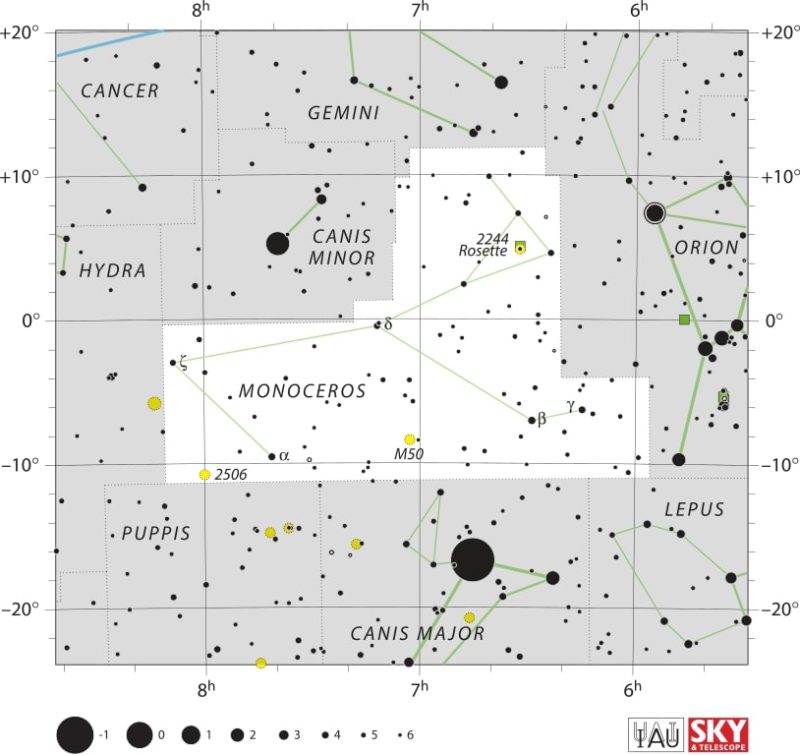
Monoceros is a faint winter constellation best known for the rich objects hidden among its stars, especially the Rosette Nebula and the open cluster M50. The unicorn itself is a stretch. From a dark site, you can trace a loose patch of sky between brighter constellations; through binoculars or a telescope, the region starts to repay the search.
What Is Monoceros?
Monoceros is one of the 88 modern constellations recognized by the International Astronomical Union (IAU). Its name comes from a Greek word meaning “one-horned,” and its familiar English name is the Unicorn. That label sounds grander than the pattern looks. The stars are faint, and they don’t make a convincing horned animal.
The constellation lies along the Milky Way’s plane, where gas, dust, young stars, and star clusters make the field far more interesting than its outline. The IAU’s official constellation information distinguishes the modern sky regions from the star patterns people imagine inside them. Monoceros is a mapped area, with defined boundaries, not a naturally drawn figure.
Where Is Monoceros Located?
Monoceros sits near the celestial equator, so it is visible in both hemispheres. Look east of Orion, below Gemini, and north of Canis Major. Its borders also meet Canis Minor, Hydra, Lepus, and Puppis. A star chart helps, because there are few bright guide stars within the constellation itself.
Neighboring constellations
The easiest route in is to find Orion first, then look toward Sirius in Canis Major and Procyon in Canis Minor. Those bright stars mark a useful neighborhood. Monoceros occupies part of the space between them, though its own stars can disappear under suburban light pollution.
Winter Triangle
The Winter Triangle is formed by Sirius, Procyon, and Betelgeuse, the bright star in Orion. Monoceros lies inside this broad triangle, a handy locator but not a shortcut to seeing the unicorn. NASA’s guide to the 88 constellations places Monoceros among the recognized patterns of the whole sky.
When Is Monoceros Visible?
Best viewing months
For observers in the Northern Hemisphere, Monoceros is best placed on winter evenings, especially from January into March. It also rises for viewers in the Southern Hemisphere, where the same objects can be observed during their summer months. The constellation crosses the celestial equator, giving it broad global visibility, though local horizons and weather still have their say.
Naked-eye visibility
Most of Monoceros is a poor naked-eye target from town or city skies. Its brightest star, Alpha Monocerotis, is around magnitude 3.9: visible from a dark location, but easy to lose in haze or streetlight glare. A few other stars are dimmer still. NOIRLab’s observing guide to Monoceros makes the practical point: the deep-sky objects, rather than the outline, are the draw.
How Large Is Monoceros?
Monoceros covers about 482 square degrees, making it a moderately large constellation. That number describes the area enclosed by its official boundaries, not a neat patch you can trace by eye. Its position along the galactic equator helps explain why the region contains so many nebulae and clusters: we are looking along the Milky Way’s crowded disk.
Which Stars Define Its Pattern?
Beta Monocerotis
Beta Monocerotis is a striking triple star system, best separated with a small telescope. William Herschel admired the group after observing it in the 18th century, and the praise makes sense: three close points of light turn an otherwise modest star field into something memorable.
Other notable stars
Alpha Monocerotis is the brightest individual star in the constellation, while 10 Monocerotis is another useful marker. R Monocerotis is a variable star associated with the reflection nebula NGC 2261, whose changing illumination has made it a long-running curiosity for observers. These stars are guides, not a ready-made unicorn. The pattern remains loose.
Which Deep-Sky Objects Are Worth Finding?
Rosette Nebula
The Rosette Nebula is Monoceros’s showpiece: a large emission nebula shaped by radiation from the young stars of the cluster NGC 2244. The cluster is easier to spot than the surrounding nebulosity, which often needs dark skies and a telescope filter to emerge clearly. Chandra’s Rosette Nebula observations show the hot gas and young stars within this stellar nursery; optical images reveal the broad ring of glowing gas. The nebula lies roughly 5,200 light-years away and spans about 130 light-years, according to this Rosette Nebula overview.
M50 and nearby clusters
M50, also called NGC 2323, is an open cluster that makes a rewarding target for binoculars or a small telescope. NGC 2232 and NGC 2353 add more scattered points of interest across the constellation. They don’t all look alike: age, distance, and the number of bright member stars change the view. Still, this is a fine stretch of sky for learning how open clusters differ from nebulae.
Seagull and Thor’s Helmet nebulae
The Seagull Nebula, including IC 2177, sprawls across the Monoceros–Canis Major border. Its bird-like shape is easier to appreciate in photographs than through an eyepiece. Thor’s Helmet, NGC 2359, is nearby but lies in Canis Major, outside Monoceros proper. That boundary detail matters when a map makes neighboring objects seem to belong to the same constellation.
How Did Its History Shape Its Myth?
The “second horse”
Monoceros has no deep ancient Greek mythology attached to it. Before the unicorn label took hold, this dim region was reportedly described in some early sources as the “second horse” between Gemini and Cancer. The folklore is thin, and the stars don’t rescue it.
Plancius and Bartsch
Dutch cartographer Petrus Plancius introduced Monoceros on celestial globes around 1612. In 1624, German astronomer Jacob Bartsch used the name Unicornu and connected the figure with biblical unicorn references. Historian Ian Ridpath’s account of Monoceros’s early history traces how that modern invention settled onto the sky map. The unicorn story is a later layer, not an ancient legend preserved among the stars.
What Should You Observe First?
Start with M50 if you have binoculars, then try the Rosette Nebula with a telescope from a dark site. Look for NGC 2244 first; the cluster is easier to find than the faint gas around it. A free star-chart app can help locate the field, though a printed map works just as well when your phone’s bright screen is wrecking your night vision.
FAQ
Is Monoceros visible to the naked eye?
From dark sites the brightest stars around magnitude 3.9 can be seen, but the constellation outline is faint and easily lost under light pollution.
Where is Monoceros in the sky?
Monoceros sits on the celestial equator east of Orion, below Gemini, and north of Canis Major inside the Winter Triangle formed by Sirius, Procyon, and Betelgeuse.
When is the best time to see Monoceros?
For Northern Hemisphere observers January through March is best with February optimal; Southern Hemisphere viewers see it during summer months.
What is the best deep-sky object in Monoceros?
The Rosette Nebula (NGC 2237–2246) is the showpiece, a large emission nebula shaped by the young cluster NGC 2244.
What does Monoceros mean?
Monoceros comes from the Greek “monokeras” meaning “one-horned” or “unicorn,” introduced by Petrus Plancius around 1612 and charted by Jakob Bartsch in 1624.
Conclusion
Follow a faint patch of sky, discover a nursery of young stars, and let the offbeat unicorn stay mostly imaginary. A little science, a little patience, and the right technology can make this quiet corner of winter feel surprisingly alive.
Would you like to receive similar articles by email?

Paul Tomaszewski
Paul Tomaszewski is a science & tech writer as well as a programmer and entrepreneur. He is the founder and editor-in-chief of CosmoBC. He has a degree in computer science from John Abbott College, a bachelor's degree in technology from the Memorial University of Newfoundland, and completed some business and economics classes at Concordia University in Montreal. While in college he was the vice-president of the Astronomy Club. In his spare time he is an amateur astronomer and enjoys reading or watching science-fiction. You can follow him on LinkedIn and Twitter.


You May Also Like
Zombie Satellites: Risks, Impacts, and Mitigation Strategies
October Camelopardalid Meteor Shower Guide