
Mimas and Iapetus: Two Moons That Look Like the Death Star
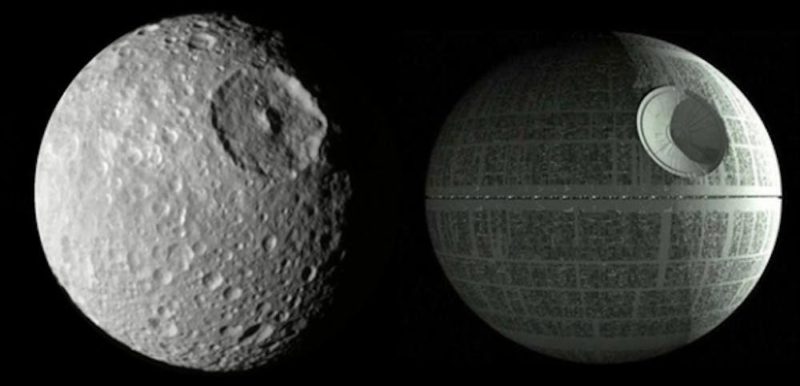
Saturn has a lot of moons. Two of them are really odd, and bear a striking resemblance to the Death Star from the Star Wars franchise. The moons in question are Mimas and Iapetus. So we have two real moons in our solar system that look like the Death Star? I have a bad feeling about this!
What Makes Mimas and Iapetus Look Like the Death Star?
Mimas has a crater of approximately the same scale as the one on the Death Star. Iapetus also has large craters, but the resemblance lies in its equatorial ridge. It’s fascinating how Mimas and Iapetus look remarkably like the Death Star thanks to these features. Images returned by the Cassini–Huygens spacecraft made the comparison even more striking when scientists saw the moons in high resolution.
Mimas’ Crater
Mimas, a mid-sized moon of Saturn discovered in 1789 by astronomer William Herschel, has a huge crater Herschel named after the discoverer of the moon. The crater’s diameter is 130 km, which is almost a third of the moon’s own diameter. Herschel’s walls are over 5 km high and its central peak rises to up to 6 km. Some parts of the crater go as deep as 10 km. To show the crater’s scale, if there was one with the same scale on Earth, it would have been over 4,000 km in diameter, which would make it wider than Canada. The impact that created this crater must have nearly shattered Mimas. The shock must have been so strong that fractures have formed on the opposite side of the moon.
Iapetus’ Equatorial Ridge
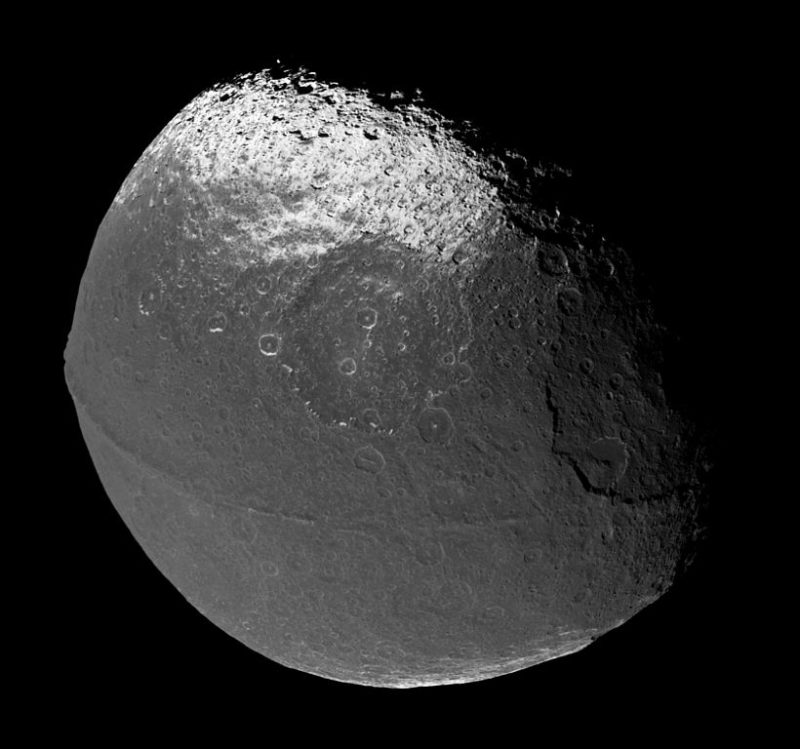
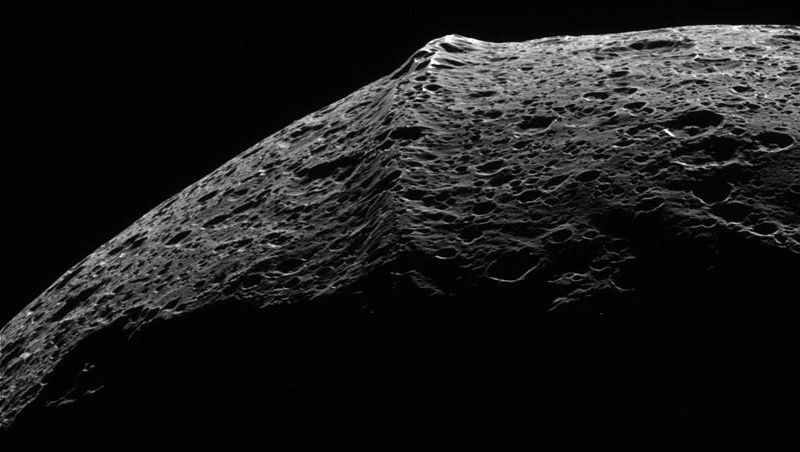
Iapetus, the third largest moon of Saturn and the 11th in the solar system, discovered in 1671 by astronomer Giovanni Domenico Cassini, has a mysterious equatorial ridge that runs for over 1,300 km. It is 20 km wide and about 13 km high. Some parts of the ridge rise as high as 20 km. Iapetus has one hemisphere much brighter than the other. What’s odd is that the ridge follows nearly perfectly the moon’s equator and that it is only prominent on the moon’s darker hemisphere. On the brighter hemisphere there are only a few high peaks that follow the same equatorial line as the ridge on the other side. The ridge system is heavily cratered which indicates that it is very ancient. The exact origin of the ridge is still debated by scientists. There are a few theories, but only three are close enough to explaining it:
- One such theory postulated by scientists associated with the Cassini mission, says that the ridge could be the remnant of an earlier time, when Iapetus was rotating much faster than today. The height of the ridge would suggest an initial rotational period of 17 hours. Iapetus cooled fast enough to preserve the ridge but remained plastic long enough for Saturn‘s tidal forces to have slowed its rotation down to 79 days (as it is currently), heated by the radioactive decay of aluminium-26, which is theorized to have been abundant during the early stages of the formation of Saturn and its moons.
- The ridge could have been icy material that welled up from beneath the surface and solidified. If this ridge formed away from the equator, it would have destabilized the moon’s rotational axis. Therefore the axis would keep oscillating until it stabilized with the ridge following nearly perfectly the equator.
- Other hypotheses suggest that the ridge may have formed when debris from a former ring or a destroyed sub-satellite collapsed onto Iapetus’ equator.
Conclusion
Saturn’s moons continue to surprise scientists with their strange and fascinating features. The giant Herschel crater on Mimas and the massive equatorial ridge on Iapetus make these worlds stand out among the many moons of the solar system. Because of these unusual formations, it’s easy to see why many people say that Mimas and Iapetus look like the Death Star. While the resemblance is purely coincidental, these moons remain some of the most visually striking objects orbiting Saturn.
Would you like to receive similar articles by email?

Paul Tomaszewski
Paul Tomaszewski is a science & tech writer as well as a programmer and entrepreneur. He is the founder and editor-in-chief of CosmoBC. He has a degree in computer science from John Abbott College, a bachelor's degree in technology from the Memorial University of Newfoundland, and completed some business and economics classes at Concordia University in Montreal. While in college he was the vice-president of the Astronomy Club. In his spare time he is an amateur astronomer and enjoys reading or watching science-fiction. You can follow him on LinkedIn and Twitter.



3 Comments
C. C.
The imagery we are able to obtain thru hi resolution optics never ceases to amaze me. I always wonder if we have equipment that is much more powerful in use that the public knows nothing about.
Captain Rick
“It’s a trap!”
Jess Woods
Wow, that imperial Death Star is cool! Why haven’t we built one of those instead of that stupid, cramped space station!