Microscopium Constellation Guide
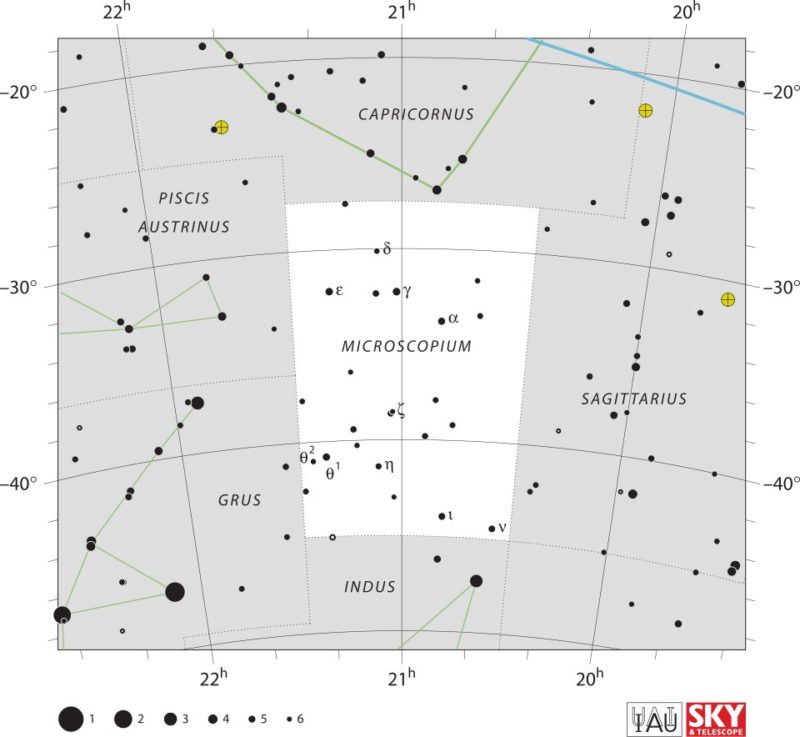
The name Microscopium promises a useful landmark, but the constellation itself is faint, small, and low in the sky for many observers. It lies in the southern celestial hemisphere between Sagittarius and Piscis Austrinus, and its brightest stars are only around fourth magnitude. That makes Microscopium easier to locate on a star map than by tracing its pattern unaided.
Where Is It, and How Large Is It?
Right Ascension and Declination
Microscopium sits near right ascension 20 hours 27 minutes and declination 36 degrees south. Those coordinates place it well below the celestial equator, in a region of the southern sky near Capricornus and Sagittarius. The constellation isn’t on the ecliptic, the Sun’s apparent annual path, so the planets don’t routinely pass through it.
Area and Boundaries
Microscopium covers about 210 square degrees, making it one of the smaller modern constellations. Its official borders were standardized by the International Astronomical Union, which defines constellations as specific regions of the sky, not just patterns of stars. The IAU’s explanation of constellation boundaries helps clear up a common mix-up: a constellation is an area; an asterism is a recognizable star pattern.
Neighboring Constellations
Microscopium is bordered by Capricornus, Sagittarius, Piscis Austrinus, Grus, Indus, and Telescopium. Nearby bright stars in those constellations can help orient you, though none forms a particularly obvious arrow pointing straight to the microscope-shaped figure. The shape is more an old scientific instrument on a chart than a convincing outline in the sky.
When and Where Can You See It?
Best Viewing Season
Microscopium is best placed for evening viewing from late summer into early fall, especially around August and September. The exact timing shifts with date and location, but it generally rises into view after sunset during the Northern Hemisphere’s late summer and the Southern Hemisphere’s winter.
Visibility by Latitude
The constellation is easiest to see from the Southern Hemisphere, where it climbs higher above the horizon. It can also be seen from temperate northern latitudes, roughly as far north as 45 degrees, but there it stays low in the south. From places farther north, it never rises above the horizon.
Light Pollution Limits
This is a faint constellation, and urban lighting can erase its dimmer stars before the search even begins. Dark skies make a real difference. If you’re observing from a city, spend your time on brighter neighboring constellations instead, then return to Microscopium from a darker site.
How Do You Find It in the Night Sky?
Start With Nearby Constellations
Find Sagittarius or Capricornus first, then look south toward Piscis Austrinus. A star map or astronomy app can show the borders and the constellation’s position for your exact location and time. A planisphere works, too; old technology still earns its place in a backpack.
Use a Dark-Sky Site
Choose a spot with a clear southern horizon and little artificial light. Microscopium’s brightest stars hover near magnitude 4.7, so trees, hills, haze, or a bright Moon can make the already faint pattern difficult to pick out. Give your eyes time to adapt, and use binoculars only to confirm stars once you have the general position. They won’t turn the whole constellation into a dramatic display.
Set Realistic Expectations
Microscopium is a constellation in name only for most people: its stars are dim, its outline is subtle, and it stays low for many observers. I wouldn’t make a trip just to hunt for it. Learn where it sits, enjoy the offbeat history, then move on to a richer patch of sky.
How Did Microscopium Get Its Name?
Nicolas-Louis de Lacaille
French astronomer Nicolas-Louis de Lacaille introduced Microscopium after observing the southern sky from the Cape of Good Hope in the 1750s. He created several new constellations to fill gaps between older patterns, naming many after instruments associated with science and innovation. Microscopium appeared in his published sky charts in the 18th century. Historical background on Lacaille’s constellations traces that practical, instrument-inspired project.
The Microscope Symbol
The name comes from the scientific instrument microscope, or le microscope in French. Its symbolic figure is a microscope, though the stars don’t neatly draw one. There is no ancient Greek myth attached to Microscopium; it belongs to the era of modern constellations, when astronomers mapped the southern sky with scientific tools in mind.
Notable Stars
Gamma Microscopii is the constellation’s brightest star, a yellow giant roughly magnitude 4.7. Alpha Microscopii is also a yellow giant, while Epsilon Microscopii is another prominent naked-eye star. The Greek letters identify stars within the constellation, but they don’t necessarily rank them in brightness.
AU Microscopii, often shortened to AU Mic, is a nearby red dwarf with a debris disk and a young planetary system. The Hubble observations of AU Microscopii’s changing debris disk offer a glimpse of material around a young star, a useful comparison point for thinking about how planetary systems develop. WASP-7, another Microscopium star, hosts the hot Jupiter WASP-7b, discovered using the transit method.
Deep-Sky Objects
Microscopium has few showpiece deep-sky objects, but telescope users can seek out galaxies such as NGC 6925, a spiral galaxy, and NGC 6958, an elliptical galaxy. Both are faint targets, so a small telescope under bright skies may show little more than a soft patch. A larger telescope and dark conditions reveal more structure, though neither galaxy is an easy visual prize.
FAQ
Is Microscopium visible from the Northern Hemisphere?
Yes, from some northern locations. It is best seen from the Southern Hemisphere, and from northern temperate regions it remains close to the southern horizon.
Does Microscopium have a myth?
No. Lacaille named it for a microscope, a scientific instrument, rather than a figure from Greek mythology.
What is the brightest star in Microscopium?
Gamma Microscopii is generally identified as the constellation’s brightest star, at about magnitude 4.7.
Conclusion
Microscopium is a small, faint southern constellation with a modern scientific name and a handful of worthwhile stars and galaxies. Find it from a dark site, keep expectations sensible, and let the science behind its quiet patch of sky do some of the work.
Would you like to receive similar articles by email?

Paul Tomaszewski
Paul Tomaszewski is a science & tech writer as well as a programmer and entrepreneur. He is the founder and editor-in-chief of CosmoBC. He has a degree in computer science from John Abbott College, a bachelor's degree in technology from the Memorial University of Newfoundland, and completed some business and economics classes at Concordia University in Montreal. While in college he was the vice-president of the Astronomy Club. In his spare time he is an amateur astronomer and enjoys reading or watching science-fiction. You can follow him on LinkedIn and Twitter.


You May Also Like

Why Scientists Need Clear Imaging to Solve Medical Mysteries
Space Elevator (Non-Rocket Spacelaunch)