Mensa Constellation Guide
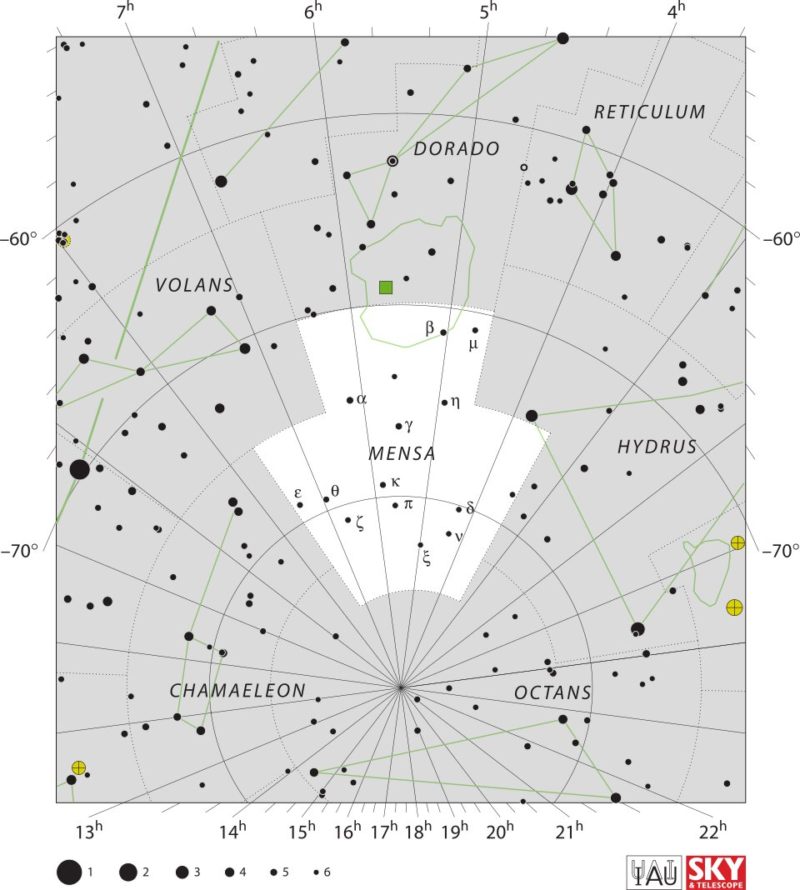
Mensa is a faint southern constellation named for Table Mountain in South Africa, and it’s a tough naked-eye target from anywhere under light-polluted skies. Its main draw is less the pattern of stars than the Large Magellanic Cloud, a nearby satellite galaxy that spills across Mensa and neighboring Dorado. If you’re looking for the high-IQ society, that’s a different Mensa; this is the Latin word for “table,” set among the stars.
Where Is Mensa in the Night Sky?
Southern Celestial Hemisphere
Mensa sits deep in the southern celestial hemisphere, close to the south celestial pole. Its boundaries run roughly from 70° to 85° south declination, making it one of the southernmost constellations. Only Octans lies farther south. The International Astronomical Union (IAU) defines its official borders, part of the standardized map astronomers use to locate celestial objects.
Neighboring Constellations
Mensa is bordered by Dorado, Hydrus, Octans, Chamaeleon and Volans. A constellation map helps show how these neighboring shapes fit together. In practice, the Large Magellanic Cloud is a useful landmark: this galaxy crosses the boundary between Mensa and Dorado, so it belongs to both regions of the sky.
Visibility by Latitude
Mensa is best viewed from the Southern Hemisphere. From locations south of about 20° north latitude, at least part of it rises above the horizon; from latitudes south of about 20° south, the whole constellation is circumpolar, meaning it never sets. That makes it observable from much of South America, southern Africa, Australia and, under the right conditions, parts of Antarctica. In the northern hemisphere, it stays low or out of view.
How Do You Find the Mensa Constellation?
Best Viewing Season
Look for Mensa on evenings in the Southern Hemisphere summer, especially around January and February, when it is well placed for observation. From the equatorial regions, it can also be seen low in the southern sky. Start with Canopus, one of the sky’s brightest stars, then look farther south toward the Large Magellanic Cloud. Mensa’s faint stars sit around and below that broad glow.
Star Charts and Coordinates
A star chart or astronomy app can do the unglamorous but useful work of marking Mensa’s boundary and the positions of its stars. The constellation spans about 153 square degrees, but its outline is subtle, and different charts may connect the same stars with different lines. For a precise map of the region, the educational Mensa guide from NOIRLab gives a helpful view of the constellation and its Table Mountain namesake.
Light Pollution Limits
Mensa has no star brighter than about magnitude 5, near the limit of what many people can see without optical aid. From a city or bright suburb, the whole constellation may look like an empty patch of sky. Dark skies matter here; even then, give your eyes time to adjust and use a dim red light rather than a phone screen.
How Did Mensa Get Its Name?
Nicolas Louis de Lacaille
French astronomer Nicolas Louis de Lacaille introduced the constellation in the 18th century, originally naming it Mons Mensae. His work helped fill in the southern sky’s less-charted regions. As Britannica’s account of Mensa notes, the modern constellation took shape in Lacaille’s cataloging, not in ancient Greek or Roman mythology.
Table Mountain
The name refers to Table Mountain near Cape Town, South Africa, where Lacaille observed the southern sky in the 1750s. He shortened Mons Mensae, Latin for “Table Mountain,” to Mensa. There’s no lion, hero or monster attached to this pattern, and no classical mythology to untangle. Its history is a record of exploration and astronomical mapping.
The Tablecloth Story
A familiar local image gives the name a little extra character: cloud often settles over Table Mountain like a cloth laid across a flat table. Lacaille saw a celestial echo in the Large Magellanic Cloud, which appears near the constellation. It’s a charming bit of history, though hardly a reason to oversell Mensa as a dramatic sight.
Which Stars Are Notable?
Alpha Mensae
Alpha Mensae is the constellation’s brightest star, though “brightest” is relative here: its apparent magnitude is about 5.1, too faint for reliable viewing in many places with light pollution. It’s a Sun-like G-type main-sequence star roughly 33 light-years away. Its SIMBAD astronomical record provides its measured properties and cross-identifications.
Gamma Mensae
Gamma Mensae is another useful point in the constellation’s sparse pattern. It appears close in brightness to Alpha Mensae, though neither makes a strong visual landmark. In a good star chart, the two help anchor the faint lines used to trace Mensa’s cup-like shape.
W Mensae
W Mensae is the more unusual stellar target. It is a variable yellow-white supergiant whose brightness can change dramatically; it belongs to the rare R Coronae Borealis class, stars known for sudden dimming when carbon-rich dust blocks their light. It’s an observing project for a telescope and careful records, not a bright point to pick out by eye.
What Can You See Beyond Its Stars?
Large Magellanic Cloud
The Large Magellanic Cloud is the region’s headline object: a dwarf satellite galaxy of the Milky Way, roughly 160,000 light-years from Earth. It covers parts of Mensa and Dorado, so the constellation doesn’t get sole ownership of this spectacular deep-sky neighbor.
NGC 1987
NGC 1987 is a star cluster associated with the Large Magellanic Cloud. It is faint and compact, making it a more rewarding target for telescopes and astrophotography than casual binocular viewing. Check its exact position on a current chart before observing; deep-sky catalogs and constellation boundaries can make a target’s location less intuitive than its name suggests.
Is Mensa Worth Observing?
Naked-Eye Expectations
Frankly, Mensa is a poor choice if the goal is a striking constellation. Its stars are faint, its pattern is modest, and from a bright site you may spend more time imagining the outline than seeing it. The basic challenge is clear: there are no showy bright stars to guide the eye.
Better Targets
Go for the Large Magellanic Cloud first, then explore its clusters and variable stars if you have suitable equipment. The galaxy is the genuine attraction, and it is shared with Dorado. Mensa’s value is partly cartographic: it gives astronomers a defined patch of sky in which to locate objects, even if the pattern itself doesn’t command attention.
Equipment Considerations
Binoculars can help reveal the LMC’s shape under dark skies, while a telescope is useful for individual clusters and W Mensae. Don’t buy gear just to “see Mensa.” Choose equipment for the object you actually want to observe, and let the constellation serve as a map.
FAQ
When is Mensa best visible?
Southern Hemisphere summer evenings, especially January and February.
Where can Mensa be seen from?
Latitudes 4° north to 90° south. Visible from South America, southern Africa, Australia, and Antarctica.
What is the brightest star in Mensa?
Alpha Mensae at magnitude 5.09. It is a Sun-like G-type star 33 light-years away. Too faint for naked-eye viewing under light pollution.
Conclusion
Mensa is a modern southern constellation with a practical name and a notably dim star pattern. Its story ties 18th-century astronomy to a real mountain near Cape Town, while its most compelling view comes from a galaxy shared across neighboring borders. Find a dark site, use a chart, and aim for the LMC. The table itself can wait.
Would you like to receive similar articles by email?

Paul Tomaszewski
Paul Tomaszewski is a science & tech writer as well as a programmer and entrepreneur. He is the founder and editor-in-chief of CosmoBC. He has a degree in computer science from John Abbott College, a bachelor's degree in technology from the Memorial University of Newfoundland, and completed some business and economics classes at Concordia University in Montreal. While in college he was the vice-president of the Astronomy Club. In his spare time he is an amateur astronomer and enjoys reading or watching science-fiction. You can follow him on LinkedIn and Twitter.


You May Also Like
Stargazing Calendar for November 2025

Dwarf Planet Ceres: Facts, Discovery, Surface, and Water Ice