Lyra Constellation Guide
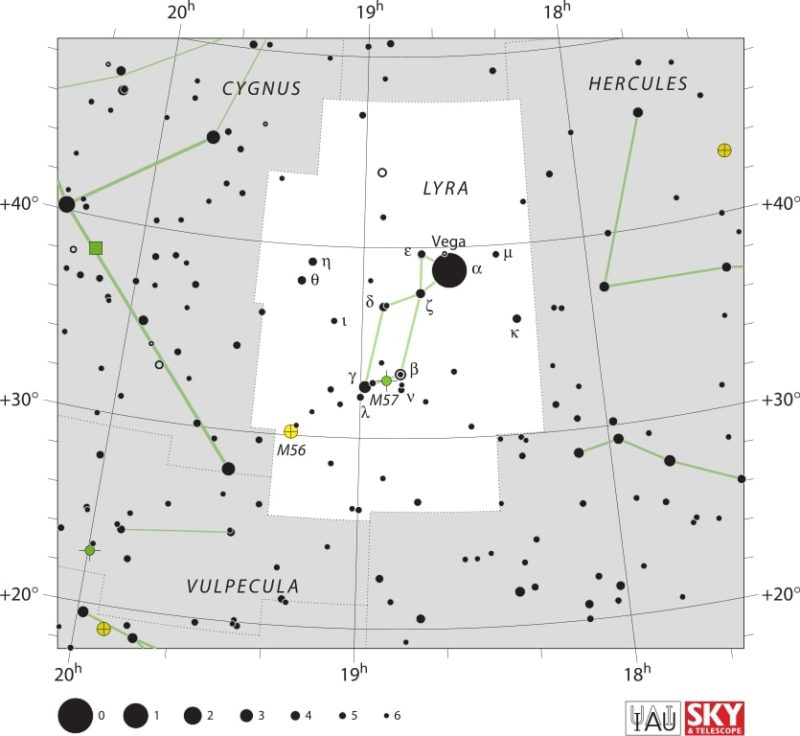
Lyra is a small northern constellation that’s easy to find because Vega, its brightest star, shines as one corner of the Summer Triangle. Look north in the Northern Hemisphere on a summer evening and you’ll find more than a handy sky marker: Lyra holds the Ring Nebula, a celebrated double-double star, and a myth that reaches back to ancient Greece.
The constellation covers about 286 square degrees, making it the 52nd largest. Its compact size is part of its charm. A bright star gives you a foothold, then a modest telescope opens the door to objects that are far less obvious.
Where Is Lyra in the Night Sky?
Northern Hemisphere
Lyra lies in the northern sky, between Cygnus and Hercules, with Draco and Vulpecula nearby. Its brightest point is hard to miss once it’s above the horizon: Vega has a visual magnitude of about 0.03 and sits roughly 25 light-years from Earth, according to this overview of Vega.
From the Southern Hemisphere, Lyra is visible mainly from locations closer to the equator, and it stays low in the sky. In much of the far south, it never rises. A map of Lyra’s neighboring constellations helps distinguish it from the larger patterns around it.
Summer Visibility
For observers in the Northern Hemisphere, Lyra is most prominent on summer evenings, when it climbs high enough to escape much of the haze near the horizon. It can be spotted at other times of year, too, though the hour matters: constellations appear to shift westward as Earth moves along its orbit.
Vega is bright enough to cut through some urban skyglow, but the fainter stars that trace Lyra’s shape may disappear in heavy light pollution.
Vega as a Guide
Start with Vega, then look for four modest stars forming a small parallelogram beside it. Those stars make the lyre’s body; a short extension suggests its strings. The shape isn’t grand, and that’s fine. Vega does the heavy lifting.
How Does Lyra Fit Into the Summer Triangle?
Summer Triangle Stars
The Summer Triangle is an asterism, not a constellation. Three bright stars from three separate constellations create its broad outline:
- Vega in Lyra
- Deneb in Cygnus
- Altair in Aquila
The triangle dominates summer skies in the Northern Hemisphere, and Lyra marks its northwest corner. EarthSky’s sky chart and guide show how the triangle and Lyra’s smaller harp-like pattern fit together.
Nearby Constellations
Cygnus lies beyond Vega in the direction of Deneb; Hercules sits on Lyra’s western side, while Vulpecula borders it to the south. The constellations can blur together when the sky is bright, so use the Summer Triangle as the broad landmark and Vega as the precise one.
Finding the Parallelogram
Once Vega is identified, the parallelogram is a short step away. Give your eyes a few minutes to adjust, then scan just beside the bright star rather than staring directly at it. A phone map can help, but a free star chart works just as well when the screen’s brightness is turned down.
Which Stars and Deep-Sky Objects Stand Out?
Vega
Vega is an A-type main-sequence star and one of the brightest stars in Earth’s night sky. It’s also a useful reference point for astronomers because its brightness and spectrum have long helped calibrate measurements. That scientific role is less visible than its familiar blue-white glow, but it’s one reason this star appears so often in astronomy.
Epsilon Lyrae
Epsilon Lyrae appears as a close pair to the unaided eye under dark skies. Binoculars separate the two stars; a telescope reveals that each is itself a pair, making the system a quadruple star. The nickname “Double-Double” is plainspoken and deserved. Observers describe it as a satisfying target even for small instruments in this guide to observing Lyra.
Ring Nebula
The Ring Nebula, also called M57, is a planetary nebula in Lyra. The name is a historical quirk: it has nothing to do with planets. It’s an expanding shell of glowing gas shed by a dying star, with a white dwarf at its center. NASA’s Ring Nebula profile explains how the star’s remnant and surrounding gas shape the object.
Through a small telescope, M57 looks like a faint smoke ring. Don’t expect a colorful Hubble image at the eyepiece; human vision in dim light is mostly grayscale. Still, seeing the nebula directly is a memorable little collision between everyday stargazing and stellar evolution. Lyra also contains the globular cluster M56, a compact, hazy target for binoculars or a telescope under dark skies.
What Does Lyra Look Like Through Binoculars or a Telescope?
Binoculars are ideal for separating Epsilon Lyrae and surveying the constellation’s star fields. A telescope brings out the Ring Nebula and M56, though steady air and a dark site matter more than sheer magnification. At high magnification, atmospheric turbulence can turn a crisp view into a quivering blur.
Try M57 when Lyra is high overhead. Looking through a thick layer of atmosphere near the horizon softens the view, a familiar frustration for observers. Averted vision, where you look slightly beside the object, can make the nebula easier to detect.
What Myths Are Linked to Lyra?
Lyra represents the lyre associated with Orpheus, the legendary musician whose playing could charm people, animals, and even the natural world. In Greek tradition, the instrument was placed among the stars. The constellation is also sometimes called the Harp, though the lyre is the more precise historical instrument.
What Meteor Showers Radiate from Lyra?
Lyra lends its name to the annual Lyrid meteor shower, which usually peaks around April 22. The meteors are debris from Comet C/1861 G1 Thatcher, not stars falling from Lyra. They appear to stream from a radiant in the constellation because of perspective, much as parallel road lines seem to meet in the distance. The Lyrids are modest in many years, but occasional outbursts make them worth watching from a dark location.
When Is the Best Time to Observe Lyra?
In the Northern Hemisphere, aim for summer evenings, ideally when Lyra is high and the Moon is not washing out the sky. For the Ring Nebula, give your eyes time to adapt and keep nearby lights out of view. In late summer and early autumn, Lyra shifts toward the western sky after dark, where atmospheric distortion can make faint targets harder to see.
FAQ
Is Lyra a constellation or an asterism?
Lyra is an officially recognized constellation. The Summer Triangle is an asterism made from stars in Lyra, Cygnus, and Aquila.
Can you see the Ring Nebula without a telescope?
No. M57 is too faint and small for unaided viewing; binoculars may show it under excellent conditions, but a telescope gives a much better chance.
Is Vega the brightest star in the sky?
No. Vega is among the brightest stars visible at night, but Sirius is brighter.
Conclusion
Lyra makes a generous first stop on a summer night: Vega is easy to find, the parallelogram rewards a closer look, and the Ring Nebula gives a small telescope a genuine deep-sky target. Explore it slowly, and the constellation’s modest outline begins to connect stellar science, old mythology, and the annual Lyrid meteor shower.
Would you like to receive similar articles by email?

Paul Tomaszewski
Paul Tomaszewski is a science & tech writer as well as a programmer and entrepreneur. He is the founder and editor-in-chief of CosmoBC. He has a degree in computer science from John Abbott College, a bachelor's degree in technology from the Memorial University of Newfoundland, and completed some business and economics classes at Concordia University in Montreal. While in college he was the vice-president of the Astronomy Club. In his spare time he is an amateur astronomer and enjoys reading or watching science-fiction. You can follow him on LinkedIn and Twitter.


You May Also Like

NASA Night Sky Network Guide for Clubs and Individuals
How Circumbinary Planets Stay Stable: Key Mechanics