Lynx Constellation Guide
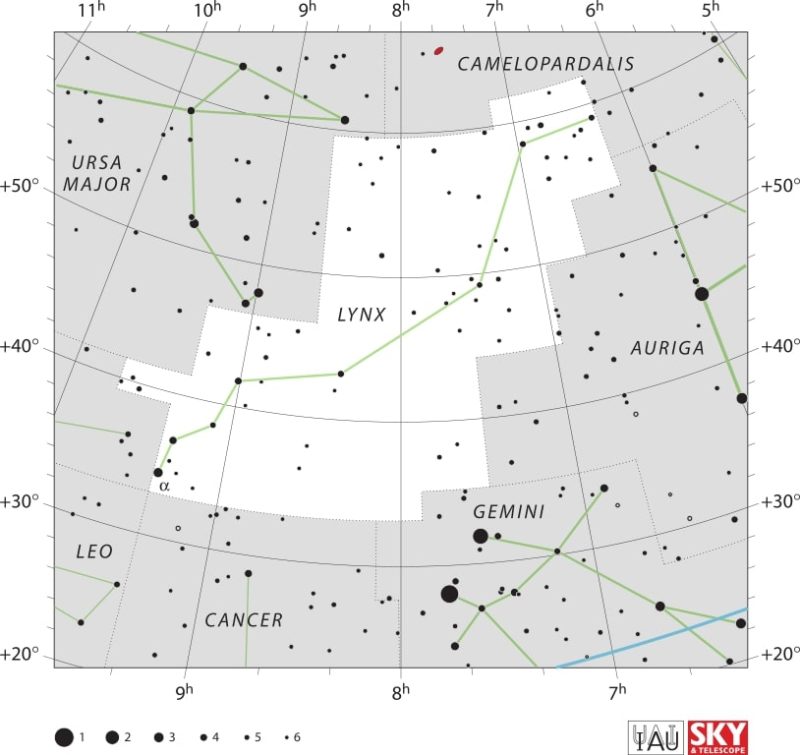
Lynx is a large, faint northern constellation between Ursa Major and Auriga, and its best targets are easier to appreciate through binoculars or a telescope than by tracing its outline. It has no bright, unmistakable pattern and little classical myth attached to it. That sounds like a poor invitation to stargaze. In practice, Lynx rewards a different kind of curiosity: look past the scattered stars and you’ll find double stars, a remote globular cluster, and galaxies that tell much bigger stories.
How did Hevelius create Lynx?
A late-17th-century constellation
Polish astronomer Johannes Hevelius introduced Lynx in the late 17th century, filling a broad, relatively bare region of the northern sky between established constellations. Unlike Orion or Ursa Major, it wasn’t shaped around a familiar figure from Greek myth. Hevelius was mapping stars that earlier sky charts had left without a named constellation.
The history of Hevelius’s constellations helps explain why Lynx feels more like a patch on a chart than a character in a story. The International Astronomical Union (IAU) later standardized constellation boundaries, turning such regions into defined areas of the celestial sphere. Lynx now covers about 545 square degrees, making it one of the larger constellations, though size alone does little to make it conspicuous.
The “eyes of a lynx” remark
Hevelius reportedly joked that observers would need the “eyes of a lynx” to see the constellation. It’s a neat line, and not much of an exaggeration. Most of its stars are faint, while its brightest, Alpha Lyncis, has an apparent magnitude of about 3.14. On the magnitude scale, lower numbers mean greater brightness, so Alpha is visible under dark skies but won’t dominate them.
What makes this constellation hard to see?
Faint, scattered stars
Lynx lacks a star brighter than magnitude 3, and its main stars are spread across a wide area. Even under a clear sky, the pattern can take patience to pick out. Light pollution makes the task considerably harder; a suburban observer may see Alpha Lyncis and little else.
No dominant pattern
The stars form a loose zigzag rather than a crisp outline. There’s no single bright marker to anchor the whole constellation, which is why trying to memorize its shape often becomes an exercise in frustration. A star chart or astronomy app is more useful than sheer optimism.
Its celestial neighbors
Lynx sits between Ursa Major, Auriga, Gemini, and Cancer, with Camelopardalis nearby. These neighbors provide practical landmarks: find the Big Dipper, part of Ursa Major, then look toward Auriga and Gemini. A star map and boundary reference can help distinguish Lynx from the surrounding star fields.
Which stars and double stars stand out?
Alpha Lyncis
Alpha Lyncis is the constellation’s brightest star, a red giant roughly 200 light-years away. Its orange-red color differs from the white and blue-white stars common in many familiar patterns. It’s a useful starting point, though “starting point” is doing some work here: Alpha won’t reveal the whole constellation by itself. NOIRLab’s Lynx constellation guide provides its brightness and other basic observing details.
12 Lyncis
For telescope users, 12 Lyncis is a more engaging target. It is a multiple-star system whose components can be separated with suitable optics and steady viewing conditions. The challenge depends on aperture, magnification, atmospheric steadiness, and the observer’s experience, so there’s no magic setting that works every night.
38 Lyncis
38 Lyncis is another double-star target, with contrasting white and blue-white components. It sits close to the boundary with Ursa Major and is a satisfying test of careful focusing.
Where and when can you find it?
Lynx is best placed for northern observers on winter and early spring evenings, reaching high in the sky during late winter. It is visible across much of the Northern Hemisphere and can also be seen from parts of the Southern Hemisphere, though it sits lower there.
Start with Ursa Major and Auriga, then scan the space between them for Alpha Lyncis and the faint chain of stars nearby. Exact visibility depends on latitude, time, and horizon conditions; a planisphere or sky app set to your location will make the search easier.
Which deep-sky objects are worth observing?
NGC 2419
NGC 2419 is a remote globular cluster, a dense sphere of old stars in the outer reaches of the Milky Way. Its nickname, the “Intergalactic Wanderer,” reflects its great distance from the galactic center, not that it has escaped the Milky Way. It lies roughly 300,000 light-years from Earth, and its stars are too faint to resolve individually in most small telescopes.
NGC 2683
NGC 2683 is a spiral galaxy seen nearly edge-on, often nicknamed the UFO Galaxy for its elongated profile. It lies tens of millions of light-years away and is a rewarding target under dark skies with a telescope. Expect a soft, narrow glow rather than a colorful photograph; the eye gathers light differently from a camera sensor.
APM 08279+5255
This distant quasar is powered by material falling toward a supermassive black hole. Its light has traveled for billions of years, and gravitational lensing by foreground matter magnifies the object for astronomers. It’s far beyond ordinary backyard observing, but its presence gives Lynx an astonishing second identity: a quiet patch of sky that opens onto the early universe.
What should you know before observing?
Don’t buy equipment just to “see” Lynx. Begin with dark adaptation, a clear chart, and a dark site; give your eyes about 20 minutes to adjust, and avoid checking a bright phone screen. Then aim for one specific target, such as 38 Lyncis or NGC 2419, rather than trying to outline every faint star.
How far away are its notable objects?
The distances span a startling range. Alpha Lyncis is about 200 light-years away, while NGC 2419 is roughly 300,000 light-years from Earth. NGC 2683 is tens of millions of light-years away, and APM 08279+5255 is seen from an era billions of years in the past. Those objects merely appear in the same constellation from our viewpoint; they aren’t neighbors in space.
FAQ
What does the Lynx constellation represent?
It represents a lynx (the wild cat). Johannes Hevelius created it in 1687, naming it because the constellation is so faint that “only the eyes of a lynx” can see it.
Where is the Lynx constellation located?
In the northern celestial hemisphere, between Ursa Major (to the west/northwest) and Auriga (to the southeast). Approximate coordinates: right ascension 8h, declination +50°. Best viewed from northern latitudes in late winter/spring.
What is the brightest star in the constellation Lynx?
Alpha Lyncis, an orange giant (spectral type K7 III) at apparent magnitude 3.14, about 203 light-years away.
Conclusion
Lynx is a lousy naked-eye constellation and a decent telescopic neighborhood. Hevelius’s faint filler stars may never become anyone’s favorite sky pattern, but the double stars and deep-sky objects give patient observers plenty to explore. The outline is optional. The discoveries aren’t.
Would you like to receive similar articles by email?

Paul Tomaszewski
Paul Tomaszewski is a science & tech writer as well as a programmer and entrepreneur. He is the founder and editor-in-chief of CosmoBC. He has a degree in computer science from John Abbott College, a bachelor's degree in technology from the Memorial University of Newfoundland, and completed some business and economics classes at Concordia University in Montreal. While in college he was the vice-president of the Astronomy Club. In his spare time he is an amateur astronomer and enjoys reading or watching science-fiction. You can follow him on LinkedIn and Twitter.


You May Also Like

Why Do We Think Triton Is a Captured Moon?

How Did the Moon Get Its Name?