Lupus Constellation Guide
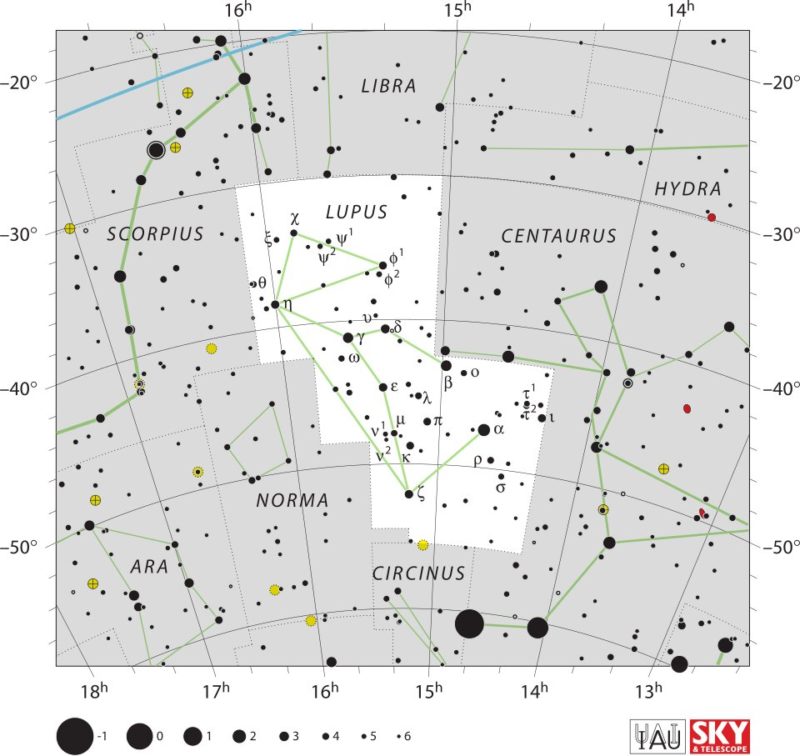
Lupus is a southern-sky constellation whose modest outline hides a busy patch of astronomy: bright blue stars, young stellar populations, an open cluster, and the remnant of a supernova seen a thousand years ago. It is easiest to trace from the Southern Hemisphere. However, parts can be seen from lower northern latitudes. The wolf in its name arrived later than the stars themselves; ancient sky-watchers first treated the figure as a more general wild animal.
What Is the Lupus Constellation?
Southern Sky
Lupus lies between Centaurus and Scorpius, with Norma and Ara nearby. Its name is Latin for “wolf,” and its standard three-letter abbreviation is Lup. The constellation sits deep in the southern sky. Therefore, it makes a useful stop on a tour that often begins with the conspicuous Southern Cross or Alpha Centauri.
IAU Boundaries
The International Astronomical Union (IAU) recognizes 88 official constellations, each with defined borders. Those boundaries turn familiar star patterns into mapped regions of the sky. This means an object can belong to Lupus even if it sits well outside the lines people imagine when they connect its brightest stars. The IAU’s explanation of constellations covers this distinction.
Shape and Size
Lupus covers about 334 square degrees, placing it around the middle in area among the modern constellations. Its stars form an uneven, tapering pattern rather than a crisp outline. Depending on the chart, the figure can look more like a beast held near Centaurus than a wolf drawn by itself. A NOIRLab constellation profile identifies Lupus among the 48 constellations cataloged by Ptolemy in the second century.
How Did Lupus Get Its Name?
Ancient Star Catalogs
The stars of Lupus were part of ancient sky maps long before the constellation acquired its current familiar label. Ptolemy recorded it in the Almagest, preserving a pattern known to earlier Greek astronomers. The name Lupus is Latin, but its history is less tidy than “the wolf constellation” suggests. Ancient descriptions commonly referred to an animal, without settling on a specific creature.
The Centaur Connection
In classical star imagery, Centaurus appears to hold or carry the animal toward an altar, represented by the nearby constellation Ara. That association helps explain why Lupus can feel visually incomplete when viewed alone. The animal’s identity shifts across old accounts and translations. Furthermore, no single famous Greek or Roman myth gives Lupus the sort of narrative attached to Hercules or the lion of Leo.
From Wild Animal to Wolf
Some historical accounts connect the figure with the Greek word therion, meaning wild animal. Over time, translations and traditions made the wolf interpretation more common. However, that does not mean every ancient observer saw a wolf in the stars; constellation figures were cultural maps, not fixed illustrations.
Which Stars and Deep-Sky Objects Stand Out?
Alpha and Beta Lupi
Alpha Lupi, the constellation’s brightest star, is a blue giant roughly 460 light-years away. It shines at about magnitude 2.3, bright enough to pick out from a dark site. However, its low position can make it less striking for observers near the northern edge of its visibility. Beta Lupi is another blue giant, slightly fainter, and helps anchor the constellation’s central pattern.
These stars belong to a wider region of young, massive stars associated with the Upper Centaurus–Lupus stellar association. Nearby molecular clouds are still forming stars, making Lupus valuable for studying how young stellar systems emerge. EarthSky summarizes research on star formation in the Lupus clouds.
Zeta Lupi
Zeta Lupi is a double star: two points of light that can be separated with suitable observing conditions and optical aid. It offers a more immediate target than faint galaxies, especially for someone learning to move from naked-eye patterns to telescope viewing. Take time with it; a good double star rewards careful focus more than a rushed sweep.
NGC 5822 and SN 1006
NGC 5822 is a loose open cluster, a broad scattering of stars rather than a compact knot. Under a dark sky, binoculars or a small telescope can help reveal its uneven texture. Lupus also contains SN 1006, the expanding remnant of a supernova recorded in historical accounts in the year 1006. It was exceptionally bright in Earth’s sky. However, the remnant itself is a challenging visual target; modern X-ray observatories show its shock waves and high-energy structure. NASA’s Chandra observations of SN 1006 reveal what ordinary backyard optics cannot.
Another notable object is IC 4406, often called the Retina Nebula because of its lattice-like appearance in detailed images. The Hubble image of IC 4406 shows a planetary nebula, the expelled outer layers of a dying star, not a planet-forming disk.
When and Where Is Lupus Visible?
Lupus is best placed for evening viewing around May and June. From much of the Southern Hemisphere, it climbs high enough to observe comfortably. In northern temperate regions, it stays low in the south. Observers around the northern United States may see only its northern parts, if local horizons are clear. Farther north, the constellation can be difficult or impossible to see in full.
How Can You Find and Observe Lupus?
Start with Centaurus, then look east toward Scorpius and south toward Ara. A star chart or astronomy app can help distinguish Lupus from the surrounding patterns, especially because the constellation has no single unmistakable shape. Choose a site with an open southern horizon. Nearby trees and buildings can hide the lower stars even when the sky is otherwise dark.
Binoculars are a sensible first tool for the wide star fields and NGC 5822. A telescope adds detail to double stars and faint objects. However, steady air and a clear horizon matter more than magnification. Give your eyes time to adjust, and keep expectations grounded: Lupus is a rewarding region to explore, not a constellation that announces itself with one dazzling centerpiece.
What Makes Lupus Worth Exploring?
I like Lupus because its appeal builds slowly. The bright stars provide a route in. Then, the history, young stellar association, and SN 1006 widen the view from a simple pattern to a region shaped by stellar birth and stellar destruction. Its wolf is a useful reminder, too, that constellations carry layers of human interpretation; the stars stay put, while the story changes.
FAQ
Is Lupus visible from the Northern Hemisphere?
Partly, from lower northern latitudes. It remains low in the southern sky, and much of it is below the horizon from more northerly locations.
Is Lupus the same as Centaurus?
No. Lupus and Centaurus are separate IAU constellations, though their traditional figures are closely linked in classical star maps.
What is the best-known object in Lupus?
SN 1006 is among its most historically significant objects. NGC 5822 and the Retina Nebula, IC 4406, are also notable observing targets.
Conclusion
Lupus rewards a little patience. Find its bright stars first, then use them to explore a constellation where ancient animal lore meets modern studies of star formation and supernova remnants. Its outline may be subtle, but the science behind it is anything but.
Would you like to receive similar articles by email?

Paul Tomaszewski
Paul Tomaszewski is a science & tech writer as well as a programmer and entrepreneur. He is the founder and editor-in-chief of CosmoBC. He has a degree in computer science from John Abbott College, a bachelor's degree in technology from the Memorial University of Newfoundland, and completed some business and economics classes at Concordia University in Montreal. While in college he was the vice-president of the Astronomy Club. In his spare time he is an amateur astronomer and enjoys reading or watching science-fiction. You can follow him on LinkedIn and Twitter.


You May Also Like

What Is the Antihelion Source Meteor Shower?
Chamaeleon Constellation Guide