Libra Constellation Guide
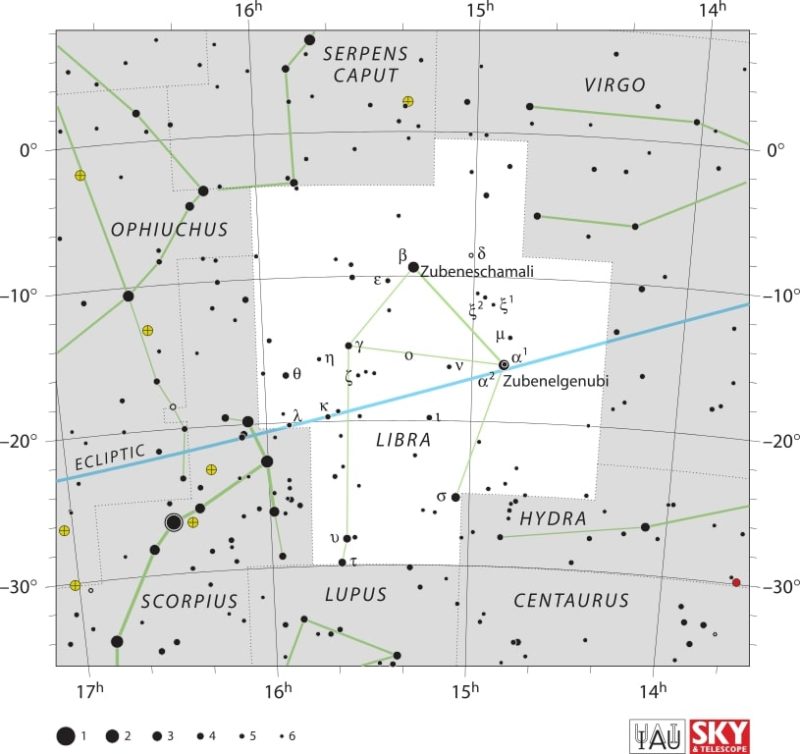
Libra is a faint zodiac constellation in the southern part of the sky, best known for its ancient association with weighing scales and its position between Virgo and Scorpius. Its stars don’t sketch an obvious set of scales, which may explain why the constellation’s identity shifted over time. Still, Libra offers a satisfying mix of old sky lore, double stars, galaxies, and a nearby planetary system to explore.
Astronomers use the Latin name Libra and the abbreviation Lib; the word Librae appears in star names and astronomical descriptions.
What makes Libra distinctive?
The celestial scales
The scales are a symbol of balance and judgment, ideas later linked with Roman depictions of justice. Libra’s position on the ecliptic, the Sun’s apparent annual path across the sky, also gave it a connection to the equinox. In antiquity, the Sun passed through this region around the autumnal equinox in the Northern Hemisphere, when day and night were close to equal length.
The zodiac’s only object
Libra is the zodiac’s only constellation represented by an inanimate object. The others portray animals or human figures, though constellation imagery is more a mapmaking tradition than a literal picture. Libra sits between Virgo and Scorpius, giving it a natural place in the zodiac sequence.
Scorpius’s former claws
The story gets messier in ancient Greece. Greek astronomers often treated Libra’s stars as Chelae, the outstretched claws of Scorpius. The Roman name and scales imagery eventually became established, while a much older Babylonian designation, Zibanu, also referred to scales. The constellation, then, carries more than one cultural layer; it wasn’t simply invented in a single moment by one civilization.
Where can you find it in the sky?
Neighboring constellations
Libra lies between Virgo to the west and Scorpius to the east. Ophiuchus is to the north, while Lupus and Hydra lie nearby farther south and west. The Libra observing guide gives its position near right ascension 15 hours 30 minutes and declination 15 degrees south. Those coordinates place it south of the celestial equator, but not so far south that many northern observers lose it.
Northern and southern visibility
Libra is visible from both hemispheres. Observers in the Northern Hemisphere find it low in the southern sky, while those farther south see it higher overhead. From locations near the equator, the constellation can appear especially well placed. Latitude matters, of course: buildings, hills, and haze near the horizon can hide its dimmer stars.
Seasonal viewing
Late spring into summer is a good time to look from the Northern Hemisphere, with Libra prominent in the evening sky around June and July. In the Southern Hemisphere, the same calendar months bring winter skies, but the constellation still appears comfortably positioned for viewing. A simple sky diagram or free stargazing app can help you trace its outline from Scorpius’s brighter stars.
Which stars and deep-sky objects stand out?
Alpha Librae
Alpha Librae, also called Zubenelgenubi, is a multiple-star system. Its name means “the southern claw,” a reminder of Libra’s earlier connection to Scorpius. The components can be separated with binoculars under suitable conditions, though a telescope gives a steadier view. Don’t expect a bright beacon: Libra is a faint constellation, and even its prominent stars are modest beside Scorpius’s Antares.
Beta Librae
Beta Librae, or Zubeneschamali, is Libra’s brightest star, with an apparent magnitude around 2.6. It is a blue-white star, sometimes described by observers as having a slight greenish cast. That impression is subtle and can depend on contrast, eyesight, and the nighttime environment; it isn’t a reliably vivid green star.
Notable observing targets
Libra has no Messier objects, but there are worthwhile targets for a small telescope. NGC 5897 is a loose globular cluster, a crowded association of old stars that appears faint and diffuse in modest equipment. Under dark skies, a telescope can begin to resolve some of its stellar texture. Galaxies also occupy the region, though they tend to demand patience and averted vision. Here the reward is less spectacle than the quiet pleasure of finding a distant object in a seemingly unremarkable patch of sky.
Which exoplanets lie within its boundaries?
The red dwarf Gliese 581 lies in Libra, about 20 light-years from Earth, and has been studied for its planetary system. NASA’s exoplanet archive entry tracks the system’s planetary records, while NASA’s profile of GJ 581 c describes a planet with a mass several times that of Earth and an orbit lasting about 12.9 days.
That short orbit matters. GJ 581 c is not a confirmed Earth-like world, and its proximity to its star makes a hot environment likely. Claims about habitable exoplanets in this system have shifted as researchers reassessed the evidence and the meaning of a star’s habitable zone. A planet’s position in that zone alone cannot establish that it has liquid water, a suitable atmosphere, or life. NASA’s overview of the Gliese 581 system offers more context on the discoveries made using the HARPS spectrograph.
How can you observe it?
Choose a clear evening in late spring or summer, then find Scorpius or Virgo first; Libra sits between them, a faint link in a much brighter stretch of sky. Give your eyes about 20 minutes to adjust to the dark, and keep phone screens dim. Binoculars can help distinguish Alpha Librae’s components, while a small telescope is useful for globular cluster NGC 5897. A printed diagram works just as well as an app, especially if you want to learn the star pattern rather than simply point a screen at it.
FAQ
Is Libra easy to see?
Not especially. Its main stars are visible from dark locations, but city light pollution can wash out the pattern. Use nearby Scorpius as a guide.
What is special about the Libra constellation?
Libra is the only zodiac sign that isn’t an animal or person; it’s just scales. Its two brightest stars were once thought to be part of the scorpion’s claws. Look closely at the brighter one: it’s actually two stars side by side.
Can you see Gliese 581 or its planets?
Gliese 581 is a faint red dwarf, not a naked-eye target for most observers. Its planets are far too close to the star in the sky to distinguish directly with ordinary backyard telescopes.
Conclusion
Libra rewards a slower look. Its scales carry a layered history, its brightest stars have memorable names, and its planetary system reminds us how much astronomy depends on careful evidence, not hopeful labels. Find the constellation between Virgo and Scorpius, and a quiet patch of sky starts to offer more than first meets the eye.
Would you like to receive similar articles by email?

Paul Tomaszewski
Paul Tomaszewski is a science & tech writer as well as a programmer and entrepreneur. He is the founder and editor-in-chief of CosmoBC. He has a degree in computer science from John Abbott College, a bachelor's degree in technology from the Memorial University of Newfoundland, and completed some business and economics classes at Concordia University in Montreal. While in college he was the vice-president of the Astronomy Club. In his spare time he is an amateur astronomer and enjoys reading or watching science-fiction. You can follow him on LinkedIn and Twitter.


You May Also Like
Exo-Gas Giant Atmospheres: Formation, Differences
Why Is Venus the Hottest Planet?