Lepus Constellation Guide
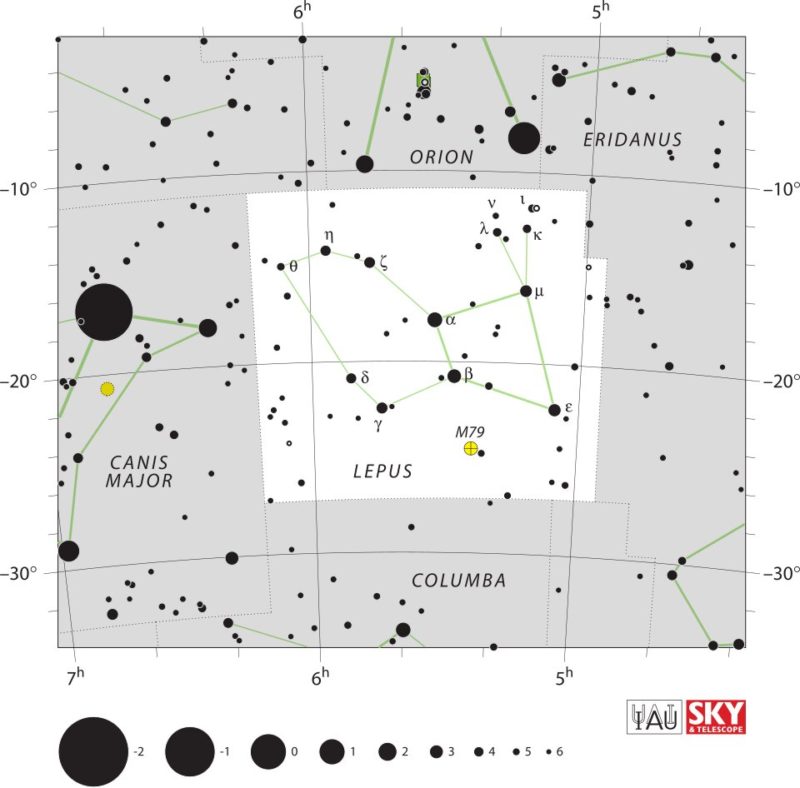
Lepus is a compact winter constellation south of Orion, recognizable as a crouching hare beneath the hunter’s feet. Its pattern is modest rather than dazzling, yet it rewards careful observation with bright stars, a remarkable carbon star, the globular cluster Messier 79, and the delicate Spirograph Nebula. In light-polluted cities, Lepus can look like a forgotten rabbit. Under a dark sky, the whole constellation becomes much easier to trace.
Where Is Lepus in the Night Sky?
Orion’s Southern Neighbor
Look first for Orion’s familiar belt and bright stars. Lepus lies directly south of Orion, near the hunter’s feet, with Canis Major and Sirius farther east. The arrangement gives the winter sky a bit of narrative motion: Orion appears to pursue the hare while his hunting dog follows nearby.
The boundaries are official, not artistic guesswork. The International Astronomical Union standardized the modern constellation borders in 1922, making Lepus one of the recognized western IAU constellations.
Celestial Coordinates
Lepus spans roughly 290 square degrees and occupies right ascension from about 4 hours 55 minutes to 6 hours 12 minutes, with declinations south of the celestial equator. Its location makes it especially useful for learning how a constellation’s position relates to Earth’s axis and the celestial hemisphere.
Northern And Southern Visibility
Observers in the northern hemisphere can see Lepus during the winter months, although it remains low toward the south. The constellation rises higher for viewers closer to the equator and becomes a much more comfortable target from the southern hemisphere. EarthSky’s winter observing guide provides a useful sense of its nightly path.
What Shape Does Lepus Have?
Hare-Like Star Pattern
Lepus does not resemble a rabbit in the way Orion resembles a human figure. The shape is more like a four-sided body with a small head and ears suggested by nearby stars. Those stick figures depend heavily on imagination, star charts, and the observer’s patience.
A simple diagram helps. Start with Arneb and Nihal, then follow the surrounding stars toward the compact outline. The hare appears to crouch beneath Orion rather than sprint across the sky, which fits the old story better than the actual geometry does.
Brightness And Boundaries
Lepus is a small constellation with several second- and third-magnitude stars, though none rivals Sirius or Rigel. Its southern position means atmospheric haze can soften the view, especially above city rooftops. Go-Astronomy’s overview places it among the larger half of the 88 modern constellations, despite its visually compact shape.
Identifying Landmarks
The easiest landmarks are Orion’s feet, Saiph and Rigel, which sit immediately north of Lepus. From there, move south and slightly east to locate the hare’s body. Eridanus curls away to the west, while Monoceros occupies the region east of Orion.
Which Stars Define Lepus?
Arneb
Arneb, or Alpha Leporis, is the constellation’s brightest star. It is a distant white supergiant with an apparent magnitude near 2.6, bright enough to anchor the pattern even when faint surrounding stars disappear. NOIRLab’s constellation guide identifies Arneb as the principal beacon of Lepus.
Nihal
Nihal, or Beta Leporis, forms another major point in the hare’s body. The name comes through Arabic and is commonly associated with camels quenching their thirst, an oddly vivid image in a constellation otherwise dominated by a running animal. Nihal appears yellowish compared with Arneb, giving the region a little color contrast.
Hind’s Crimson Star
R Leporis is a long-period variable star and a carbon star, famous for its deep red appearance. Its brightness changes substantially, so it may be subtle during one observation and much more noticeable during another. The nickname Hind’s Crimson Star comes from astronomer John Russell Hind, who observed its striking color in the nineteenth century.
What Deep-Sky Objects Are Inside Lepus?
Messier 79
Messier 79 is a globular cluster containing a dense, ancient population of stars. It lies in the outer regions of the Milky Way and has sometimes been discussed in connection with the disrupted Canis Major dwarf galaxy, though that interpretation remains debated. A medium-aperture telescope can begin to resolve its grainy appearance under a dark sky.
The Spirograph Nebula
The Spirograph Nebula, IC 418, is a planetary nebula roughly 2,000 light-years from Earth. Its glowing shell formed after a dying star expelled its outer atmosphere. The nebula measures about 0.1 light-years across and shows intricate internal structure in Hubble imagery. NASA’s profile of IC 418 reveals why this small object has become such a favorite among astrophotographers.
Accessible Telescope Targets
IC 418 is faint and compact, while M79 is generally the more approachable target. Binoculars can help identify the field, but aperture amateur telescopes are better suited to separating these objects from the surrounding stars.
How Did Lepus Become the Celestial Hare?
The constellation was recorded by Ptolemy in the second century and preserved through later Greek and Latin astronomy. In the familiar story, Orion hunts Lepus while Canis Major chases behind it. The hare’s placement beneath Orion’s raised foot gives the scene its visual drama.
Not every story agrees. One legend links hares to the island of Leros, where they multiplied so quickly that they overwhelmed the local ecosystem. Other folklore connects the animal with fertility, spring, and later rabbit symbolism. These accounts belong to different traditions, not one universally accepted Greek myth.
What Does Lepus Mean Across Cultures?
The Arabic sky tradition used different names and groupings for some of the surrounding stars, while later European maps settled on the Latin Lepus, meaning hare. The constellation itself has no physical connection to rabbits, hunting, or mythology. It is a line-of-sight pattern made from unrelated stars.
How Can You Find Lepus?
Best Viewing Season
February is an especially favorable month for Lepus in the northern hemisphere. Begin observing after Orion becomes prominent in the evening, then scan below the hunter before the constellation sinks toward the southern horizon.
Light Pollution
City light erases the dimmer outline first. Find an unobstructed southern horizon, allow your eyes time to adapt, and use a red flashlight rather than a bright phone screen. A planisphere or astronomy app can prevent the common mistake of searching beneath the wrong foot of Orion.
Binoculars And Telescopes
Binoculars reveal the star field around Arneb and Nihal, but a telescope makes M79 and IC 418 more rewarding. Do not expect the glowing colors shown in processed images. The eye sees faint gray-green impressions; cameras collect light patiently.
What Should You Notice Beyond the Main Features?
Lepus is valuable precisely because it is easy to overlook. Its stars sit in a crowded winter region where Orion, Sirius, and the Milky Way usually steal attention. Spend a few minutes tracing the boundaries, and the constellation becomes a useful lesson in celestial geography, variable stars, historical storytelling, and the limits of naked-eye astronomy.
FAQ
Is Lepus a southern constellation?
It is positioned south of the celestial equator, but observers across much of the northern hemisphere can still see it during winter.
What is the brightest star in Lepus?
Arneb, also called Alpha Leporis, is the brightest star.
What deep-sky object is best known in Lepus?
Messier 79 is the most famous, while IC 418 is notable for its detailed planetary-nebula structure.
Does Lepus really look like a rabbit?
Only loosely. Its hare shape comes from connecting selected stars into a traditional diagram.
Conclusion
Lepus rewards the observer who looks past the obvious. Beneath Orion’s famous silhouette sits a compact constellation with ancient stories, changing stars, and distant stellar fossils. Once Arneb and Nihal become familiar, the celestial hare stops being a minor winter curiosity and turns into a gateway for exploring the deeper structure of the sky.
Would you like to receive similar articles by email?

Paul Tomaszewski
Paul Tomaszewski is a science & tech writer as well as a programmer and entrepreneur. He is the founder and editor-in-chief of CosmoBC. He has a degree in computer science from John Abbott College, a bachelor's degree in technology from the Memorial University of Newfoundland, and completed some business and economics classes at Concordia University in Montreal. While in college he was the vice-president of the Astronomy Club. In his spare time he is an amateur astronomer and enjoys reading or watching science-fiction. You can follow him on LinkedIn and Twitter.


You May Also Like
List of Meteor Showers in 2026

Light Pollution Solutions