Leonis Minorid Meteor Shower Guide
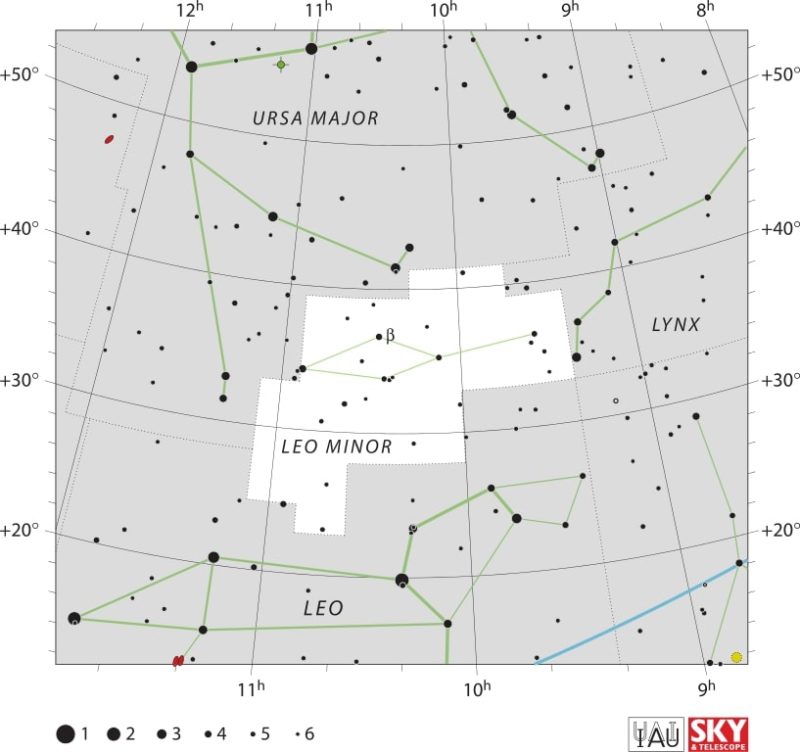
The Leonis Minorids are an obscure meteor shower peaking October 24, radiating from Leo Minor.
At its peak, most years, the Leonis Minorid meteor shower delivers a pretty minimal display, with just two meteors per hour. It is not always quiet and can often shock stargazers with dramatic outbursts of activity. The shower’s meteors are all quite fast (62 km/s), frequently producing bright, quick streaks of light that vanish in a few seconds.
What Are the Leonis Minorids?
Beyond their subtle beauty, the Leonis Minorids are an interesting meteor shower. They get their name from the constellation Leo Minor—a small and easily missed patch of sky in the northern celestial hemisphere. The “-ids” suffix denotes the radiant’s constellation, a convention that helps astronomers track and categorize showers active at the same time of year. Leo Minor is a dim constellation; its position on the celestial map gives the Leonis Minorids their character.
Origin & Parent Comet
All meteor showers come from somewhere. For the Leonis Minorids, comet C/1739 K1 (Zanotti) is suggested as the parent object per IMO analysis. Meteor showers are created when Earth travels through streams of debris that comets or asteroids leave behind in the solar system.
As these particles of rock and dust collide with the Earth’s atmosphere, they burn up and produce bright meteors in the night sky. For meteor science, knowing the parent comet is key. It shows us a lot about the composition of the debris and the comet itself. Understanding this connection can enhance our understanding of the solar system’s evolution.
Leonis Minorids vs. Leonids
The Leonis Minorids are often confused with the Leonids, but the Leonids produce spectacular storms (100+ meteors/hour at peak) while the Leonis Minorids are tame—just a handful of meteors per hour.
When & Where to Watch
The Leonis Minorids are among the weakest showers, with a ZHR around 2. Their faint meteors demand dark skies and patience—city lights or a bright moon wash them out. But that challenge is the appeal: catching even one meteor on a crisp October evening delivers a quiet, meditative reward that stronger showers don’t offer. Each streak feels like a personal discovery.
Radiant Point Location Details
The Leonis Minorids radiate from the constellation Leo Minor, a dim northern constellation located just above Leo.
For precise location, we recommend using a star chart or astronomy phone app to help identify where Leo Minor is located. Understanding where to look can ensure that the meteors you’re seeing are from this shower and not one of its close neighbors.
The radiant sits at RA 10h48m, Dec +37° (J2000). Familiarizing oneself with the shape of Leo Minor will prove helpful for naked-eye observers. Its subtlety is what can make it difficult to identify without the right preparation.
Typical Meteor Speed Data
Leonis Minorids meteors pour in at an average speed of 62 km/s—very fast even by meteoric standards. This high speed ensures that their trails are speedy and bright, but typically fleeting.
Faster meteors will be harder to catch, so being attentive is essential. The excitement of experiencing a meteor darting above at that speed gives the annual meteor shower an exhilarating boost.
Understanding Zenith Hourly Rate (ZHR)
Understanding Zenith Hourly Rate (ZHR) is important for meteor watchers. It is a measure of how many meteors you would see if conditions were perfect. In the case of the Leonis Minorids, the ZHR is usually around 2.
These figures are useful in establishing expectations. It’s a thin shower, to be savored with some patience and away from glare-filled areas.
Shower Activity Window Annually
To put that in perspective, this shower lasts from October 19th to October 27th. Look for it to peak on October 24. The seasonal sky transition brings with it cooler nights and clearer skies, making fall a welcoming time for meteor-watching.
Scheduling your observations for when there will be peak activity or when Leo Minor is highest in the sky provides the greatest opportunity to see activity.
Observing the Leonis Minorid Meteor Shower Successfully
Follow these tips to make the most of your Leonis Minorid meteor shower experience. Prepare with the proper knowledge and plan your viewing to optimize your experience.
Below are key strategies and tips for making your viewing session worthwhile, along with practical advice on timing, location, and gear.
Finding Dark Skies Near You
- See maps from the International Dark-Sky Association to find certified dark sky parks and reserves.
- Check online resources such as Dark Site Finder and Light Pollution Map to identify dark-sky locations within traveling distance of your home.
- Look for nearby rural parks, state forests, or other public lands where light pollution is less present.
- Consider joining local astronomy clubs or groups—many host or plan group trips to established dark sky sites.
- Inquire about any local “star parties” or community skywatching events which are beginner-friendly and open to the public.
Light pollution from urban areas is the greatest challenge to meteor observers, particularly within 50 km of major cities. Choosing a location well away from the blinding urban glow will make all the difference in the world.
Just a 30-minute drive outside of town may open up a vastly improved sky. Apps and online resources guide you as you compare locations, but clubs provide on-the-ground knowledge and fellowship on your journey.
Essential Gear (Or Lack Thereof)
Meteor watching needs only your eyes—no binoculars or telescopes (they restrict your field of view). A reclining chair or blanket, warm layers, a red flashlight, and a thermos keep you comfortable for long sessions.
Tips for Patient Skywatching
Be calm and give your eyes time to adapt to the darkness. Take someone with you, or try to find a group—talking about what you’re seeing will make the wait easier. If you begin to feel sore or fatigued, take a moment to stretch or rest.
Since the best sightings are sometimes the most surprising, we recommend being vigilant even on days where the sky looks boring.
The meteors are typically a bit fainter than sporadic meteors, but even just one bright streak is worth the patience.
FAQ
What are the Leonis Minorids?
A minor meteor shower visible each autumn, radiating from Leo Minor in the Northern Hemisphere.
How many meteors can I expect to see?
About 2 per hour at peak under dark skies.
Do I need special equipment to see the Leonis Minorids?
No, just your eyes, dark-adapted for 20–30 minutes.
Conclusion
The Leonis Minorids won’t draw crowds like the Perseids or Leonids, but that’s their charm: a quiet October night under dark skies, waiting for a few swift meteors from Leo Minor, turns an ordinary evening into a personal discovery. No equipment needed—just patience and a willingness to watch.
See also:
- Previous meteor shower: Orionid Meteor Shower
- Next meteor shower: Northern Taurid Meteor Shower
Would you like to receive similar articles by email?

Paul Tomaszewski
Paul Tomaszewski is a science & tech writer as well as a programmer and entrepreneur. He is the founder and editor-in-chief of CosmoBC. He has a degree in computer science from John Abbott College, a bachelor's degree in technology from the Memorial University of Newfoundland, and completed some business and economics classes at Concordia University in Montreal. While in college he was the vice-president of the Astronomy Club. In his spare time he is an amateur astronomer and enjoys reading or watching science-fiction. You can follow him on LinkedIn and Twitter.

You May Also Like
Why Didn’t a Planet Form Where the Asteroid Belt Is Now Located?
How Did Jupiter’s Moon Ganymede Get Its Name