Leo Minor Constellation Guide
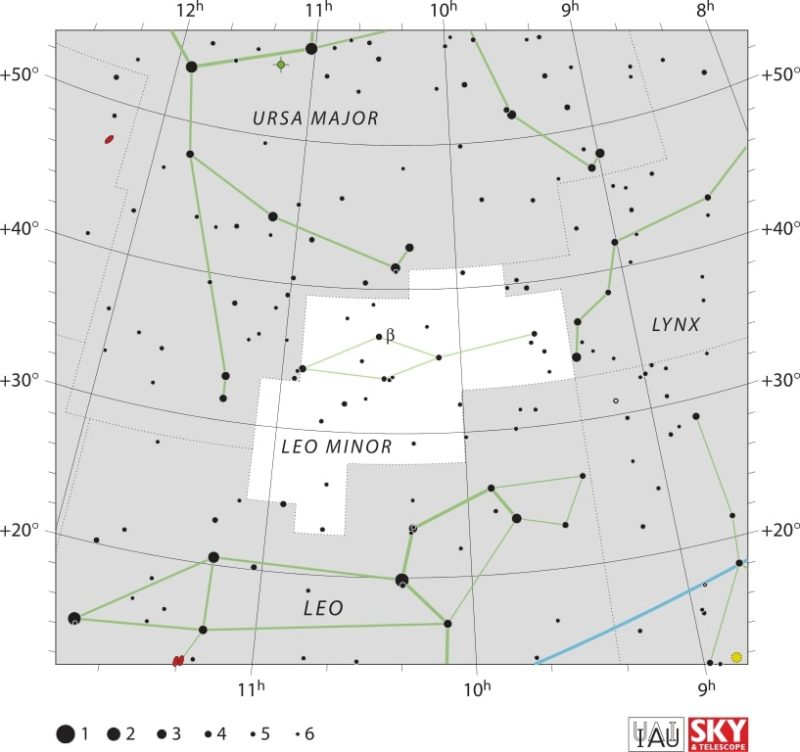
Leo Minor is a small, faint northern constellation created in the seventeenth century by Johannes Hevelius. It has no ancient Greek myth, no exceptionally bright star, and no showpiece rivaling the great galaxies of Leo. Its value lies elsewhere: Leo Minor preserves a chapter in the history of star mapping, offers a useful lesson in modern constellation boundaries, and rewards patient observers under dark skies.
The name means “Little Lion,” placing it beside the much larger constellation Leo. That relationship gives Leo Minor its charm, although Sir Patrick Moore was less generous, describing its claim to a separate identity as “dubious.” Frankly, both views have merit.
Who Created Leo Minor and Why?
Johannes Hevelius
Johannes Hevelius, a Polish astronomer based in Gdańsk, introduced Leo Minor from previously unassigned stars between Leo and Ursa Major. The constellation appeared in his posthumously published Firmamentum Sobiescianum in 1690, while many references date its creation to 1687 or earlier chart work. A historical overview from Britannica’s student encyclopedia places its introduction in 1679.
Hevelius was not discovering a hidden ancient constellation. He was organizing an untidy patch of the northern sky. His choice was tidy and visual: the Little Lion sits above Leo and below the Great Bear, giving the region a coherent animal theme.
The Lesser Lion
Leo Minor contains only a modest pattern of stars, and its brightest star is not particularly bright. Even so, the name has endured through subsequent astronomers, atlas makers, and modern databases. Hevelius’s original rendering can still be compared with later maps in historical collections such as the NOIRLab constellation archive.
The Mythology Gap
There is no classical mythology attached to Leo Minor. The lion is a cartographic invention, not the Nemean Lion of Greek legend, which belongs to Leo. Stories sometimes portray the smaller lion as a playful companion or a young animal, but those are modern interpretations rather than inherited mythology.
That gap is part of the constellation’s appeal. The Little Lion works almost like a celestial mascot: small, slightly cheeky, and memorable because it sits beside something much grander.
Where Is Leo Minor Located?
Celestial Coordinates
Leo Minor occupies roughly 10 to 11.5 hours of right ascension and about 25 to 42 degrees of northern declination. It is entirely in the northern celestial hemisphere, making it most accessible from mid-northern latitudes during spring.
The constellation covers about 232 square degrees, ranking it among the smaller modern constellations. Its official abbreviation is LMi, while the genitive form used in star names is Leonis Minoris.
Neighboring Constellations
Leo Minor is bordered by Leo to the south, Lynx to the north, Ursa Major to the northeast, and Cancer toward the southwest. Its position is useful for navigation because Leo’s bright stars act as a visual signpost, while the Big Dipper in Ursa Major helps establish the broader region of sky.
Official Boundaries
The modern constellation is defined by straight boundary lines established by the International Astronomical Union in 1922. Those boundaries matter because a galaxy belongs to Leo Minor according to its position, not according to whether it appears visually connected to the Little Lion’s stars.
How Can You Find It?
Best Viewing Season
The best time to observe Leo Minor is during northern spring, especially from March through May. It climbs high in the evening sky for observers in the northern hemisphere. Farther south, the constellation remains low and becomes increasingly difficult to see.
Star-Hop From Leo
Start with Leo’s distinctive sickle, then look north toward the dim space separating Leo from Ursa Major. Leo Minor does not leap out at you. Its main pattern is a small, irregular triangle or quadrilateral, with 46 Leonis Minoris marking the brightest point.
A useful sequence is simple:
- Locate Regulus and the sickle in Leo.
- Move north toward the Big Dipper.
- Search for the small triangle formed by Leo Minor’s brighter stars.
- Confirm the field with a planisphere or astronomy app.
Light Pollution
Urban light pollution can erase most of Leo Minor. Under suburban skies, you may see only its brightest stars. A rural site, binoculars, or a small telescope makes the pattern much easier to separate from the surrounding darkness. The constellation is a fine test of observing discipline because its identity emerges gradually.
Which Stars Define the Pattern?
46 Leonis Minoris
46 Leonis Minoris is the brightest star in the constellation, with an apparent magnitude near 3.8. It is an orange giant, far more luminous and physically larger than the Sun. Its warm color becomes more noticeable through binoculars.
Beta Leonis Minoris
Beta Leonis Minoris is a binary star system and the second-brightest named star in Leo Minor. Its primary is a yellowish giant, accompanied by a fainter companion. The pair is more interesting through a telescope than by naked-eye appearance.
The Asterism Shape
Leo Minor has no famous central figure comparable to Leo’s sickle or Ursa Major’s Big Dipper. Its stars form a loose, uneven shape. That weakness is also its observational signature. You are looking for a pattern that feels almost unfinished.
What Deep-Sky Objects Are Nearby?
NGC 3344
NGC 3344 is a face-on spiral galaxy near the southern part of Leo Minor. Its broad structure and low surface brightness make it a demanding target, requiring dark skies and a telescope with enough aperture to reveal its spiral form.
NGC 3432
NGC 3432, sometimes called the “Knitting Needle Galaxy,” is an edge-on spiral galaxy. Its elongated profile is easier to recognize than its internal detail, although larger amateur telescopes may reveal uneven patches associated with active star formation.
Other galaxies occupy the same region, including NGC 2859 and NGC 3350. These are distant galaxies, not members of the Milky Way.
Variable Stars
Leo Minor also contains variable stars, including systems whose brightness changes through pulsation, eclipses, or mass transfer. Such objects are valuable to amateur astronomers because repeated measurements can contribute to long-term monitoring.
What Makes Its Astronomy Significant?
Modern Boundaries
Leo Minor demonstrates that constellations are defined regions, not physical gatherings of related stars. Its stars may be separated by enormous distances, and their apparent arrangement is simply a line-of-sight effect.
Size and Brightness
Its small area and lack of a first-magnitude star explain why Leo Minor receives less attention than Leo or Ursa Major. Calling it insignificant, however, misses the point. Its faintness makes it a useful bridge between casual stargazing and serious deep-sky observing.
Observational Value
Leo Minor teaches patience. It encourages observers to work with star charts, compare magnitudes, and understand how light pollution changes the night sky. The Little Lion may never dominate a celestial clock, but it quietly rewards anyone willing to look twice.
FAQ
Is Leo Minor part of Leo?
No. Leo Minor is a separate constellation north of Leo, with boundaries established by the IAU.
Does Leo Minor have ancient mythology?
No. It was created by Johannes Hevelius and has no established classical myth.
Can you see Leo Minor without a telescope?
Yes, though its faint stars are easiest under dark skies. A telescope is needed for most of its distant galaxies.
Conclusion
Leo Minor is a modest constellation with an outsized historical lesson. It shows how astronomy moved from mythological sky pictures toward standardized charts, coordinates, and scientific boundaries. The Little Lion is faint, modern, and admittedly a little awkward. That is precisely why it remains worth discovering.
Would you like to receive similar articles by email?

Paul Tomaszewski
Paul Tomaszewski is a science & tech writer as well as a programmer and entrepreneur. He is the founder and editor-in-chief of CosmoBC. He has a degree in computer science from John Abbott College, a bachelor's degree in technology from the Memorial University of Newfoundland, and completed some business and economics classes at Concordia University in Montreal. While in college he was the vice-president of the Astronomy Club. In his spare time he is an amateur astronomer and enjoys reading or watching science-fiction. You can follow him on LinkedIn and Twitter.


You May Also Like
Orionid Meteor Shower Guide

How Did NASA Choose the First Astronauts to Walk on the Moon