Leo Constellation Guide
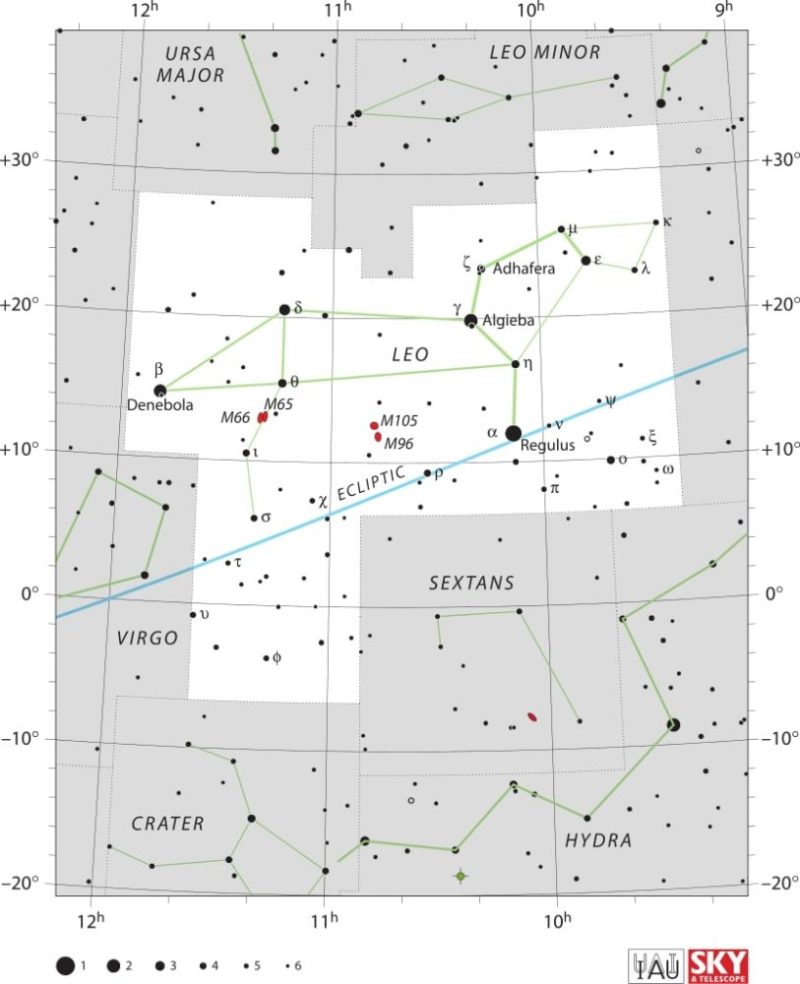
The Leo constellation is one of the easiest zodiac constellations to recognize, especially during spring evenings in the Northern Hemisphere. Its brightest star, Regulus, anchors a crooked pattern that resembles a backward question mark, while Denebola forms the lion’s tail. Leo matters because it connects ancient mythology, seasonal navigation, stellar astronomy, galaxies, and even the Leonid meteor shower.
What Does Leo Represent?
Lion of Nemea
In Greek mythology, Leo represents the Nemean lion, a monstrous animal defeated by Heracles during his first labor. Its hide could not be pierced by ordinary weapons, so Heracles used his strength to strangle it. Zeus later placed the lion among the stars.
The story gave the constellation a durable identity. Ancient observers saw a crouching lion in the pattern, although the resemblance depends heavily on the diagram used. Ptolemy included Leo among the 48 classical constellations, and the International Astronomical Union later preserved Leo as one of the 88 official constellations.
Egyptian Interpretations
Leo’s symbolism is sometimes connected with ancient Egypt, where lions represented power, heat, kingship, and protection. Some modern writers also connect the lion with the Sphinx, arguing that its body reflects Leo while its human face represents Virgo.
That interpretation is imaginative, but it is not established Egyptological consensus. Archaeological evidence, including quarry marks, erosion studies, and stylistic details, places the Great Sphinx broadly within the Fourth Dynasty and the reign of Khafre. The Virgo-lion theory is better treated as cultural storytelling than historical reconstruction.
Astronomy Versus Astrology
Leo is a real astronomical region of the sky. Astrology uses Leo as one of the twelve zodiac signs, assigning it symbolic traits in a horoscope. Those systems overlap in language, but they serve different purposes.
The constellation’s boundaries are fixed by astronomy. The astrological sign of Leo occupies a thirty-degree segment of the ecliptic and no longer matches the constellation precisely because of Earth’s axial precession.
Where Is Leo Located?
Zodiac Position
Leo lies along the ecliptic, the apparent path followed by the Sun across the sky. It sits between Cancer and Virgo, with the faint constellation Sextans below it. Its approximate center is near right ascension 11 hours and declination +15 degrees.
Neighboring Constellations
Leo borders Ursa Major, Leo Minor, Lynx, Cancer, Sextans, Crater, Hydra, Virgo, and Coma Berenices. This neighborhood helps when using a chart or a planisphere, particularly if light pollution makes the dimmer stars difficult to trace.
Celestial Coordinates
The western side of Leo contains the Sickle, a distinctive asterism shaped like a reverse question mark. The eastern side ends at Denebola, whose name means “tail of the lion.” The pattern is broad, so beginners often identify the head first and then work eastward toward the tail.
When Can You See Leo?
Best Viewing Months
Leo is best placed for evening viewing from March through May. It rises in the east during early spring and moves toward the southern sky as the night progresses. By late spring, it is already prominent shortly after sunset.
Northern Hemisphere Visibility
From much of the Northern Hemisphere, Leo climbs high enough for comfortable observation. The farther north you live, the lower its southern portions appear, but Regulus and the Sickle remain accessible across a wide range of latitudes.
Southern Hemisphere Visibility
Observers south of the equator can also see Leo clearly, although it appears lower and often inverted compared with Northern Hemisphere star charts. In southern autumn, the constellation remains a useful marker near Virgo and the ecliptic.
How Do You Find Leo?
Big Dipper Pointer
Use the Big Dipper as a starting point. Its pointer stars normally guide the eye toward Polaris, but tracing the broader arc of the handle and surrounding spring sky can lead you toward Regulus. A planisphere or sky app makes this route easier on a first attempt.
Regulus Landmark
Regulus is the key. It appears as a bright, blue-white star at the base of the Sickle. Its name means “little king,” which explains why it has long been associated with royal symbolism and the phrase king star. EarthSky describes Regulus as a complex four-star system located close to the ecliptic, roughly 79 light-years away.
Lion Outline
Once the Sickle is visible, look east for a triangular arrangement ending at Denebola. The full outline is less obvious than the Sickle, so do not expect a perfect lion. Star patterns are suggestions, not celestial drawings carved in ink.
Which Stars Define Leo?
Regulus
Regulus, or Alpha Leonis, has an apparent magnitude near 1.4 and is the brightest star in Leo. It is a multiple-star system rather than a solitary sun. Its position near the ecliptic also makes it useful for following the apparent route of the Sun, Moon, and planets.
Denebola
Denebola, or Beta Leonis, marks the lion’s tail. At roughly 36 light-years away, it is considerably closer to Earth than Regulus. Its debris disk has made it interesting in studies of planetary-system formation.
Algieba
Algieba, Gamma Leonis, is a striking double star. Through binoculars it may remain difficult to split, but a small telescope can reveal its golden components. NASA’s observing guide to Leo also points observers toward Algieba and the galaxies of the Leo Triplet.
Which Deep-Sky Objects Are Nearby?
The Leo Triplet is the major attraction: Messier 65, Messier 66, and the edge-on spiral galaxy NGC 3628. These galaxies lie about 35 million light-years away and can be detected with a modest telescope under dark skies. Their gravitational interactions have distorted their shapes, giving astrophotographers a rewarding target.
Leo also contains Leo I, a faint dwarf spheroidal galaxy associated with the Milky Way. It is difficult to see because it sits near the glare of Regulus. Farther out, Leo IV is an ultra-faint dwarf galaxy whose stars are more than 13 billion years old, offering a glimpse into the early history of the galactic neighborhood.
Why Does Leo Matter In Astronomy?
Leo provides more than a recognizable seasonal pattern. Its galaxies help astronomers study tidal interactions, star formation, and the structure of galaxy groups. The constellation is also linked to the Leonid meteor shower, whose meteors appear to radiate from Leo. The stream comes from debris left by Comet Tempel-Tuttle, which returns to the inner solar system about every 33 years.
How Do Leo And The Sphinx Relate?
They do not have a proven astronomical relationship. The idea that the Sphinx combines a Virgo face with a Leo body is an intriguing modern theory, but it does not establish the monument’s date, purpose, or alignment. I think the appeal comes from visual storytelling: people see the lion-bodied figure, recognize zodiac imagery, and build a grand narrative around it.
That can be culturally interesting. It should not replace archaeology.
FAQ
Is Leo a zodiac constellation?
Yes. Leo lies along the ecliptic and is one of the twelve traditional zodiac constellations.
What is the brightest star in Leo?
Regulus, also called Alpha Leonis, is the brightest star.
When is Leo easiest to see?
March, April, and May are generally the best evening months.
Can you see the Leo Triplet without a telescope?
Usually not. Binoculars may reveal hints under very dark skies, but a telescope is much more effective.
Conclusion
Leo remains one of the most useful constellations for new stargazers because its Sickle, Regulus, and Denebola form a practical route across the spring sky. Beyond the familiar lion shape, it opens onto multiple-star systems, ancient galaxies, dwarf companions, and meteor streams. Explore it slowly. The outline is only the doorway.
Would you like to receive similar articles by email?

Paul Tomaszewski
Paul Tomaszewski is a science & tech writer as well as a programmer and entrepreneur. He is the founder and editor-in-chief of CosmoBC. He has a degree in computer science from John Abbott College, a bachelor's degree in technology from the Memorial University of Newfoundland, and completed some business and economics classes at Concordia University in Montreal. While in college he was the vice-president of the Astronomy Club. In his spare time he is an amateur astronomer and enjoys reading or watching science-fiction. You can follow him on LinkedIn and Twitter.


You May Also Like

Building a Greener Future: Steps to Becoming an Eco-Friendly Business

NGC 4565: The Needle Galaxy