Launch Loop (Non-Rocket Spacelaunch)
A launch loop (also known as a Lofstrom loop) is a proposed design for a very efficient non-rocket spacelaunch method. It is a much simpler concept than the space elevator. However, it is still more complex than tether propulsion systems such as the rotovator.
The launch loop concept was first described by tether propulsion systems such as the rotovator.
The launch loop concept was first described by Keith Lofstrom in November 1981 Reader’s Forum of the American Astronautical Society newsletter, and in the August 1982 L5 News. Another pioneer of the concept was Paul Birch. In 1982, he published a series of papers in the Journal of the British Interplanetary Society which described orbital rings. Moreover, he described a form of launch loop which he called Partial Orbital Ring System (PORS).
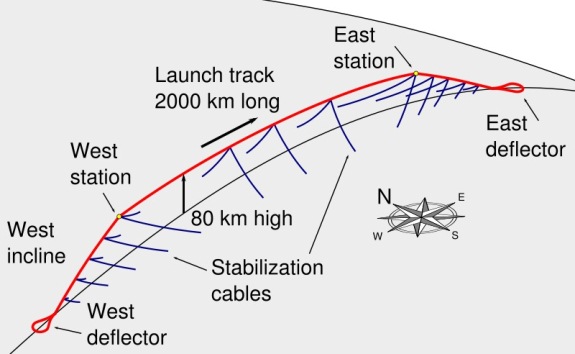
What is a launch loop?
A proposed launch loop design is about 2,000 km long and 80 km high. Such a loop would run from the surface in a curve peaking at 80 km above the Earth. It would then descend to the surface and loop back on itself. This would allow it to follow the reverse path leading back to the starting point.
Unlike space elevators which would require passengers to traverse the hazardous Van Allen radiation belts for days, launch loops operate below these belts, reducing radiation exposure to levels comparable to Apollo missions.
The loop would be in the form of a tube, known as the sheath. Inside the sheath enclosed and kept in a state of vacuum is another continuous tube, known as the rotor which is a sort of belt or chain. The rotor is an iron tube approximately 5 cm in diameter, moving around inside the sheath at 14 km/s. The vacuum will eliminate the resistance that would otherwise be caused by air drag.
According to more recent analyses, a launch loop could potentially reduce launch costs to approximately $300/kg for a $10 billion initial system. Alternatively, costs could be as low as $3/kg for a $30 billion system with higher capacity.
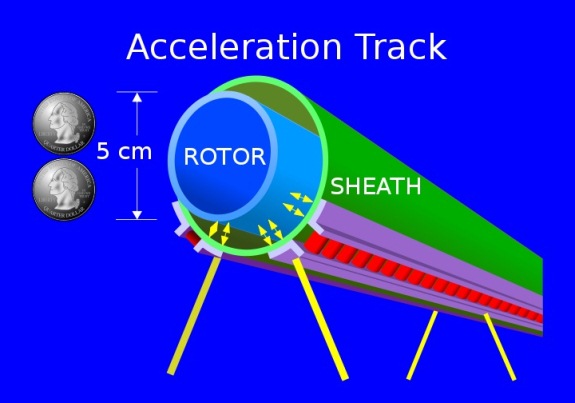
When the rotor is at rest, the loop stays at ground level. However, when the rotor is accelerated up to speed, the loop curves to form an arc with a peak of 80 km over the Earth’s surface. The sheath forces the loop to follow a curve steeper than the rotor’s natural ballistic curve. This, in turn, exerts a reactive centrifugal force on the sheath, holding it aloft. The loop would have to be anchored to the ground in order to remain at a fixed height.
Once raised, the structure would require continuous power to overcome the energy dissipated, since there is no such thing as perpetual motion, even in the most efficiently designed systems. Power requirements scale with launch frequency: approximately 500 MW for moderate launch rates (35/day) or 17 GW for high-frequency launch scenarios (80/hour). The system could enable launch rates of up to 35 launches per day with a 500 MW power station. It could also provide up to 80 launches per hour with a 17 GW power installation. Additional energy would be required to power any vehicles that are launched from the loop.
Launching payloads
To launch, vehicles climb the cable until they reach the West station loading dock at 80 km where they are placed on the track. The payload applies a magnetic field which generates eddy currents in the fast-moving rotor. This both lifts the payload away from the cable, as well as pulls the payload along with 3g (30 m/s²) acceleration. The payload then rides the rotor until it reaches the required orbital velocity, at which point it leaves the track and is propelled into space.
Advantages of launch loops
Unlike conventional rockets, launch loops can have many launches per hour, independent of weather, and are not inherently polluting. Rockets create pollution such as nitrates in their exhausts due to high exhaust temperature, and can also create greenhouse gases depending on propellant choices. Launch loops require power in the form of electricity and as such it can be clean. For example it can run on geothermal, nuclear, wind, solar or any other power source, even intermittent ones, as the system has huge built-in power storage capacity. Additionally, launch loops would be quiet in operation, and would not cause any sound pollution, unlike rockets.
Launch loops are also intended for human transportation. It gives a safe 3g acceleration which the vast majority of people would be capable of tolerating well, and would be a much faster way of reaching space than space elevators.
Unlike space elevators which would have to travel through the Van Allen belts over several days, launch loop passengers can be launched to low Earth orbit, which is below the belts, or through them in a few hours. This would minimize radiation doses and keep them within safe levels.
Human Rating & Radiation Environment
Launch loops wouldn’t be subjected to the risks of space debris and meteorites, unlike space elevators. This is because they are to be situated at an altitude where orbits are unstable due to air drag. Therefore damage or collapse of loops in this way is expected to be extremely rare. Even if an accident does occur the consequences would be much less catastrophic than with a space elevator. If the launch loop is built over an uninhabited area such as a desert or an ocean, then there should be very little risk to human life in case of failure.
Finally, their low payload costs of as low as $3/kg (Lofstrom’s design target) would open up large-scale commercial space tourism and even space colonization. Also the initial construction cost estimate of $10B (1980s estimate; ~$30B+ today) is quite low compared to other non-rocket spacelaunch methods. This is roughly equivalent to the cost of 20 space shuttle launches.
Difficulties of launch loops
A running loop would have an extremely large amount of energy in the form of linear momentum (about 1.5×10¹⁵ J (1.5 PJ; ~350 kt TNT equivalent)). If a major failure did occur the energy release would be approaching a nuclear bomb explosion, although not emitting any nuclear radiation. This is why the magnetic suspension system of the launch loop would be highly redundant, with failures of small sections having essentially no effect at all.
Even if the safeties fail and this large amount of energy is released, it is unlikely that it would destroy very much of the structure due to its very large size. Also most of the energy would be deliberately dumped at preselected places when the failure is detected. Steps might need to be taken to lower the cable down from 80 km altitude with minimal damage, such as parachutes.
A few technical issues involving the cable’s instability problems would have to be solved before constructing a launch loop. Lofstrom’s design requires electronic control of the magnetic levitation to minimize power dissipation and to stabilize the otherwise under-damped cable.
Launch Rate & Thermal Limits
Launch rate is ultimately limited by rotor temperature. Each launch adds ~80 K to the iron rotor; at ~1043 K (770 °C) the rotor reaches its Curie point and loses ferromagnetism, causing containment failure. Lofstrom’s design caps sustained operation at ~35 launches/day with a 500 MW power station; 80 launches/hour would require 17 GW and active cooling not yet demonstrated. Source: Launch loop capacity analysis.
Power & Siting Requirements
A launch loop demands continuous baseload power (500 MW minimum; 17 GW for max rate) and a 2,000 km ground track near the equator for direct equatorial orbit access. The sheath must be sited over ocean or sparsely populated desert to limit casualty risk from a rotor failure. These constraints make site selection a primary feasibility filter. Source: Launch loop siting & power requirements.
Current Status: Conceptual / No Hardware Demonstrator
The launch loop remains a theoretical concept first published by Keith Lofstrom in 1981. No subscale hardware demonstrator, test track, or prototype has been built. Active development is limited to Lofstrom’s personal site (launchloop.com) and occasional conference papers; it has not attracted institutional funding or a formal research program.
Conclusion
In conclusion, the launch loop concept does have a few technical difficulties, but if those can be solved, the advantages of such a spacelaunch method are great. Recent engineering analyses continue to examine its feasibility, though no hardware demonstrator has been built.
Links to the other articles in this series:
- Space Elevator
- Extraterrestrial Space Elevator Concepts
- Space Elevators in Fiction
- Tether propulsion
Would you like to receive similar articles by email?

Paul Tomaszewski
Paul Tomaszewski is a science & tech writer as well as a programmer and entrepreneur. He is the founder and editor-in-chief of CosmoBC. He has a degree in computer science from John Abbott College, a bachelor's degree in technology from the Memorial University of Newfoundland, and completed some business and economics classes at Concordia University in Montreal. While in college he was the vice-president of the Astronomy Club. In his spare time he is an amateur astronomer and enjoys reading or watching science-fiction. You can follow him on LinkedIn and Twitter.


You May Also Like
How Did Uranus’ Moon Ariel Get Its Name
What Are The Benefits of 3D Printing in Space?