Lacerta Constellation Guide
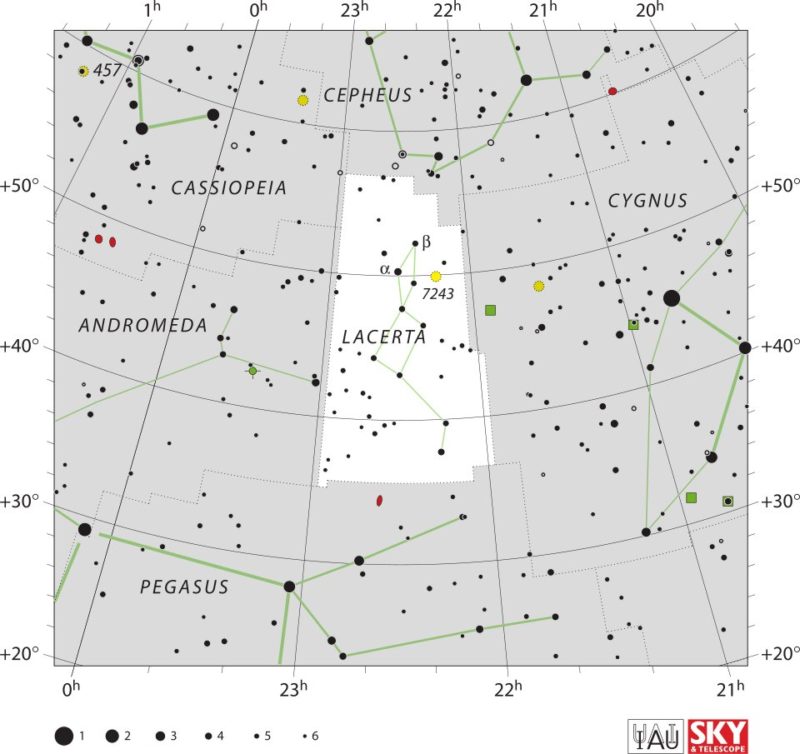
Lacerta is a small northern constellation between Cassiopeia, Cygnus, and Andromeda, best recognized by a faint zigzag of stars nicknamed “Little Cassiopeia.” It is easy to overlook, partly because none of its stars are especially bright. Yet this modest patch of sky carries an unusual history and contains BL Lacertae, the prototype of a powerful class of active galaxies.
For observers, Lacerta is a useful lesson in patience. Under suburban skies, its pattern can dissolve into glare. From a dark location, however, the lizard emerges clearly, along with several open star clusters and rich Milky Way fields.
What Is the Lacerta Constellation?
Name And Abbreviation
Lacerta means “the lizard” in Latin. Its official three-letter abbreviation is Lac, and the International Astronomical Union recognizes it as one of the 88 modern constellations. It covers about 202 square degrees, making it the 68th-largest constellation.
The name comes from Johannes Hevelius, who introduced the pattern in 1687. He chose a small lizard because the narrow gap between existing constellations did not leave much room for a larger figure. His original placement appeared in the Firmamentum Sobiescianum atlas, as described in this historical account of Lacerta.
Boundaries And Coordinates
Lacerta occupies a northern section of the celestial sphere, roughly between right ascension 21 hours 55 minutes and 22 hours 57 minutes, with declinations from about +35 to +56 degrees. Its official boundaries are geometric lines established by the IAU, rather than the loose animal outline shown on many star charts. The IAU constellation framework explains why those borders matter: deep-sky objects belong to a constellation according to position, not artistic interpretation.
Historical Origins
Hevelius was not the only person trying to claim this region. Earlier proposals included Sceptrum et Manus Iustitiae, associated with Louis XIV, and Honores Frederici, intended to honor Frederick the Great. Neither survived modern astronomical standardization. Lacerta did.
That persistence is partly because its name was neutral and visually plausible. Interestingly, Chinese astronomers identified some of the same northern stars as Tengshe, or the flying serpent, an independent cultural reading of the same stellar territory. The wider history is explored in Ridpath’s Star Tales.
Where Can You Find It?
Northern Sky Position
Lacerta sits in the Milky Way’s northern band, east of Cygnus and west of Cassiopeia. The constellation is near Deneb, one of the stars forming the Summer Triangle, so learning the Cygnus constellation’s location gives you a useful starting point.
Its position also places it near the rich star fields surrounding the Great Rift of the Milky Way. Those fields can be spectacular in binoculars, although the background glow makes Lacerta’s outline harder to isolate.
Latitude And Season
The Lacerta constellation is easiest to observe from northern latitudes during late summer and autumn. From roughly 35 degrees north and farther north, the constellation is effectively circumpolar, meaning it remains above the horizon throughout the year, though its altitude changes.
Observers in the northern United States, southern Canada, and much of Europe can find it high in the evening sky from August through November. Farther south, it appears lower and for less time. In the Southern Hemisphere, only the northernmost portions may be visible, and locations south of about 34 degrees south generally cannot see it.
Cassiopeia’s Neighbor
Cassiopeia is the easiest landmark. Find its unmistakable W or M shape, then look southwest toward the narrow region between Cassiopeia and Cygnus. Lacerta lies below the line connecting Cassiopeia with Deneb, though star charts help because several neighboring patterns overlap visually.
How Do You Identify Its Pattern?
Little Cassiopeia
The five principal stars form a compact, flattened W shape. This is why observers call Lacerta “Little Cassiopeia,” though the resemblance is more useful than exact. Alpha Lacertae, at about magnitude 3.8, is the brightest star, but even it is modest compared with stars such as Deneb or Vega.
A dark sky makes the pattern far easier. Give your eyes 20 minutes to adapt, avoid white light, and use a red flashlight or a planisphere. A planisphere guide can help translate the chart into the actual sky.
Star-Hopping Routes
One practical route begins at Deneb. Move eastward toward the compact chain of stars between Cygnus and Cassiopeia, then search for the small zigzag of Lacerta. Another route starts at Cassiopeia’s western side and drops toward the faint stars of the lizard.
Binoculars can reveal the pattern, but they may also overwhelm it with extra stars. Start with unaided vision, then switch to binoculars once the outline is secure.
Visibility Challenges
Lacerta’s main difficulty is not its size but its faintness. Moonlight, haze, and light pollution erase the weaker stars first, leaving an incomplete shape that can resemble random field stars. Urban observers should use the brightest stars as anchors rather than expecting the entire lizard to appear at once.
Which Stars Matter Most?
Alpha Lacertae is an A-class star and an optical double, while Beta Lacertae is slightly fainter and helps define the northern part of the pattern. Gamma Lacertae contributes to the compact zigzag. None is a dramatic naked-eye target, but together they create the constellation’s identity.
| Star | Approximate magnitude | Observational role |
|---|---|---|
| Alpha Lacertae | 3.8 | Brightest anchor |
| Beta Lacertae | 4.4 | Defines the zigzag |
| Gamma Lacertae | 4.6 | Helps form “Little Cassiopeia” |
What Deep-Sky Objects Lie Within Its Borders?
Lacerta rewards binocular and small-telescope observers with open clusters. NGC 7243, also called Caldwell 16, is a loose cluster near the constellation’s eastern side, with an apparent magnitude around 6.4. Its scattered stars look best at low magnification; too much power makes the group lose its shape.
NGC 7209 is another open cluster, while NGC 7296 is a fainter target suited to larger instruments. Long-exposure astrophotography can also reach diffuse hydrogen-alpha and dust structures in the broader Lacerta region, but claims of vivid nebular detail deserve skepticism. Narrowband filters, accurate tracking, flat-fielding, and many stacked exposures are usually needed. A single casual frame will rarely produce the dramatic result shown in processed images.
Why Does Lacerta Matter Scientifically?
The constellation’s most important object is BL Lacertae, an active galactic nucleus powered by matter falling toward a supermassive black hole. Its relativistic jet points close to Earth, making the object appear unusually bright and violently variable. Astronomers initially mistook it for a variable star inside the Milky Way.
That mistake became historically useful. BL Lacertae became the prototype for BL Lac objects, a subclass of blazars whose jets are aimed toward us. A small constellation, then, opens a window onto some of the most energetic processes in the universe.
FAQ
Is Lacerta visible without a telescope?
Yes. Its main stars are visible to the naked eye under reasonably dark skies, although city light can erase the pattern.
When is Lacerta easiest to see?
Late summer and autumn evenings are best for observers in the Northern Hemisphere, especially around September and October.
Is Lacerta near Cassiopeia?
Yes. Cassiopeia is one of the best landmarks for locating it, with Cygnus and Andromeda forming other useful reference points.
What is the brightest star in Lacerta?
Alpha Lacertae is the brightest, at approximately magnitude 3.8.
Conclusion
The Lacerta constellation does not announce itself with a brilliant star or a famous myth. It asks you to look carefully. Once found, its small W-shaped pattern connects Hevelius’s sky maps, the Milky Way’s northern star fields, open clusters, and the extreme physics of BL Lacertae. That is a fine return for such a faint little lizard.
Would you like to receive similar articles by email?

Paul Tomaszewski
Paul Tomaszewski is a science & tech writer as well as a programmer and entrepreneur. He is the founder and editor-in-chief of CosmoBC. He has a degree in computer science from John Abbott College, a bachelor's degree in technology from the Memorial University of Newfoundland, and completed some business and economics classes at Concordia University in Montreal. While in college he was the vice-president of the Astronomy Club. In his spare time he is an amateur astronomer and enjoys reading or watching science-fiction. You can follow him on LinkedIn and Twitter.


You May Also Like
Discovering the Wonders of Asteroid 3 Juno
October Camelopardalid Meteor Shower Guide