July Gamma Draconid Meteor Shower Guide
The July Gamma Draconids are a minor late-July meteor shower with a radiant in Draco, probably fed by debris from an as-yet unidentified long-period comet, and they usually peak on July 28. Most years, you are dealing with low rates. Still, this is a variable-rate meteor shower, so sharp outbursts are possible.
That mix is why people keep coming back to it. Not because it is the flashiest meteor shower on the calendar. It is not. Yet for anyone who likes offbeat sky events, or anyone who wants to explore how modern science teases structure out of messy meteor data, this shower is interesting.
If you want the practical answer fast, aim for dark, moonless skies in the Northern Hemisphere, watch from late evening through the hours after midnight, face generally in the direction of the Draconid radiant, and keep expectations sober. A handful of meteors is normal. A brief surprise enhancement is possible. A guaranteed meteor storm is fantasy.
What is the July Gamma Draconid meteor shower?
IAU status
The July Gamma Draconids are recognized as a distinct stream in professional meteor work. That matters more than it sounds. Minor showers can look like statistical noise until enough video, radar, and orbital data pile up and refuse to go away. In this case, that pile became convincing enough that the stream was validated in the literature, including the confirmation work by Holman and Jenniskens, after earlier detection efforts traced it back to P. Babadzhanov.
Radiant location
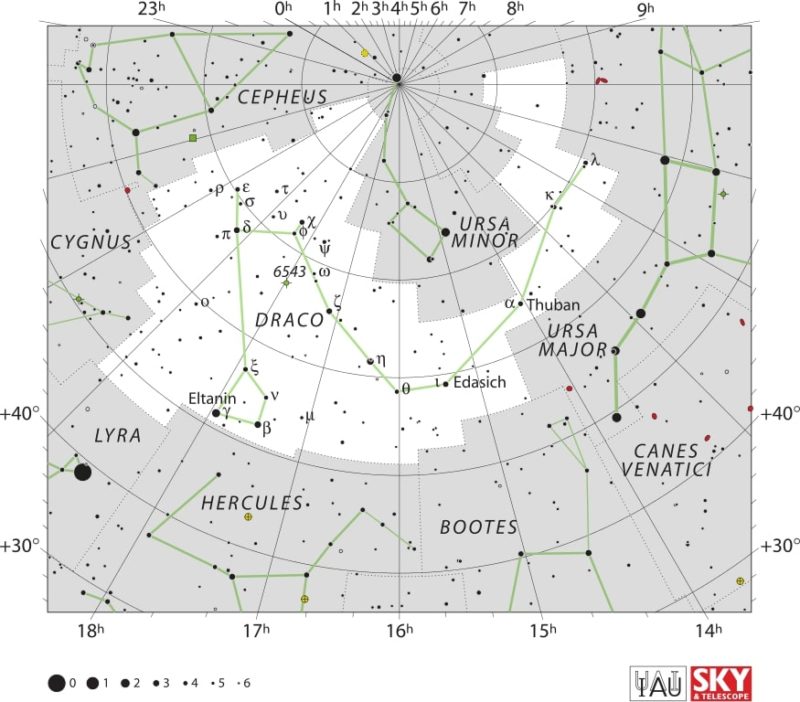
The radiant sits in the far northern sky, in the constellation of Draco, close to Gamma Draconis, also called Eltanin. The American Meteor Society’s July activity outlook places it roughly 8 degrees southeast of Eltanin during the active period.
Researchers also describe this as a drifting radiant. In the detailed 2012 IMO analysis, its position slides a little each day, with right ascension drifting west and declination nudging north. That sounds fussy, and it is, but it is one of the fingerprints that helped separate the shower from nearby activity west of Deneb and from the broader clutter of late-July sky traffic.
Meteor speeds
The July Gamma Draconids have an entry speed near 27 km per second. That makes these meteors medium-slow by meteor-shower standards, not the kind that rip across the sky like the swift August and November streams.
Active dates
The July Gamma Draconid meteor shower lasts from July 25 to 31. If you only have one or two clear nights to gamble on, the night of July 27 and the early hours of July 28 are the classic bet.
Where do these meteors come from?
Parent body
The most honest answer is slightly annoying: the parent body has not been securely identified. That is the central mystery. Orbital work points toward a long-period comet, likely with an orbit measured in centuries rather than decades, but no currently confirmed periodic comet fits cleanly enough to close the case.
That missing parent comet tells you something about this shower immediately. The July Gamma Draconids are not one of those well-behaved streams where you can point to a famous nucleus and say, there, that is the culprit. The stream exists. The orbit is real. The source object is still hiding in the paperwork, or in the outer dark.
Kappa Cygnid link
This is where the map of the subject gets more interesting. The July Gamma Draconids are widely treated as a compact branch of the Kappa Cygnid complex, a family of related meteoroid streams that share similar orbital traits but do not all behave the same way. That phrase, “complex,” matters. It means observers are not dealing with one neat river of meteoroids. They are looking at braided filaments, probably released at different times, maybe by related family comets, maybe by one source body that shed material across multiple returns.
When does the peak usually happen?
Late July window
The usual peak date falls on July 28. You will see slightly different timing from year to year because shower maxima are often quoted in solar longitude, not just calendar date, and because minor streams do not always read like clockwork. Still, if somebody asks when the July Gamma Draconid activity matters most, late on the 27th into the 28th is the short answer.
That does not mean the shower is dead outside those hours. Weak activity can leak across several nights. It does mean the odds of catching anything that feels organized, instead of random sporadic meteors, improve around that narrow late-July slot.
Moonlight effects
Moonlight can wreck this shower. Since normal rates are modest and many members are fainter meteors, a bright Moon strips away the subtle stuff and leaves you with almost nothing.
That is why a dark-sky site matters more here than it does for a stronger annual shower. Under dark skies, you might discover a few real meteors. Under suburban glare plus moonlight, you may spend an hour watching airplanes and doubting your life choices.
How can you watch it best?
Sky direction
You do not need a telescope. In fact, a telescope is the wrong instrument. You need a wide view, a reclining chair if you have one, and patience.
A simple watch plan works better than overthinking it:
- Set up under a clear dark sky with a broad view of the northern and overhead sky.
- Let your eyes adapt for at least 20 to 30 minutes, and keep phone screens dim or red.
- Look about 30 to 60 degrees away from the Draconid radiant, not straight at it, because longer meteor trails show better there.
- Stay out for at least an hour. Weak showers punish short attention spans.
The shower is named for the radiant in constellation Draco, but the visible trails can flash anywhere across the upper sky.
Best conditions
Clear, transparent air matters. So does low haze, low humidity, and a night with no Moon or only a thin crescent out of the way. The shower’s velocity is moderate, which often makes the tracks feel a little more deliberate than the fast summer streams, but the shower is still weak enough that atmospheric conditions can decide whether you see five members or none.
Late July also brings competition. The antihelion source is active. The Delta Aquariids start entering the conversation. Random background meteors keep cutting through. If you are doing serious counts or astrophotography, that clutter matters. If you are a casual skywatcher, it mostly means you should not assume every streak belongs to the July Gamma Draconid meteor shower.
Visibility south
This is a north-favoring shower, plain and simple. In the Northern Hemisphere, especially from the middle latitudes, the radiant can get very high and sometimes feels almost comfortable to watch. In the tropics south of the equator, it clings low in the northern sky. However, in much of the Southern Hemisphere, the geometry is poor enough that this shower shifts from “minor” to “why bother.”
That does not make it invisible everywhere south of the equator. It makes it compromised. Low radiant, shorter observing window, more atmospheric murk near the horizon, fewer obvious July Gamma Draconid meteors.
Conclusion
The July Gamma Draconid meteor shower sits in that narrow lane between obscure and genuinely useful. It is a minor meteor shower, radiating from Draco, likely born from an unidentified long-period comet, usually peaking on July 28, and strongly favoring dark northern skies. Most years, rates stay low. Some years, the stream remembers old dust and briefly wakes up.
That combination makes it a fine target for anyone who likes the quieter side of skywatching. Not every worthwhile shower arrives with headlines. Some just leave clues.
FAQ
Is this the same as the October Draconids?
No. The October Draconids, also called the Giacobinids, come from comet 21P/Giacobini-Zinner and have produced famous meteor storms. The July Gamma Draconids are a separate late-July stream with a different orbital story and no confirmed source object.
Do I need binoculars or a telescope?
No. Use your eyes. A telescope narrows the field too much for meteor work. Binoculars are useful for star-hopping around Draco before the watch begins, not for catching the meteors themselves.
Can people in the Southern Hemisphere see it?
Sometimes, but poorly. The shower strongly favors the Northern Hemisphere because the radiant is far north. Farther south, the radiant stays low or never rises enough to be useful.
See also:
- Previous meteor shower: July Pegasid Meteor Shower
- Next meteor shower: Piscis Austrinid Meteor Shower
Would you like to receive similar articles by email?

Paul Tomaszewski
Paul Tomaszewski is a science & tech writer as well as a programmer and entrepreneur. He is the founder and editor-in-chief of CosmoBC. He has a degree in computer science from John Abbott College, a bachelor's degree in technology from the Memorial University of Newfoundland, and completed some business and economics classes at Concordia University in Montreal. While in college he was the vice-president of the Astronomy Club. In his spare time he is an amateur astronomer and enjoys reading or watching science-fiction. You can follow him on LinkedIn and Twitter.


You May Also Like
Is Mercury Theia? Evidence, Theories, and What Scientists Know

How Did NASA Choose the First Astronauts to Walk on the Moon