Evaluating the 7 Best ISO Certification Bodies for Small Businesses
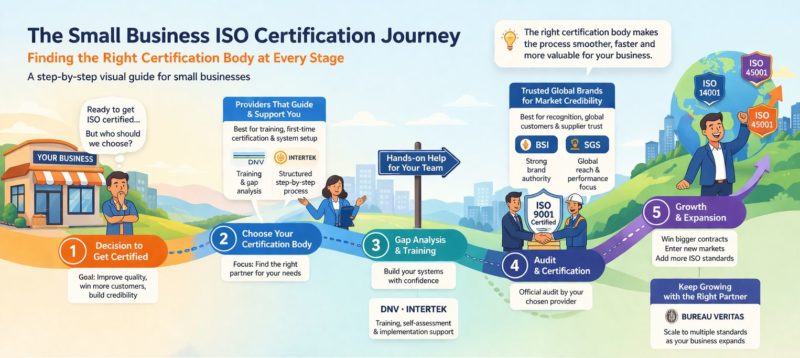
Choosing the right ISO certification body is a key step for small businesses that want to build credibility, improve operations and compete in larger markets. With many providers available — each offering different levels of expertise, pricing and recognition — the decision can feel challenging. A reliable certification body helps ensure compliance with international standards, strengthening customer trust and overall efficiency.
Whether a business is aiming for ISO 9001 for quality management or other standards, understanding various factors such as global recognition, audit process and customer support helps make an informed decision that aligns with business goals and growth plans.
Why Certification Bodies Matter
ISO explains that certification adds credibility by showing that a product, service or system meets recognized international standards, while accredited certification bodies provide the independent assurance behind that claim.
The certification body plays a major role in that journey. It shapes the audit experience, the level of support and the long-term value a business receives from certification. For small businesses, a provider with a clear process and practical guidance can make a major difference.
Small teams often manage certification alongside daily operations. They need a provider that communicates clearly, works efficiently and understands the pace of a growing business. The right certification body can help a company navigate certification with greater confidence and less friction.
What Small Businesses Should Look for
The best ISO certification body depends on what the business values most. Some companies want a provider with a clear small-business focus. Others want a large global brand with broad coverage and deep market recognition. A provider should match the company’s goals, internal capacity and growth plans.
That said, there are several core factors small businesses should focus on when comparing ISO certification bodies.
- Accreditation that supports market trust and acceptance
- Coverage for the standards the business needs
- A simple and clear certification process
- Training and support for teams that need guidance
- Capacity to support future growth across more standards
These points matter across many industries. A software firm, IT service provider, manufacturer, or SaaS company may pursue different ISO standards, yet each one benefits from a provider that keeps the process practical and credible.
Top 7 ISO Certification Bodies for Small Businesses
The providers below stand out for their accreditation, service range, credibility and support for small businesses seeking a manageable path to certification.
1. NQA
NQA combines global credibility with a practical approach for small businesses. It offers certification for key standards, such as ISO 9001, ISO 14001, ISO 45001, ISO 27001, ISO 50001 and ISO 27701.
NQA provides business benefits, including increased customer satisfaction, reduced operating costs, improved stakeholder relationships, better legal and regulatory awareness, and stronger risk management. It also offers practical advice in plain English, improvement-focused audits, flexible learning options and competitive pricing.
2. BSI
BSI is one of the most recognized names in standards and certification. That reputation gives small businesses added confidence when they want a provider with strong market recognition and long-standing authority.
Its appeal comes from trust, scale and visibility. A small business seeking a certification partner with broad recognition may find strong value in BSI.
3. DNV
DNV is a solid choice for small businesses that want support beyond the audit. Its services include training, self-assessment, gap analysis and certification support. That structure can help teams build their systems with more clarity.
This approach works well for businesses that are setting up formal management systems for the first time. It supports learning and implementation while helping the business prepare for certification.
4. Bureau Veritas
Bureau Veritas is a good fit for small businesses with growth plans. It offers certification services across sectors and supports a wide range of compliance needs.
That broad coverage can help a company as requirements grow. A business can start with one standard and expand later while keeping the same provider.
5. Intertek
Intertek works well for businesses that want a clear and structured path to certification. Its process includes gap analysis, implementation, internal training, audit, certification and continuous improvement.
It also offers training in several formats. Teams can choose in-person, virtual, on-site or e-learning options. That flexibility helps small businesses fit certification work into busy schedules.
6. SGS
SGS is a major global name in testing, inspection and certification. Its strong international presence can appeal to small businesses with global customers, suppliers or long-term expansion plans.
Its ISO certification services focus on improving performance and supporting consistent quality. Those outcomes align well with the goals many small businesses pursue when pursuing certification.
7. LRQA
LRQA is a strong option for smaller organizations because it offers a Small Business Scheme for key standards, including ISO 9001, ISO 14001 and ISO 45001. That focus makes it relevant for companies that want a provider with experience serving smaller teams.
This type of scheme can make the process feel more accessible. It can also help small businesses move through certification in a way that fits their size and pace.
Comparative Summary of Best ISO Certification Bodies
To help clarify the core advantages of each provider, the table below provides a side-by-side comparison. It summarizes what each certification body is best for, its specific approach to small businesses and its most notable strengths.
Certification Body | Best for | Small Business Angle | Notable Strengths |
NQA | Businesses that want structured certification and clear guidance | Offers dedicated small business programs and broad standards coverage | Practical advice, flexible learning, improvement-focused audits and competitive pricing |
BSI | Businesses that value market recognition | Supports smaller organizations through dedicated resources | |
DNV | Teams that want training with certification | Helps smaller firms build systems step by step | Training, self-assessment, gap analysis and certification support |
Bureau Veritas | Growing businesses with expanding compliance needs | Supports firms that may add standards over time | Sector coverage and broad certification services |
Intertek | Teams that want a staged certification process | Flexible training works well for lean teams | Gap analysis, implementation support, training and continuous improvement |
SGS | Businesses with global goals | Focuses on improving performance and supporting consistent quality – core goals for many small businesses | Global reach and strong certification capability |
LRQA | Smaller organizations seeking tailored support | Offers a Small Business Scheme for select standards | Small-business focus and accessible service model |
Finding the Right Partner for Growth
Ultimately, the “best” ISO certification body is the one that aligns with a small business’s specific needs and long-term goals. Whether a business prioritizes a provider with global brand recognition, a structured and supportive audit process, or a program tailored specifically for smaller teams, the right partner is out there. By focusing on proper accreditation, relevant service offerings and a good cultural fit, a company can confidently ensure compliance and select a valuable partner in its journey toward growth and improvement.
Would you like to receive similar articles by email?

Paul Tomaszewski
Paul Tomaszewski is a science & tech writer as well as a programmer and entrepreneur. He is the founder and editor-in-chief of CosmoBC. He has a degree in computer science from John Abbott College, a bachelor's degree in technology from the Memorial University of Newfoundland, and completed some business and economics classes at Concordia University in Montreal. While in college he was the vice-president of the Astronomy Club. In his spare time he is an amateur astronomer and enjoys reading or watching science-fiction. You can follow him on LinkedIn and Twitter.

You May Also Like

Mastering the Art of Local SEO with Translation and Localization

85 Digital Product Ideas You Can Sell Online in 2026